
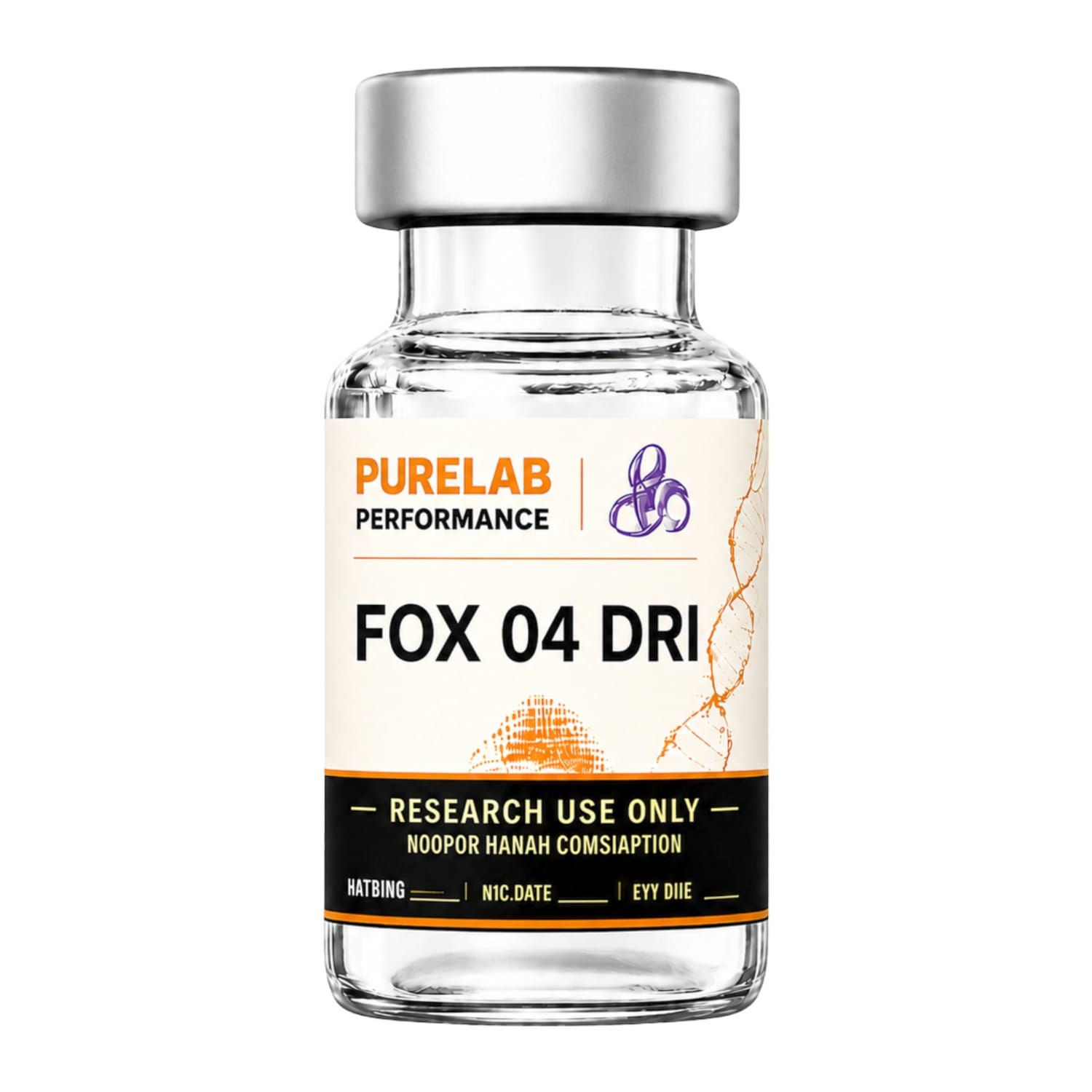
What FOXO4-DRI is
FOXO4-DRI is a synthetic, cell-penetrating peptide designed to disrupt the interaction between the transcription factor FOXO4 and the tumour suppressor p53. “DRI” denotes D-retro-inverso: the peptide is built from D-amino acids in reversed sequence order, a construction that preserves the side-chain topology of the parent L-peptide while resisting proteolysis.
It is a senolytic — an agent intended to selectively kill senescent cells. It was created as a research tool to test a hypothesis about ageing. It is now sold as a consumer product. This page is organised around one question: what has actually been measured, and in what.
Identity — and why fields read N/A
PubChem CID: none. We queried the PubChem compound database by name and no record was returned. FOXO4-DRI is not in PubChem.
CAS number: none assigned. We will not print one. Any vendor showing you a CAS for FOXO4-DRI should be asked which registry issued it.
Molecular formula and molecular weight: not stated here. Not because they are unknowable in principle — a defined 40-odd-residue D-peptide has a definite mass — but because there is no authoritative registry entry we can cite, and we are not going to compute a number and present it as if a database had verified it.
What we can point to is the primary literature: the construct is the D-retro-inverso FOXO4 peptide described by Baar et al., Cell, 2017[1]. That paper is the identity authority for this molecule. There is no other.
This matters practically. Without a reference standard or registry mass, “identity confirmed” on a certificate of analysis means confirmed against the published sequence — a weaker claim than confirmation against an authentic external standard. We state that rather than obscure it.
Where the evidence stands
This is the section most vendors skip. It is the most important one on the page.
Selective p53 nuclear exclusion and apoptosis in senescent cells; mechanism reasonably characterisedSome
Chemotoxicity, fast-ageing Xpd mice, naturally aged mice, aged Leydig cellsLimited
Senolytic elimination of senescent pulmonary endothelial cells worsened pulmonary haemodynamics. See §4.YES
No trial. No case series. No exposure. Nothing.ZERO
The pulmonary safety signal mouse / rat
This is the most important study on this page and it is a study that almost nobody selling FOXO4-DRI mentions.
Born et al., Circulation, 2023 (published online December 2022), asked what happens to the lung circulation when senescent cells are cleared. The title is not ambiguous: “Eliminating Senescent Cells Can Promote Pulmonary Hypertension Development and Progression.”[2]
The investigators removed senescent cells by three independent methods — a suicide-gene construct (p16-ATTAC mice), the senolytic drug ABT263, and FOXO4-DRI itself. What they measured:
- Senescent cell elimination increased right ventricular systolic pressure and the right ventricular hypertrophy index
- It increased vessel remodelling, with higher counts of dividing proliferating vascular cells in both normoxia and hypoxia
- It markedly depleted pulmonary endothelial cells, which comprise around 30% of lung senescent cells under normal conditions
- Pulmonary haemodynamic deterioration and endothelial cell loss occurred in serotonin-transporter-overexpressing mice given either ABT263 or FOXO4-DRI
- In monocrotaline rats, ABT263 gave a slight benefit at one week and then aggravated pulmonary hypertension at three weeks
“Elimination of senescent P-ECs by senolytic interventions may worsen pulmonary hemodynamics. These results invite consideration of the potential impact on pulmonary vessels of strategies aimed at controlling cell senescence in various contexts.”[2]
Read the mechanism, because it is not a fluke. Senescent pulmonary endothelial cells are not merely damaged bystanders — killing them removed a cell population the lung vasculature apparently needs, and the vasculature responded by remodelling badly. This is a predicted consequence of the intervention working as designed, not an off-target toxicity. That makes it harder to engineer away, not easier.
This finding directly contradicts the premise on which FOXO4-DRI is sold.
Baar 2017 — the founding paper mouse
The compound originates in Baar et al., Cell, 2017[1]. The work is good and we are not going to disparage it. The authors identified FOXO4 as a pivot in senescent-cell viability, designed a peptide to perturb the FOXO4–p53 interaction, and showed that in senescent cells it selectively caused p53 nuclear exclusion and cell-intrinsic apoptosis. In mice, under conditions where it was well tolerated, it counteracted doxorubicin-induced chemotoxicity and restored fitness, fur density and renal function in fast-ageing Xpd mice and in naturally aged mice.
Note the qualifier the authors themselves put in: “under conditions where it was well tolerated in vivo”. That phrasing is doing work. It signals that tolerability was a constraint on the experiment, not a demonstrated property of the compound. It is the kind of sentence that a careful reader should slow down for and a marketer will skip.
These are mouse endpoints: fur density, renal function markers, fitness assays. They are not human outcomes and cannot be read as such.
Zhang 2020 — aged mouse Leydig cells mouse
Zhang et al., Aging, 2020, examined FOXO4-DRI in the context of testicular ageing[3]. Using hydrogen-peroxide-induced senescent TM3 Leydig cells as an in-vitro model, they showed FOXO4-DRI selectively induced p53 nuclear exclusion and apoptosis in the senescent population. In naturally aged mice, they report an improved testicular microenvironment and altered age-related testosterone secretion.
This is a mouse study with an in-vitro component. It is frequently cited in marketing as evidence for hormonal effects in men. There are no men in it.
What “senolytic” actually commits you to
The senolytic thesis is that senescent cells accumulate with age, secrete inflammatory factors, and degrade tissue function — so killing them should help. It is a serious, well-funded, scientifically respectable hypothesis.
It is also a hypothesis with a sharp edge, which §4 exposes. Senescence is not simply damage. It is a programme cells enter for reasons, including tumour suppression and wound resolution, and in at least one vascular bed the senescent population turns out to be load-bearing. A compound that kills senescent cells efficiently will kill them everywhere it reaches — including where they were doing something.
“Selectively kills senescent cells” is usually presented as the safety feature. Born et al. is the paper demonstrating that it can also be the hazard.
The human data — all of it
There is none.
No clinical trial. No registered study. No case series. No published human exposure. No pharmacokinetics. No dose. No toxicology. No maximum tolerated dose. Nothing.
A senolytic peptide with a documented capacity to worsen pulmonary vascular outcomes in animals, with zero human safety data, is not a compound about which anyone can responsibly say anything reassuring — and we won’t.
Limitations of the literature
Everything is mouse. Every efficacy finding, without exception.
The harm signal is in the same species as the benefit signal. This is not a case of “animal benefit, unknown human risk”. The benefit and the harm were both demonstrated in rodents, by different groups, and the harm study used FOXO4-DRI itself[2].
Tolerability was a constraint even in mice. Baar et al.’s own careful phrasing[1].
No registry identity. See §2. You cannot look this compound up in PubChem, and there is no CAS to check a supplier’s material against.
Against the “healthy ageing” pitch
FOXO4-DRI is sold on a story about clearing out worn-out cells and restoring youthful tissue function. That story comes from Baar et al. and it is a fair reading of Baar et al.
It is not a fair reading of the literature as a whole. The literature as a whole now contains a paper in Circulation demonstrating that this exact class of intervention, using this exact compound among others, can drive pulmonary vascular disease in animal models[2]. Any account of FOXO4-DRI that presents the 2017 result without the 2022/2023 result is not an incomplete account. It is a misleading one.
Regulatory and anti-doping status
FOXO4-DRI is not listed by name on the WADA 2025 Prohibited List. It is captured by Section S0 (Non-Approved Substances), which prohibits at all times any pharmacological substance not addressed by another section of the List and with no current approval by any governmental regulatory health authority for human therapeutic use. FOXO4-DRI holds no approval anywhere and has never entered clinical development. On a plain reading of S0 it is prohibited at all times, in and out of competition.
Anti-doping lists change annually and by governing body. If you compete under any tested organisation, the only reliable source is that organisation’s current prohibited list — not this page, and not any vendor’s.
FOXO4-DRI has not been approved by the FDA or any other regulator for any human use.
What we don’t know
- Anything about its behaviour in a human. There is no human data of any kind.
- Whether the pulmonary vascular harm seen in rodents[2] occurs in humans. Nobody has looked, and nobody should find out informally.
- Its human pharmacokinetics, clearance, tissue distribution, or effective dose.
- Its toxicology — every category.
- Which senescent cell populations are safe to remove and which are load-bearing. This is an open question at the frontier of the field, not a solved one.
- Its exact molecular mass as supplied, in the absence of any registry entry or reference standard.
We supply this compound for laboratory research. It is a legitimate and interesting research tool. It is also the item in this catalogue about which we would most strongly urge caution, and the safety literature is the reason.
FOXO4-DRI supplied by PureLab Performance is furnished strictly for in-vitro laboratory research. It is not a medicine or a drug and has not been approved by the FDA to prevent, treat, or cure any medical condition, ailment, or disease. Bodily introduction of any kind into humans or animals is strictly forbidden by law. Per-kilogram dosing in animal models does not scale to humans. Purchasers must be 18 or older and qualified to handle research chemicals.
References
Retrieved from PubMed. DOIs link to the original publications. No PubChem or CAS record exists for this compound; see §2.
- Baar MP, Brandt RMC, Putavet DA, et al. “Targeted Apoptosis of Senescent Cells Restores Tissue Homeostasis in Response to Chemotoxicity and Aging.” Cell. 2017;169(1):132–147.e16. DOI
- Born E, Lipskaia L, Breau M, et al. “Eliminating Senescent Cells Can Promote Pulmonary Hypertension Development and Progression.” Circulation. 2023;147(8):650–666. Published online 14 December 2022. DOI
- Zhang C, Xie Y, Chen H, et al. “FOXO4-DRI alleviates age-related testosterone secretion insufficiency by targeting senescent Leydig cells in aged mice.” Aging (Albany NY). 2020;12(2):1272–1284. DOI
- World Anti-Doping Agency. “The 2025 Prohibited List — International Standard.” Section S0, Non-Approved Substances. WADA
Reviews
There are no reviews yet.