
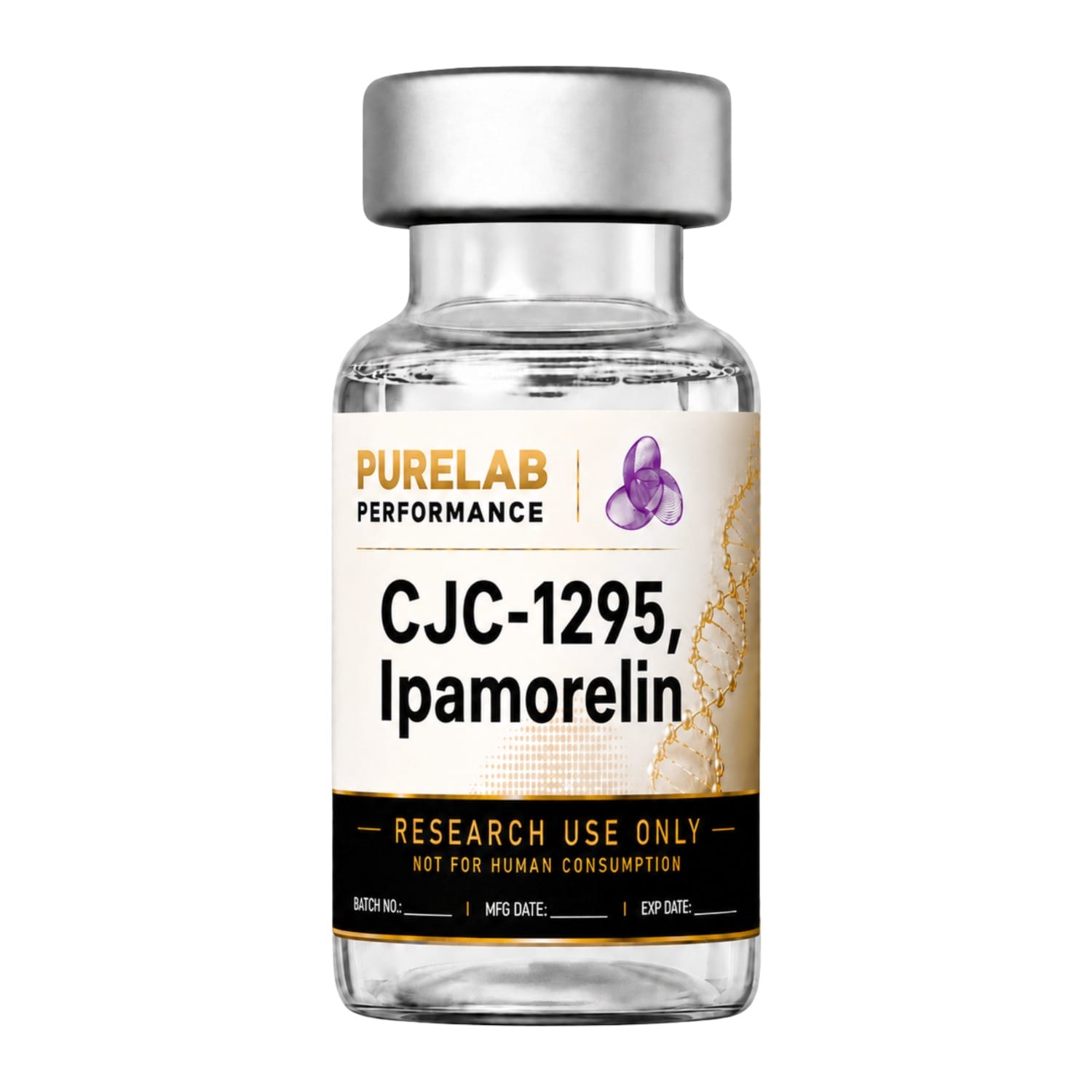
What this blend is
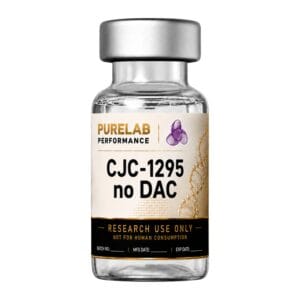
This vial contains two distinct peptides, co-lyophilised: CJC-1295 without DAC — a 29-residue GHRH analogue acting at the GHRH receptor — and ipamorelin — a pentapeptide agonist at the ghrelin receptor, a completely different receptor.
We supply the DAC-free form of CJC-1295 in this blend. The market uses the name “CJC-1295” for two chemically different molecules with a 279.3 g/mol mass difference.
No study has tested this combination
We searched PubMed and ClinicalTrials.gov. There is no published study — in humans, in animals, or in cell culture — of CJC-1295 co-administered with ipamorelin. Not one. No trial has been registered. No pharmacokinetic interaction has been characterised. No combined safety data exists in any species.
Everything below is evidence for the two components separately. Adding two evidence bases together does not produce evidence for the mixture. If someone tells you this blend “works synergistically,” ask them for the citation. There isn’t one.
Structure and identity — both components
CJC-1295 no-DAC
PubChem carries no CAS registry number for this compound, and its depositor-supplied synonym list is internally inconsistent — it lists both “with DAC” and “without DAC” names against the same record. We print N/A rather than invent one. The molecular formula and mass are the identifiers that discriminate[11].
Ipamorelin
Where the evidence stands
This is the section most vendors skip. It is the most important one on the page.
No published human trial of the DAC-free moleculeNone
Phase 2 in postoperative ileus: primary endpoint not met (p=0.15)Negative
Component 1 — the CJC-1295 evidence
Of the DAC-free molecule in this vial: nothing. PubMed indexes no human study. ClinicalTrials.gov registers none. A 2026 narrative review in Frontiers in Endocrinology that specifically names “CJC-1295 without DAC” places it among peptides for which what circulates is self-administration protocols rather than clinical evidence[1].
Of the DAC form — a different molecule: two randomised, placebo-controlled, double-blind ascending-dose trials in healthy adults found that a single subcutaneous injection raised mean plasma GH 2- to 10-fold for six days or more, and mean IGF-1 1.5- to 3-fold for 9–11 days, with an estimated half-life of 5.8–8.1 days[2]. A separate overnight-sampling study found trough GH raised 7.5-fold with pulse frequency and amplitude unchanged, and — a detail almost never quoted — the IGF-1 rises did not correlate with any measured parameter of GH secretion[3]. human
Those numbers are produced by the albumin linker. This vial does not contain the albumin linker. They do not transfer.
The DAC form’s only Phase 2 efficacy trial, in HIV-associated visceral obesity, is registered as terminated with no results posted[4]; a contemporaneous news report states it was halted in July 2006 after the death of a participant, with causality never publicly determined[5].
Component 2 — the ipamorelin evidence
Preclinical. In primary rat pituitary cells, ipamorelin released GH with potency similar to GHRP-6 (EC50 1.3 ± 0.4 nmol/L). In conscious swine, ED50 2.3 ± 0.03 nmol/kg. Uniquely among GHRPs tested, it did not raise ACTH or cortisol even at doses 200-fold above its ED50 for GH release[6]. animal in vitro
Human. A multicentre, double-blind, placebo-controlled Phase 2 trial in 117 bowel-resection patients (NCT00672074) measured time to tolerance of a solid meal. Median 25.3 hours on ipamorelin versus 32.6 hours on placebo — p = 0.15, not significant. The authors’ conclusion: “There were no significant differences between ipamorelin and placebo in the key and secondary efficacy analyses.”[7] human
A larger 320-patient Phase 2 dose-finding trial (NCT01280344) completed in May 2014. No results have been posted and no publication exists. There was no Phase 3[8].
The synergy rationale, and its status
The pharmacological argument for combining these two is coherent on paper. GHRH analogues act at the GHRH receptor on pituitary somatotropes; ghrelin-receptor agonists act at a different receptor on the same cells and additionally suppress somatostatin tone. Two different inputs to the same output. In principle the combination could produce a larger GH pulse than either alone.
That is a hypothesis. It has not been tested for this pair. The literature on GHRH-plus-GHRP co-administration involves other molecules — GHRH itself, GHRP-6, GHRP-2, hexarelin — in other protocols. Extrapolating from those to this pair, at these ratios, in this vial, is an inference, not a result. We are not going to present an inference as a finding.
What a blend does to your data
Beyond the evidence problem there is a methodological one that matters if you are actually doing research.
- You cannot attribute an effect. Any change you observe could come from either component, or their interaction. A two-drug vial is a two-variable experiment with one condition.
- You cannot vary the ratio. Co-lyophilisation fixes it. Dose-response work on either component individually becomes impossible.
- Analytical verification is harder. A blend certificate must resolve, identify and quantify two peptides of very different mass (711.9 and 3367.9 g/mol) in one matrix. Many certificates for blends do not actually do this. Ours will, or we will not publish one.
- Stability is not additive either. Co-lyophilised peptide mixtures have not been characterised for this pair. No degradation study exists.
Limitations of the literature
The combination has no literature. That is the finding, not a caveat on the finding.
The components’ human records are weak and negative respectively. One has no human trial. The other has a human trial that missed its endpoint and a larger one that was never published.
Reported adverse effects in self-administration are the only human safety signal for either. The 2026 Frontiers review lists, across this compound class: prolactin and cortisol elevations, appetite change, dysglycaemia, fluid retention, myalgia and arthralgia, injection-site reactions[1]. A 2026 Sports Medicine review reaches the same conclusion — favourable animal data, scarce human safety data, real potential for serious harm[9]. Neither review is able to say anything about the two compounds given together, because nobody has studied it.
Regulatory and anti-doping status
Both components are named explicitly on the WADA Prohibited List under S2.2.4, Growth Hormone Releasing Factors — CJC-1295 as a GHRH analogue, ipamorelin as a growth hormone secretagogue[10]. Section S2 substances are prohibited at all times, in and out of competition. Both are detectable in routine doping-control assays.
Neither component has been approved for any indication by the FDA or any other regulatory authority. Anti-doping lists change annually and by governing body. If you compete under any tested organisation, the only reliable source is that organisation’s current prohibited list — not this page, and not any vendor’s.
What we don’t know
- Whether the two peptides interact pharmacokinetically. No study.
- Whether co-administration produces any effect greater than either alone in any species. No study.
- Whether the combination carries safety risks that neither component carries alone. No study.
- How the two peptides behave in the same lyophilised cake over time. No stability data for this pair.
- Long-term safety in humans is uncharacterised for either component, individually or together. Per-kilogram dosing in animal models does not scale to humans, and nothing on this page should be read as implying that it does.
We supply this blend for laboratory research because researchers ask for it. We have told you exactly what is behind it, which is two separate evidence bases and a hypothesis nobody has tested. We are not going to pretend it is more than it is.
The CJC-1295 + Ipamorelin blend supplied by PureLab Performance is furnished strictly for in-vitro laboratory research. It is not a medicine or a drug and has not been approved by the FDA to prevent, treat, or cure any medical condition, ailment, or disease. Bodily introduction of any kind into humans or animals is strictly forbidden by law. Per-kilogram dosing in animal models does not scale to humans. Purchasers must be 18 or older and qualified to handle research chemicals.
References
Retrieved from PubMed, ClinicalTrials.gov, PubChem and the World Anti-Doping Agency. DOIs link to the original publications. No reference below reports the combination; each reports a single component.
- Dominikowski A, Rękoś Z, Olejarz M, Szczepanek-Parulska E, Domin R, Ruchała M. “The emerging landscape of performance-enhancing peptides modulating GH-IGF1 axis: bridging the gap between clinical evidence and patient self-administration.” Front Endocrinol. 2026;17:1822475. DOI
- Teichman SL, Neale A, Lawrence B, Gagnon C, Castaigne JP, Frohman LA. “Prolonged stimulation of growth hormone (GH) and insulin-like growth factor I secretion by CJC-1295, a long-acting analog of GH-releasing hormone, in healthy adults.” J Clin Endocrinol Metab. 2006;91(3):799–805. DOI
- Ionescu M, Frohman LA. “Pulsatile secretion of growth hormone (GH) persists during continuous stimulation by CJC-1295, a long-acting GH-releasing hormone analog.” J Clin Endocrinol Metab. 2006;91(12):4792–97. DOI
- ConjuChem. Phase 2 study of CJC-1295 in HIV-associated visceral obesity. ClinicalTrials.gov identifier NCT00267527. Status: Terminated. Registry record
- Bernard EJ. “Lipodystrophy study halted after patient death.” NAM aidsmap, 31 July 2006. Article — contemporaneous news report; no causality determination was ever published.
- Raun K, Hansen BS, Johansen NL, et al. “Ipamorelin, the first selective growth hormone secretagogue.” Eur J Endocrinol. 1998;139(5):552–61. DOI
- Beck DE, Sweeney WB, McCarter MD, et al. “Prospective, randomized, controlled, proof-of-concept study of the ghrelin mimetic ipamorelin for the management of postoperative ileus in bowel resection patients.” Int J Colorectal Dis. 2014;29(12):1527–34. DOI · ClinicalTrials.gov NCT00672074
- Helsinn Therapeutics (U.S.), Inc. Phase 2 dose-finding study of ipamorelin for recovery of gastrointestinal function. ClinicalTrials.gov identifier NCT01280344. Enrolment 320; completed May 2014; no results posted. Registry record
- Mendias CL, Awan TM. “Safety and Efficacy of Approved and Unapproved Peptide Therapies for Musculoskeletal Injuries and Athletic Performance.” Sports Med. 2026. DOI
- World Anti-Doping Agency. The Prohibited List, Section S2.2.4 — Growth Hormone Releasing Factors. wada-ama.org
- National Center for Biotechnology Information. PubChem Compound Summaries for CID 91976842 (CJC1295 Without DAC) and CID 9831659 (Ipamorelin). PubChem
Reviews
There are no reviews yet.