
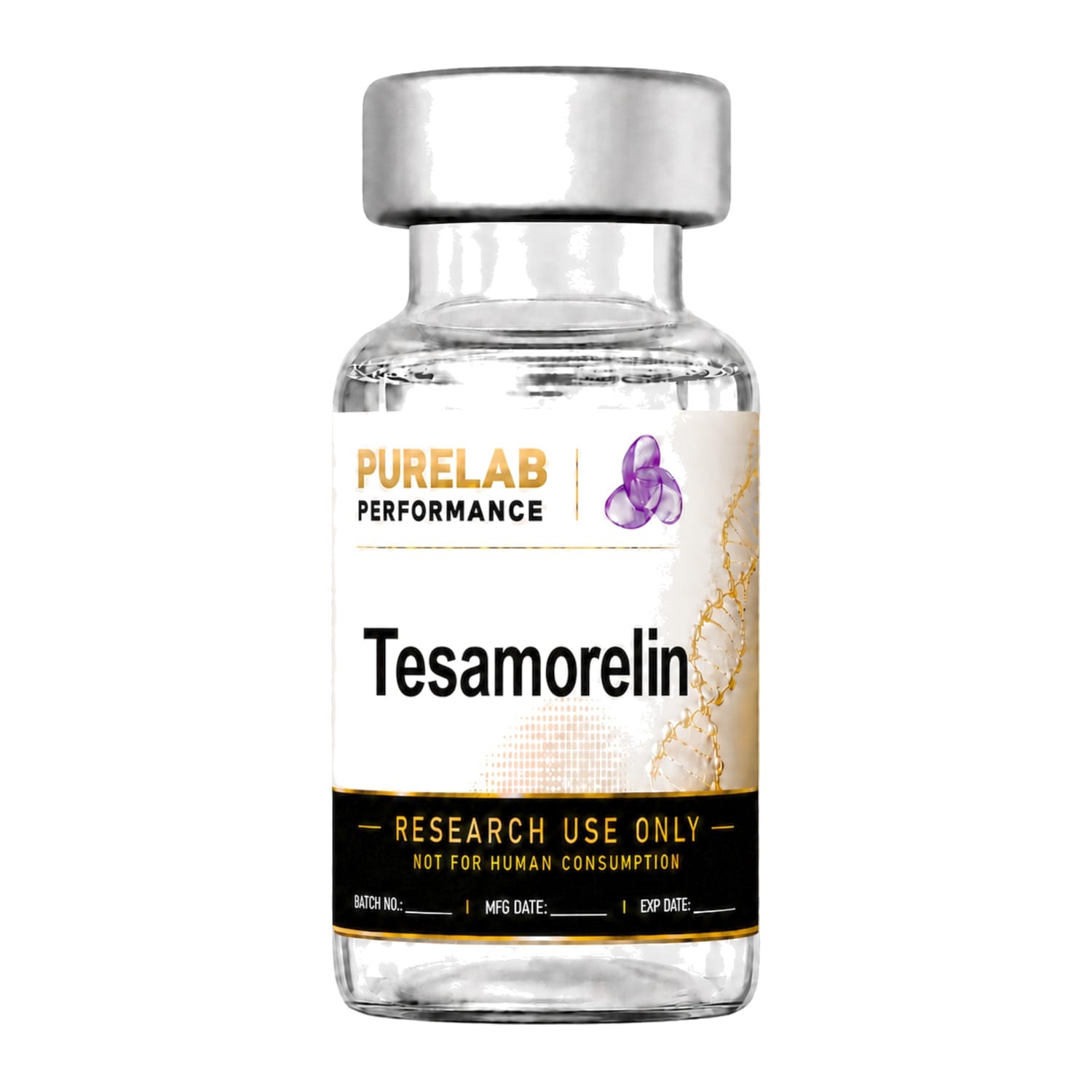
What tesamorelin is
Tesamorelin (development code TH9507) is a synthetic analogue of human growth hormone-releasing hormone — specifically, GHRH(1-44) with a trans-3-hexenoyl group attached at the N-terminus[6]. That acyl group is the whole design: unmodified GHRH is degraded almost immediately in plasma, and the hexenoyl modification is what makes the molecule survive long enough to reach the pituitary and act as a secretagogue.
It is a growth hormone-releasing factor, not growth hormone. It does not supply GH; it prompts the pituitary to release the GH it already makes, which is why the resulting secretion remains subject to normal feedback regulation[2].
And it is an FDA-approved drug. That makes this page different from most in the catalogue, and it makes the anti-doping line in the spec block above different too.
Structure and identity
Molecular formula, molecular weight, CAS registry number and structure above were retrieved directly from the PubChem PUG-REST API, not transcribed from a secondary source[6]. PubChem’s record explicitly identifies the compound as an N-((3E)-1-oxo-3-hexenyl) somatoliberin derivative and lists GHRH(1-44) among its synonyms — which is the cleanest available confirmation of the structural claim in the line above[6].
Every batch we supply is assayed by an independent laboratory using HPLC-UV-MS: mass spectrum against an authentic reference standard for identity, peak area against total chromatogram area for chromatographic purity, and total peptide mass against the stated label claim. Measured values for the current lot are pending. We do not print numbers we do not have.
An approved drug substance, sold for research use
Tesamorelin is an FDA-approved prescription drug, marketed under a brand name by its originator, with an approved indication, a full prescribing label, warnings, contraindications, and a monitored supply chain[5]. What PureLab supplies is not that product. It is bulk research material sold under research-use-only terms: no NDA, no pharmacy chain of custody, no prescribing information, no clinician.
An approved drug sold RUO is a genuinely different animal from an unapproved research peptide, and the difference cuts both ways. On one hand, the molecule has a real regulatory dossier and real phase 3 data behind it — that is more than most of this catalogue can say. On the other, every safety guardrail that makes the approved product usable — the label, the monitoring, the prescriber, the pharmacy — is exactly what is absent from a vial of research powder. The pharmacology is the same. The safety architecture is not.
Where the evidence stands
GHRH receptor agonism; protease-resistant N-terminal acylationEstablished
Standard preclinical package supporting the NDAEstablished
Two multicentre double-blind placebo-controlled phase 3 trials, pooled n=806, plus safety extensionsExtensive
Yes — with 26-week randomised phases and 26-week safety extensionsYes
Approved. The material on this page is not that product.Yes
The pivotal phase 3 trials human
Two multicentre, international, double-blind, placebo-controlled phase 3 trials were run in adults on antiretroviral therapy with excess abdominal fat: a 26-week randomised intervention phase followed by a 26-week safety extension. Falutz et al. published the pooled analysis in the Journal of Clinical Endocrinology & Metabolism in 2010[2]. The first of the two trials, with its safety extension, was reported separately in JAIDS[1].
806 participants were randomised 2:1 to tesamorelin 2 mg daily (n=543) or placebo (n=263). At week 26, participants originally on tesamorelin were re-randomised either to continue (T-T, n=246) or to switch to placebo (T-P, n=135), while the original placebo group crossed to tesamorelin (P-T, n=197) — a design built specifically to test durability[2].
Measured outcomes at week 26 in the tesamorelin arm versus placebo:
- Visceral adipose tissue: −24 ± 41 cm² vs +2 ± 35 cm² (p < 0.001); treatment effect −15.4%
- Abdominal subcutaneous adipose tissue: −2 ± 32 cm² vs +2 ± 29 cm² — no significant change (p = 0.08). The compartment specificity is real and it is a finding in its own right.
- Triglycerides: −37 ± 139 mg/dL vs +6 ± 112 mg/dL (p < 0.001)
- IGF-1: +108 ± 112 ng/mL vs −7 ± 64 ng/mL (p < 0.001) — see the safety section, because this number matters
- Glucose parameters: no clinically meaningful differences between groups at weeks 26 and 52, as reported by the authors[2]
In the group that continued tesamorelin through week 52 (T-T), the visceral fat reduction was maintained (−35 ± 50 cm², −17.5%)[2]. The re-randomisation to placebo existed precisely because the investigators needed to know what happens when you stop. That is a question anyone reading this page should be asking too.
The liver-fat trial human
Stanley et al., Lancet HIV 2019. A randomised, double-blind, multicentre trial in 61 participants with HIV and a hepatic fat fraction of 5% or more, randomised 1:1 to tesamorelin 2 mg daily or placebo for 12 months. Absolute effect size on hepatic fat fraction was −4.1% (95% CI −7.6 to −0.7; p = 0.018), a relative reduction of −37% (95% CI −67 to −7; p = 0.016). Changes in fasting glucose and HbA1c did not differ between groups at 12 months[3].
The 95% CI on the relative reduction runs from −67% to −7%. That is an enormous interval — it is consistent with a very large effect and with a barely detectable one. n = 61. The authors’ own stated conclusion was that tesamorelin “might be beneficial” and that “further studies are needed”[3]. That is the language of a small trial, and it is the language the authors chose.
A follow-on proteomic and transcriptomic analysis of the same cohort examined the pathways associated with response[4] — mechanistic work on a small sample, not additional efficacy evidence.
Mechanism at the pituitary in vitro
Tesamorelin binds and activates the GHRH receptor on pituitary somatotrophs, stimulating synthesis and pulsatile release of endogenous growth hormone; the resulting GH acts on the liver and elsewhere to raise circulating IGF-1[2]. Because the compound acts upstream of GH, the release stays pulsatile and remains subject to somatostatin feedback — which is the pharmacological argument for a secretagogue over exogenous GH.
That argument is a mechanistic hypothesis about feedback regulation. It is not a demonstration that the resulting exposure is safe, and the IGF-1 numbers below are the reason to keep that distinction sharp.
Adverse events and safety signals
The IGF-1 elevation human
In the pooled phase 3 analysis, mean IGF-1 rose by 108 ± 112 ng/mL on tesamorelin versus a fall of 7 ± 64 ng/mL on placebo[2]. That is the intended pharmacology working — and it is also a sustained elevation in a growth factor. The approved prescribing information for tesamorelin carries warnings addressing neoplasms, glucose intolerance and diabetes mellitus, hypersensitivity reactions, fluid retention and injection-site reactions, and directs that IGF-1 be monitored during use[5].
Read the two halves of that together. A regulator looked at this drug, approved it, and still wrote a label that says: watch the growth factor. There is no IGF-1 monitoring on a research vial.
Injection-site reactions human
In the Lancet HIV trial, participants on tesamorelin reported more localised injection-site complaints than placebo, though none were judged serious[3]. Daily subcutaneous administration is the delivery pattern used across every trial cited here, and local reactions are the most consistently reported adverse event across the programme.
Glucose human
The pooled phase 3 analysis reported no clinically meaningful between-group differences in glucose parameters at weeks 26 and 52[2], and the Lancet HIV trial found no difference in fasting glucose or HbA1c at 12 months[3]. Nonetheless the approved label carries a glucose-intolerance warning[5]. Growth hormone axis stimulation is a recognised route to insulin resistance, and “not detected in these trials” is not the same as “does not occur.”
What the trials did not test human
Every efficacy result on this page comes from a population of adults living with HIV on antiretroviral therapy[1][2][3]. There is no randomised evidence here about anyone else. Extrapolating a body-composition finding from that population to a healthy one is not a small step, and no trial cited on this page licenses it.
Limitations of the literature
Every efficacy trial is in one population. The phase 3 programme and the liver-fat trial were all conducted in people with HIV on antiretroviral therapy. That is the approved indication and it is the only population with randomised data[1][2][3].
Durability off-drug is the open question the design itself flagged. The phase 3 protocol re-randomised participants to placebo at week 26 for exactly this reason. Maintained reductions are reported for those who stayed on drug[2]. Any pharmacology that depends on continuous administration to sustain an effect implies continuous IGF-1 elevation to sustain it — and that is a trade the label warnings are about[5].
The liver-fat trial is small. n = 61, with a confidence interval wide enough to drive a truck through, and authors who chose the word “might”[3].
Regulatory and anti-doping status
Tesamorelin is an FDA-approved drug substance with an approved indication and a full prescribing label[5]. The material sold on this page is supplied as a research chemical and is not that approved product. Nothing about the approval of the branded medicine extends to a vial of bulk research powder — not the label, not the warnings, not the monitoring, not the supply chain.
WADA status appears as a neutral data line in the specification block above — Prohibited — S2.2 — in the same register as the CAS number and the molecular weight. Growth hormone-releasing factors, including GHRH and its analogues, sit in section S2 of the WADA Prohibited List and are prohibited at all times, in and out of competition[7]. This is a specification field, not a warning: it is a fact about the molecule’s classification, stated the same way we state its formula.
Anti-doping lists change annually and by governing body. If you compete under any tested organisation, the only reliable source is that organisation’s current prohibited list — not this page, and not any vendor’s.
What we don’t know
- What a sustained IGF-1 elevation of this magnitude does over years rather than months. The trials ran 26 to 52 weeks[2].
- Whether any of the body-composition findings apply to a population without HIV. No randomised trial has tested it[1][2][3].
- Whether the liver-fat effect is real at the size the point estimate suggests, or at the bottom of its confidence interval[3].
- Long-term neoplasm risk — the label warns about it precisely because it has not been resolved[5].
- Per-kilogram dosing in animal models does not scale to humans, and nothing on this page should be read as implying that it does.
We supply this compound for laboratory research. Tesamorelin has a real regulatory dossier and real phase 3 data, which is more than most of this catalogue can say. It also has a label full of warnings that a research vial does not come with.
Tesamorelin supplied by PureLab Performance is furnished strictly for in-vitro laboratory research. It is not a medicine or a drug and has not been approved by the FDA to prevent, treat, or cure any medical condition, ailment, or disease. Bodily introduction of any kind into humans or animals is strictly forbidden by law. Per-kilogram dosing in animal models does not scale to humans. Purchasers must be 18 or older and qualified to handle research chemicals.
References
Retrieved from PubMed. DOIs link to the original publications. Chemical identity retrieved from PubChem.
- Falutz J, Potvin D, Mamputu JC, et al. “Effects of tesamorelin, a growth hormone-releasing factor, in HIV-infected patients with abdominal fat accumulation: a randomized placebo-controlled trial with a safety extension.” J Acquir Immune Defic Syndr. 2010;53(3):311–22. DOI
- Falutz J, Mamputu JC, Potvin D, et al. “Effects of tesamorelin (TH9507), a growth hormone-releasing factor analog, in human immunodeficiency virus-infected patients with excess abdominal fat: a pooled analysis of two multicenter, double-blind placebo-controlled phase 3 trials with safety extension data.” J Clin Endocrinol Metab. 2010;95(9):4291–304. DOI
- Stanley TL, Fourman LT, Feldpausch MN, et al. “Effects of tesamorelin on non-alcoholic fatty liver disease in HIV: a randomised, double-blind, multicentre trial.” Lancet HIV. 2019;6(12):e821–e830. DOI
- Fourman LT, Stanley TL, Billingsley JM, et al. “Delineating tesamorelin response pathways in HIV-associated NAFLD using a targeted proteomic and transcriptomic approach.” Sci Rep. 2021;11(1):10485. DOI
- U.S. Food and Drug Administration. Approved prescribing information for tesamorelin, including warnings for neoplasms, glucose intolerance and diabetes mellitus, hypersensitivity reactions, fluid retention, and injection-site reactions, and the direction to monitor IGF-1. Drugs@FDA. Regulatory document; no DOI assigned.
- National Center for Biotechnology Information. PubChem Compound Summary for CID 16137828, Tesamorelin. PubChem. Database record; no DOI assigned.
- World Anti-Doping Agency. Prohibited List — Section S2, Peptide Hormones, Growth Factors, Related Substances and Mimetics; growth hormone-releasing factors including GHRH and its analogues. WADA. Regulatory document; no DOI assigned.
Reviews
There are no reviews yet.