
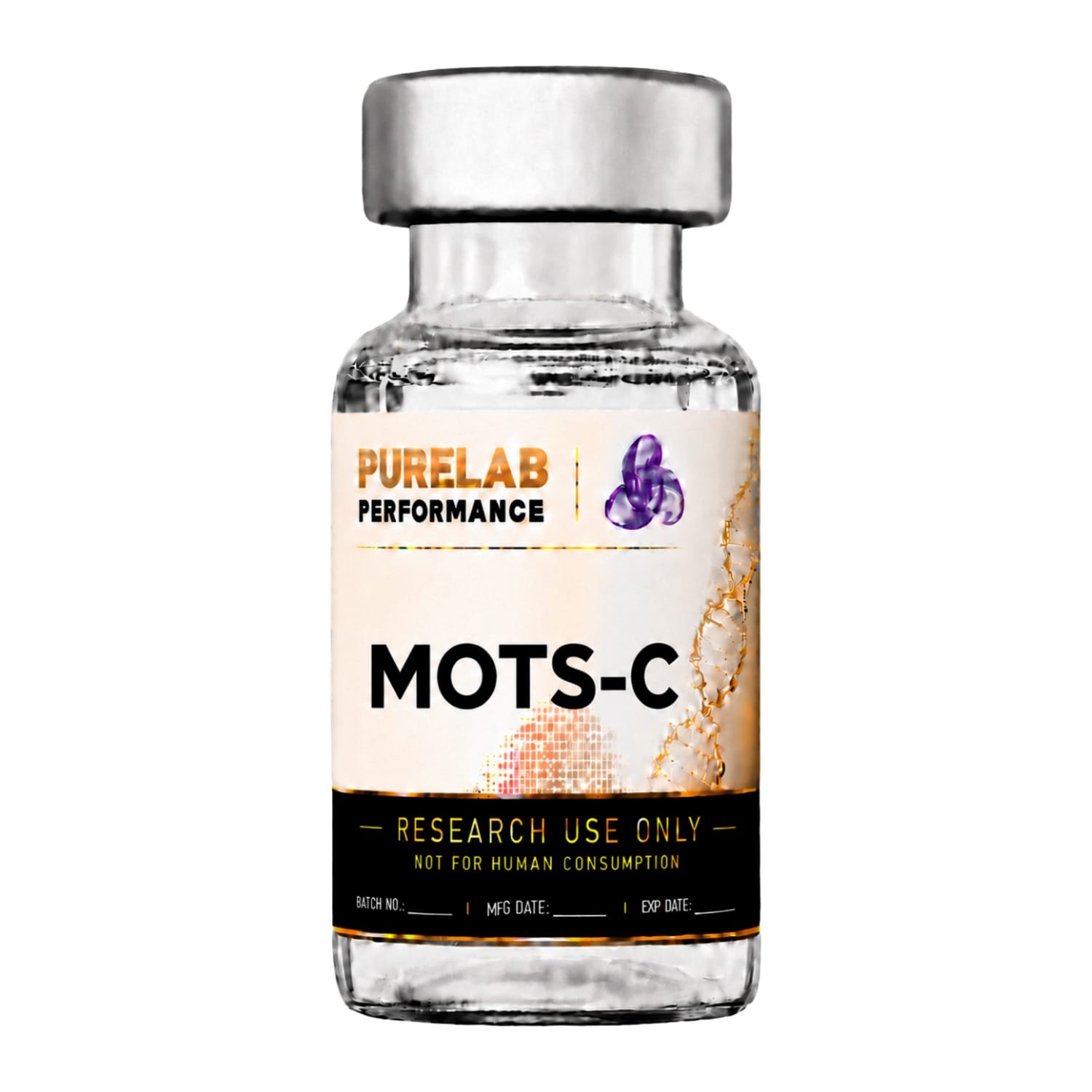
What MOTS-c is
MOTS-c is a 16-amino-acid peptide with an unusual provenance: it is not encoded in the nuclear genome. It is encoded by a short open reading frame located within the mitochondrial 12S rRNA gene, on the mitochondrial DNA. Its name is an acronym for exactly that — mitochondrial open reading frame of the 12S rRNA-c[1].
It belongs to a small class called mitochondrially-derived peptides, of which humanin was the first identified. The underlying idea is that mitochondria are not merely power plants but signalling organelles, capable of communicating their status to the rest of the cell — and to other tissues — using peptides encoded in their own genome[1]. That is a genuinely interesting piece of biology, and it is why this compound is in our catalogue.
It is also, as of the current WADA Prohibited List, a named prohibited substance. More on that below, because a great deal of what is written about MOTS-c online is out of date on this point.
Structure and identity
Every batch is assayed by an independent laboratory using HPLC-UV-MS, with the mass spectrum compared against an authentic reference standard. Measured purity for the current lot is Certificate pending. We publish the certificate in full when the analysis returns.
Why the CAS field says N/A
Because there isn’t one that we can verify.
MOTS-c is registered in PubChem as CID 146675088, with a confirmed molecular formula and mass. We could not verify a CAS Registry Number for it from an authoritative source, so the CAS field on this page reads N/A. It does not read “pending,” it does not read a plausible-looking number, and it does not silently borrow the CAS of a related compound.
Fabricated CAS numbers are common in this industry, because a CAS number looks like proof of identity and almost nobody checks. A number we cannot verify is worth less than an honest blank. If you need a registry identifier for procurement or safety documentation, use the PubChem CID above — that one is real, and you can check it yourself in about four seconds.
Where the evidence stands
Folate cycle inhibition, de novo purine biosynthesis, AMPK activation; myoblast metabolic stress adaptationGood
High-fat-diet and age-dependent insulin resistance; physical capacity in young, middle-aged and old miceGood
Exercise induces endogenous MOTS-c expression in skeletal muscle and circulationLimited
No published efficacy or safety trial of the peptide given to humansNone
Note carefully the distinction between the third and fourth rows. That humans make more of a peptide when they exercise is an observation about endogenous physiology. It is not evidence that injecting the peptide does anything. These two things are constantly conflated in marketing copy for this compound, and they are not the same claim.
Mechanism at the cell in vitro
The 2015 paper in Cell Metabolism that identified MOTS-c also worked out what it does at the cell. Its cellular actions were reported to inhibit the folate cycle and the de novo purine biosynthesis tethered to it, leading to activation of AMP-activated protein kinase (AMPK). The primary target organ appeared to be skeletal muscle[1].
AMPK is the cell’s central energy sensor. Activating it pharmacologically is a well-trodden strategy — and, as it happens, it is precisely the property that puts this compound on the Prohibited List.
Murine metabolic models murine
In the same 2015 study, MOTS-c treatment in mice was associated with prevention of age-dependent and high-fat-diet-induced insulin resistance, and of diet-induced obesity[1]. In a murine model, that is a substantial and cleanly reported result.
It is a result in mice. Mice are not small humans, and the history of metabolic pharmacology is substantially a history of compounds that did this in mice and then did not do it in people.
Aged mice and physical capacity murine
A 2021 study in Nature Communications reported that MOTS-c significantly enhanced physical performance in young (2 months), middle-aged (12 months) and old (22 months) mice. Late-life-initiated intermittent treatment beginning at 23.5 months, dosed three times weekly, was associated with increased physical capacity and healthspan in those mice. The authors reported that MOTS-c regulates nuclear genes related to metabolism and proteostasis, skeletal muscle metabolism, and myoblast adaptation to metabolic stress[2].
The same paper contains the human observation noted above: exercise induces endogenous MOTS-c expression in human skeletal muscle and in circulation[2]. That is an observation about what human bodies do on their own. It is not a trial.
The human data — all of it human
There is no published clinical trial in which MOTS-c was administered to human beings and an outcome was measured. No randomised trial, no pilot efficacy study, no published safety or pharmacokinetic study of the administered peptide.
What exists is observational: acute high-intensity exercise increases concentrations of MOTS-c in human skeletal muscle and plasma[2][3]. Human safety, human dosing and human bioavailability of administered MOTS-c are all uncharacterised.
Limitations of the literature
The training data are conflicting. A 2021 review in Biochimica et Biophysica Acta examined the mitochondrially-derived peptide literature and concluded that evidence that exercise training produces chronic changes in MOTS-c expression is conflicting, and may depend on the mode, duration and intensity of the training plan and on participant characteristics[3]. The acute-exercise response is more consistent than the chronic one.
MOTS-c is not simply an exercise mimetic. The same review notes that studies using an inactivating genetic variant, or combining exercise with MOTS-c treatment in mice, suggest there are distinct as well as overlapping pathways through which exercise and MOTS-c produce metabolic effects[3]. The popular framing of MOTS-c as “exercise in a vial” is not what the literature says.
The field is young and concentrated. Much of the foundational work originates from a single group at the University of Southern California, which discovered the peptide. That does not make the work wrong — the discovery papers are in Cell Metabolism and Nature Communications, which is not nothing — but independent replication of the aging and performance findings remains thinner than the enthusiasm around them.
Regulatory and anti-doping status
Read this section even if you skip the rest, because it is the fact most often reported incorrectly about this compound.
MOTS-c is prohibited by the World Anti-Doping Agency by name, at all times, in and out of competition. It appears on the Prohibited List under section S4.4.1, among “Activators of the AMP-activated protein kinase (AMPK),” listed explicitly as “mitochondrial open reading frame of the 12S rRNA-c (MOTS-c),” alongside AICAR and BAM15[4]. Substances in class S4.4 are non-Specified Substances[4], which carries the more severe sanctioning framework under the World Anti-Doping Code.
A great deal of vendor copy and forum commentary still describes MOTS-c as “not on the WADA list.” That is wrong. It is on the list, it is on it by name, and it is on it in a non-Specified class. If you compete under any tested organisation, verify against your governing body’s current list — but do not start from the assumption that this one is unlisted, because it is not.
MOTS-c has not been approved for human therapeutic use by the FDA or any other governmental regulatory health authority.
What we don’t know
- Whether administered MOTS-c does anything measurable in a human. No trial has been published.
- Human bioavailability, half-life or clearance of the administered peptide — unmeasured.
- Whether the murine healthspan findings replicate in laboratories independent of the group that discovered the peptide.
- Whether chronic exercise training alters endogenous MOTS-c at all — the literature conflicts on this.
- Long-term safety of a systemic AMPK activator in humans — uncharacterised.
- Per-kilogram dosing in mice does not scale to humans, and nothing on this page should be read as implying that it does.
We supply this compound for laboratory research. A peptide encoded inside the mitochondrial genome that signals to the nucleus is one of the more genuinely surprising findings in recent metabolic biology. It is also a named prohibited substance with no human trial behind it, and both of those things are true at once.
MOTS-c supplied by PureLab Performance is furnished strictly for in-vitro laboratory research. It is not a medicine or a drug and has not been approved by the FDA to prevent, treat, or cure any medical condition, ailment, or disease. Bodily introduction of any kind into humans or animals is strictly forbidden by law. Per-kilogram dosing in animal models does not scale to humans. Purchasers must be 18 or older and qualified to handle research chemicals.
References
Retrieved from PubMed. DOIs link to the original publications.
- Lee C, Zeng J, Drew BG, Sallam T, Martin-Montalvo A, Wan J, Kim SJ, Mehta H, Hevener AL, de Cabo R, Cohen P. “The mitochondrial-derived peptide MOTS-c promotes metabolic homeostasis and reduces obesity and insulin resistance.” Cell Metab. 2015;21(3):443–54. DOI
- Reynolds JC, Lai RW, Woodhead JST, Joly JH, Mitchell CJ, Cameron-Smith D, Lu R, Cohen P, Graham NA, Benayoun BA, Merry TL, Lee C. “MOTS-c is an exercise-induced mitochondrial-encoded regulator of age-dependent physical decline and muscle homeostasis.” Nat Commun. 2021;12(1):470. DOI
- Woodhead JST, Merry TL. “Mitochondrial-derived peptides and exercise.” Biochim Biophys Acta Gen Subj. 2021;1865(12):130011. DOI
- World Anti-Doping Agency. Prohibited List — S4.4.1, Metabolic Modulators: “Activators of the AMP-activated protein kinase (AMPK), e.g. … mitochondrial open reading frame of the 12S rRNA-c (MOTS-c).” Classes S4.3 and S4.4 are non-Specified Substances. wada-ama.org/en/prohibited-list
Reviews
There are no reviews yet.