
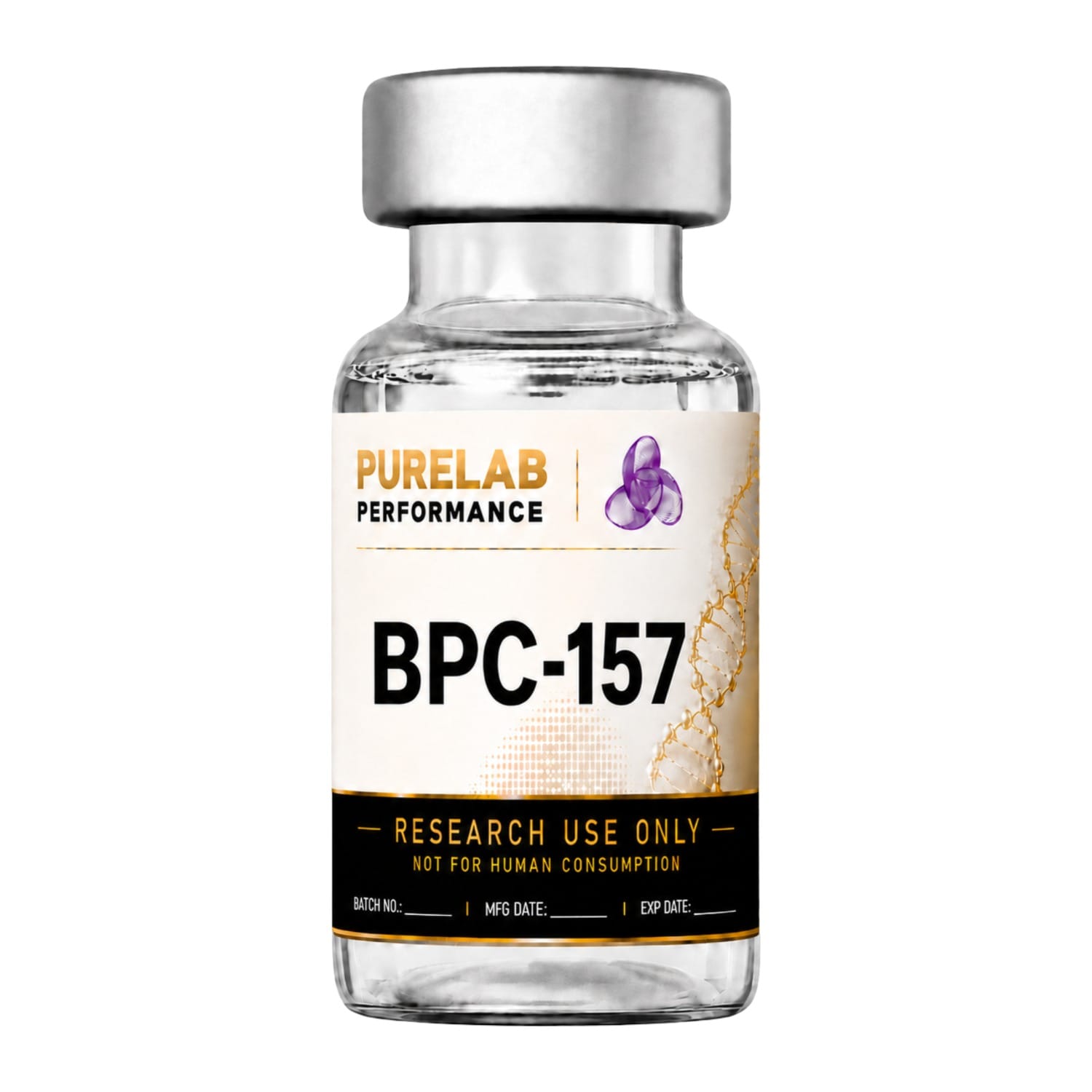
What BPC-157 is
BPC-157 is a synthetic pentadecapeptide — fifteen amino acids — corresponding to a partial sequence of a larger protein isolated from human gastric juice, referred to as body protection compound[1].
It has been studied since the 1990s, overwhelmingly in rodents and in cell culture. It is one of the most-searched compounds in the research peptide market, and one of the most frequently misdescribed. This page is organised around a single question: what has actually been measured, and in what.
Structure and identity
Every batch we supply is assayed by an independent laboratory using HPLC-UV-MS. The mass spectrum is compared against an authentic reference standard to confirm molecular identity; the peptide’s peak area is measured against the total chromatogram area to establish chromatographic purity; and total peptide mass in the vial is measured against the stated label claim.
For lot 8sprqvs that analysis returned chromatographic purity above 99.1%, identity confirmed, and 9.47 mg recovered against a 10 mg label — 94.7% of claim. The certificate is published in full and can be verified with the issuing laboratory independently of us.
Where the evidence stands
This is the section most vendors skip. It is the most important one on the page.
Fibroblast migration, F-actin, FAK–paxillin, growth hormone receptor expressionExtensive
Transected Achilles tendon, gastrointestinal injury, vascular and neurological modelsExtensive
Three pilot studies in total, per a 2025 review of the musculoskeletal literatureMinimal
Not approved for use in standard medicine by FDA or other regulatorsNone
2026 Prohibited List, S0 — named explicitly. Specified Substance.Prohibited
A 2025 narrative review in Current Reviews in Musculoskeletal Medicine assessed the musculoskeletal literature and concluded that despite broad preclinical support, human data are extremely limited — three pilot studies, covering intraarticular knee pain, interstitial cystitis, and an intravenous safety and pharmacokinetics assessment. The authors state that until well-designed clinical trials are conducted, BPC-157 should be considered investigational[5].
Tendon and soft tissue rodent
The foundational study appeared in the Journal of Orthopaedic Research in 2003. Rat Achilles tendons were fully transected 5 mm proximal to the calcaneal insertion, producing a substantial defect between the cut ends. Animals receiving BPC-157 improved against saline controls on four independent measures[1]:
- Biomechanically — increased load to failure, load to failure per unit area, and Young’s modulus of elasticity
- Functionally — significantly higher Achilles functional index scores
- Microscopically — greater fibroblast, reticulin and collagen formation; fewer granulocytes
- Macroscopically — smaller defect size and depth
A 2019 review in Cell and Tissue Research surveyed the soft-tissue literature and found consistently positive healing effects across injury types and tissues — while noting that the majority of that work is in small rodent models and that efficacy in humans is yet to be confirmed[6].
Mechanism at the cell in vitro
A 2010 study in the Journal of Applied Physiology isolated tendon fibroblasts from rat Achilles tendon and asked precisely what BPC-157 does to them. The findings are specific, and one of them is very commonly reported backwards:
- BPC-157 did not directly increase fibroblast proliferation — MTT assay showed no direct effect
- It did significantly increase cell survival under hydrogen peroxide oxidative stress
- It increased fibroblast migration in a dose-dependent manner
- It induced F-actin formation and dose-dependently increased phosphorylation of FAK and paxillin — proteins central to the cell migration pathway[2]
The distinction matters. The mechanism implicated is migration and survival under stress, not proliferation. Descriptions claiming BPC-157 “makes cells multiply” are describing an effect this study specifically tested for and did not find.
A follow-up in Molecules (2014) found that in the same cell type, BPC-157 dose- and time-dependently upregulated growth hormone receptor expression at both mRNA and protein level, with downstream JAK2 activation[3]. This is a finding about receptor expression in cultured cells. It is not a finding about growth hormone concentrations in a living organism.
Blood vessels and angiogenesis preclinical
A 2014 review in Current Pharmaceutical Design characterised BPC-157 as an angiomodulatory agent acting through nitric oxide, VEGF and FAK pathways, with described effects across endothelial damage, clotting, vasoconstriction and vasodilatation, and the formation of collateral vessels[7]. The 2025 review summarises the current mechanistic picture as engagement of VEGFR2 and nitric-oxide synthesis via the Akt–eNOS axis, together with ERK1/2 signalling — with effects most pronounced in poorly vascularised tissue such as tendon and the myotendinous junction[5].
A 2018 review compared BPC-157 directly against the standard angiogenic growth factors — EGF, FGF and VEGF — across healing models[4].
Gastrointestinal cytoprotection preclinical
BPC-157’s original context was the gastrointestinal tract, and that remains the largest body of work. A 2020 review in Current Pharmaceutical Design examined its described role in maintaining epithelial integrity and intestinal permeability in the context of NSAID exposure, alcohol, and bile acids, in preclinical models[8].
These are animal and cell-culture findings. They are not clinical outcomes and should not be read as such.
Nervous system preclinical
A 2016 review in Current Neuropharmacology covers the described brain–gut axis effects, implicating Egr-1, NAB2, FAK–paxillin and JAK-2 pathways, and reporting modulation of serotonergic and dopaminergic systems and neuroprotective effects in rodent models of nerve transection, traumatic brain injury and spinal cord compression[9]. All rodent.
The human data — all of it
There are three human studies. Here is what they are.
Intraarticular injection for knee pain human
A 2021 report in Alternative Therapies in Health and Medicine described a retrospective chart review at a single clinic in Orlando. Seventeen patients had received intraarticular BPC-157, alone or with thymosin beta-4. Sixteen were reached by telephone and asked to recall their pain before and after. Of the twelve who received BPC-157 alone, eleven reported significant improvement[10].
This is a retrospective, unblinded, uncontrolled chart review of twelve patients, with outcomes collected by phone from memory, six to twelve months later. The authors themselves state that no validated instruments were used to measure function, quality of life or stiffness. It is a hypothesis-generating observation. It is not evidence of efficacy, and anyone citing “87.5% of patients improved” as a headline number is misrepresenting what was done.
The other two are a pilot study in interstitial cystitis and an intravenous safety and pharmacokinetics assessment. No adverse effects were reported across them — but pilot studies are small by design and are not powered to detect much[5].
Limitations of the literature
Two structural problems with the BPC-157 evidence base are worth stating plainly, because almost nobody selling this compound will state them.
The literature is concentrated. A 2019 review noted that over roughly two decades, only a handful of research groups have performed in-depth work on this peptide[6]. A large fraction of the positive findings originate from a single group at the University of Zagreb. That does not make the work wrong. It does mean the evidence base has had far less independent replication than its volume suggests.
Preclinical breadth is not clinical depth. A compound showing an effect in twenty different rodent models is showing you twenty rodent results, not mounting human evidence. The number of papers is not the strength of the case.
Regulatory and anti-doping status
BPC-157 is prohibited by WADA. The 2026 Prohibited List, effective 1 January 2026, names it explicitly under S0 — Non-Approved Substances: “This class covers many different substances including but not limited to BPC-157.” It is classified as a Specified Substance and is prohibited at all times, in and out of competition.
Note that this is a change. A 2025 review in Pharmaceuticals recorded that BPC-157 had been temporarily banned by WADA in 2022 and was not listed at the time of that writing[11]. The 2026 list names it. Anti-doping lists change annually, and individual federations may differ from WADA. If you compete under any tested organisation, the only authoritative source is that organisation’s current prohibited list — not this page, and not any vendor’s.
BPC-157 has not been approved for use in standard medicine by the FDA or other global regulatory authorities, owing to the absence of sufficient clinical studies confirming benefit in humans[11] — which is the basis on which S0 applies.
See our full anti-doping reference table for the status of every compound we supply.
What we don’t know
- No large randomised controlled trial has been conducted in humans.
- Long-term safety in humans is uncharacterised.
- Per-kilogram dosing in rodents does not scale to humans, and nothing on this page should be read as implying that it does.
- Optimal route, timing and exposure are not established in any species relevant to a human protocol.
We supply this compound for laboratory research.
BPC-157 supplied by PureLab Performance is furnished strictly for in-vitro laboratory research. It is not a medicine or a drug and has not been approved by the FDA to prevent, treat, or cure any medical condition, ailment, or disease. Bodily introduction of any kind into humans or animals is strictly forbidden by law. Per-kilogram dosing in animal models does not scale to humans. Purchasers must be 18 or older and qualified to handle research chemicals.
References
Retrieved from PubMed. DOIs link to the original publications.
- Staresinic M, Sebecic B, Patrlj L, et al. “Gastric pentadecapeptide BPC 157 accelerates healing of transected rat Achilles tendon and in vitro stimulates tendocytes growth.” J Orthop Res. 2003;21(6):976–83. DOI
- Chang CH, Tsai WC, Lin MS, Hsu YH, Pang JHS. “The promoting effect of pentadecapeptide BPC 157 on tendon healing involves tendon outgrowth, cell survival, and cell migration.” J Appl Physiol. 2011;110(3):774–80. DOI
- Chang CH, Tsai WC, Hsu YH, Pang JHS. “Pentadecapeptide BPC 157 enhances the growth hormone receptor expression in tendon fibroblasts.” Molecules. 2014;19(11):19066–77. DOI
- Seiwerth S, Rucman R, Turkovic B, et al. “BPC 157 and Standard Angiogenic Growth Factors. Gastrointestinal Tract Healing, Lessons from Tendon, Ligament, Muscle and Bone Healing.” Curr Pharm Des. 2018;24(18):1972–89. DOI
- McGuire FP, Martinez R, Lenz A, Skinner L, Cushman DM. “Regeneration or Risk? A Narrative Review of BPC-157 for Musculoskeletal Healing.” Curr Rev Musculoskelet Med. 2025;18(12):611–19. DOI
- Gwyer D, Wragg NM, Wilson SL. “Gastric pentadecapeptide body protection compound BPC 157 and its role in accelerating musculoskeletal soft tissue healing.” Cell Tissue Res. 2019;377(2):153–59. DOI
- Seiwerth S, Brcic L, Vuletic LB, et al. “BPC 157 and blood vessels.” Curr Pharm Des. 2014;20(7):1121–25. DOI
- Park JM, Lee HJ, Sikiric P, Hahm KB. “BPC 157 Rescued NSAID-cytotoxicity Via Stabilizing Intestinal Permeability and Enhancing Cytoprotection.” Curr Pharm Des. 2020;26(25):2971–81. DOI
- Sikiric P, Seiwerth S, Rucman R, et al. “Brain-gut Axis and Pentadecapeptide BPC 157: Theoretical and Practical Implications.” Curr Neuropharmacol. 2016;14(8):857–65. DOI
- Lee E, Padgett B. “Intra-Articular Injection of BPC 157 for Multiple Types of Knee Pain.” Altern Ther Health Med. 2021;27(4):8–13. PubMed
- Józwiak M, Bauer M, Kamysz W, Kleczkowska P. “Multifunctionality and Possible Medical Application of the BPC 157 Peptide — Literature and Patent Review.” Pharmaceuticals (Basel). 2025;18(2):185. DOI
Reviews
There are no reviews yet.