
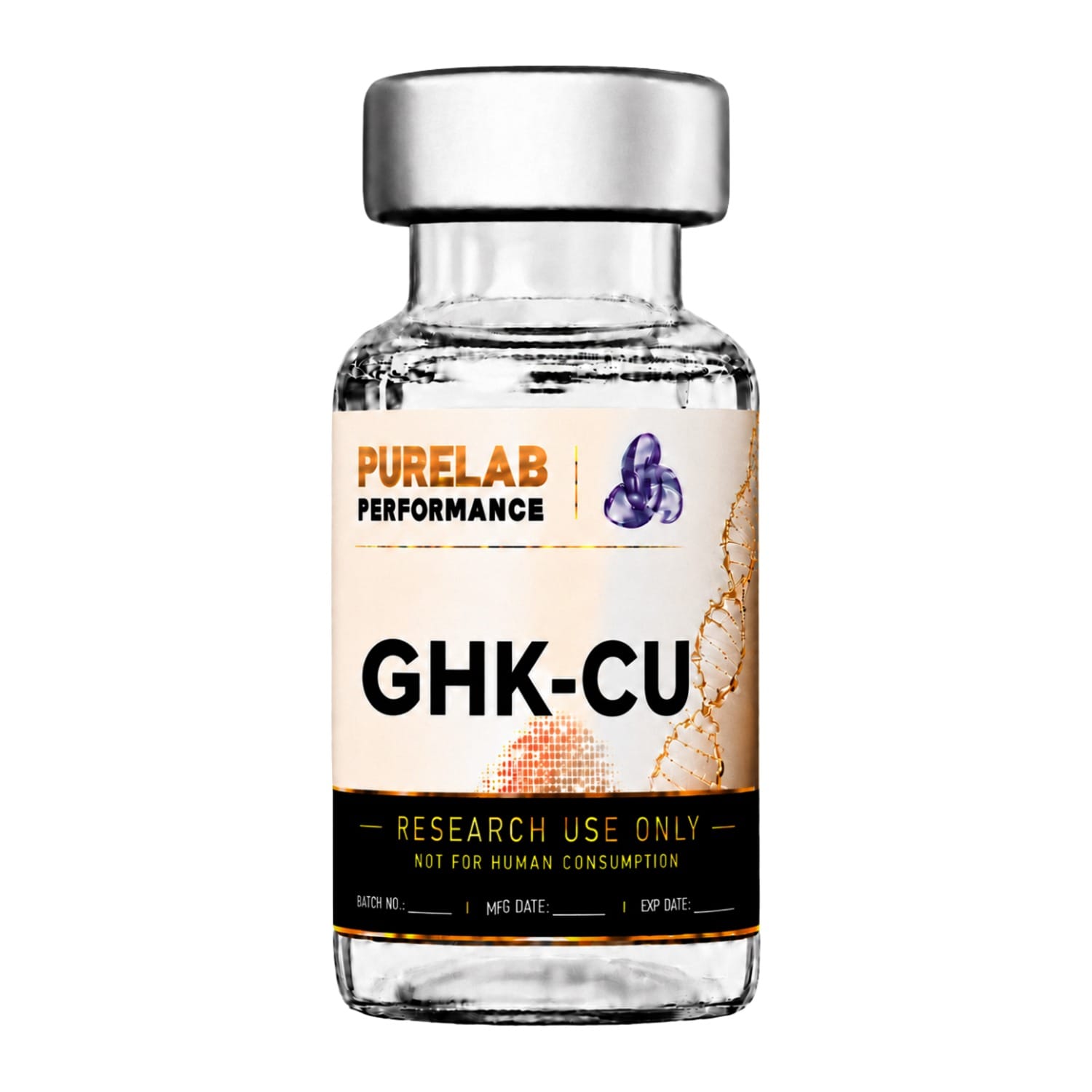
What GHK-Cu is
GHK is a tripeptide — glycyl-L-histidyl-L-lysine — that occurs naturally in human plasma, saliva and urine. It has a high affinity for copper(II) ions and readily forms a complex with them. That complex is GHK-Cu, known in the cosmetic ingredient nomenclature as copper tripeptide-1 and in the pharmaceutical literature as prezatide copper[1].
It has been studied since the 1970s, largely in cell culture and in animal wound models, and it is one of the few compounds in this catalogue that has actually been through a randomised controlled trial in humans. That trial is the most informative thing on this page, and it is not the result the marketing literature would lead you to expect.
Structure and identity
A word on identity, because this compound is sold in two forms that are frequently confused. The free tripeptide GHK is C14H24N6O4, 340.38 g/mol, CAS 49557-75-7 (PubChem CID 73587). The copper complex GHK-Cu is what is listed above. They are not interchangeable, they do not weigh the same, and a product sold by mass as “GHK-Cu” that is actually the free peptide contains no copper at all. We state which one is in the vial, and the COA confirms it.
Every batch is assayed by an independent laboratory using HPLC-UV-MS. Measured purity for the current lot is Certificate pending. We publish the certificate in full when the analysis returns.
Where the evidence stands
Collagen and glycosaminoglycan synthesis, metalloproteinase modulation, gene expression profilingExtensive
Rabbit open-wound healing vs zinc oxide and untreated controlModerate
One. Venous stasis ulcers, n=86 evaluable, evaluator-blinded, vehicle-controlledOne
No difference between the copper tripeptide cream and the placeboNegative
Not approved as a drug. Permitted as a cosmetic ingredient, which is a different standardNone
The 1992 controlled trial human
In 1992, a group at the University of Texas Medical Branch published a prospective, randomised, evaluator-blinded trial in the Journal of Vascular Surgery. Patients with chronic venous stasis ulcers were randomised between three arms: silver sulfadiazine 1% cream, a biologically active tripeptide copper complex 0.4% cream, and an inert vehicle placebo. Eighty-six evaluable patients completed the trial[2].
The result, in the authors’ own words: silver sulfadiazine “proved to statistically reduce the ulcer size compared with a biologically active tripeptide copper complex 0.4% cream formulation or the placebo. There was no difference between the latter two treatments.“[2]
This is the only randomised, vehicle-controlled human trial of a copper tripeptide preparation that we have been able to find, and the copper tripeptide arm did not separate from inert vehicle. It was also beaten by a cheap, decades-old antimicrobial cream in the same trial — and beaten on a mechanism that had nothing to do with antibacterial action, since all ulcers had comparable bacterial loads at baseline. A negative result in a single trial is not proof that a compound does nothing. But it is the highest-quality human evidence that exists for this compound, and it is negative. Any page that sells you GHK-Cu without mentioning this trial is not telling you the truth about the evidence.
A note on who wrote the reviews
If you search the GHK-Cu literature you will quickly encounter a set of unusually enthusiastic review articles — papers describing GHK as capable of “up- and downregulating at least 4,000 human genes, essentially resetting DNA to a healthier state,” and proposing it as a therapeutic agent for conditions ranging from skin inflammation to chronic obstructive pulmonary disease to metastatic colon cancer[3].
We checked the authorship. The 2015 review in BioMed Research International is authored by Loren Pickart, Jessica Michelle Vasquez-Soltero and Anna Margolina. The affiliation given for all three authors, in the paper itself, is “Skin Biology, Research & Development Department, 4122 Factoria Boulevard SE, Bellevue, WA”[3]. Skin Biology is a commercial company that sells copper-peptide skincare products. The same lead author, with the same corporate affiliation, wrote the 2012 review in Oxidative Medicine and Cellular Longevity proposing GHK as an agent against age-associated cognitive decline[4].
Mechanism at the cell in vitro
The reported cell-level activities of GHK and GHK-Cu include stimulation of both the synthesis and the breakdown of collagen and glycosaminoglycans; modulation of the activity of metalloproteinases and their tissue inhibitors; and stimulation of dermatan sulfate, chondroitin sulfate and the small proteoglycan decorin[3]. GHK has also been reported to restore replicative capacity to irradiated fibroblasts in culture[3].
These are cell-culture findings, reported in a review written by authors employed by a company selling the compound. We flag that not to dismiss them but because it is a material fact about the source. Independent replication of the gene-expression claims in particular is thinner than the citation count suggests.
Animal models rabbit
In an experiment published in Veterinary Dermatology in 2006, eighteen New Zealand rabbits received full-thickness open wounds on each side of the dorsal midline and were assigned to topical tripeptide-copper complex, topical zinc oxide, or no treatment for 21 days. In this rabbit model, the mean unhealed wound area was significantly smaller in the tripeptide-copper group than in the untreated control group on days 7, 14 and 21, and smaller than the zinc oxide group on day 7. Time to coverage of the wound bed with granulation tissue was significantly shorter in the tripeptide-copper group, and neovascularisation was most pronounced in that group[5].
This is a positive animal result and we are not going to hide it either. It is worth noting that the comparator that mattered — an inert vehicle — was not among the arms; the comparison was against zinc oxide and against nothing at all. When an inert vehicle was used as the comparator, in humans, the effect did not appear[2].
Limitations of the literature
The best-quality evidence is the negative evidence. The single randomised, vehicle-controlled human trial returned a null result for the copper tripeptide arm[2]. Everything more encouraging than that is either cell culture, animal work without a vehicle control, or review articles.
The review literature has a commercial centre of gravity. See above. This is verifiable from the affiliations printed on the papers themselves.
Cosmetic approval is not drug approval. Copper tripeptide-1 appears in cosmetic ingredient listings and in commercial skincare formulations. That reflects a safety-for-topical-use determination, not a demonstration that it does anything. The two are routinely conflated in marketing copy.
Route matters and is untested. Essentially the entire human and animal literature concerns topical application to a wound or to skin. There is no controlled human evidence at all regarding any other route of administration.
Regulatory and anti-doping status
GHK-Cu is not listed by name on the World Anti-Doping Agency Prohibited List. However, the List’s section S0, Non-Approved Substances, prohibits at all times “any pharmacological substance which is not addressed by any of the subsequent sections of the List and with no current approval by any governmental regulatory health authority for human therapeutic use”[6]. Substances captured by S0 are Specified Substances. Athletes under a tested organisation should not read “not listed by name” as “permitted,” and should consult their governing body’s current list rather than this page or any other vendor’s.
GHK-Cu has not been approved as a drug by the FDA or by other global regulatory authorities.
What we don’t know
- Whether GHK-Cu outperforms an inert vehicle in any human endpoint. The one trial that asked found that it did not.
- Whether the extensive gene-expression claims replicate in laboratories with no commercial interest in the answer.
- Anything at all about non-topical routes in humans — no controlled data exist.
- Long-term safety of repeated exposure in humans, including the consequences of chronically delivering additional copper.
- Per-kilogram dosing in animal models does not scale to humans, and nothing on this page should be read as implying that it does.
We supply this compound for laboratory research. The cell biology is real and the copper coordination chemistry is elegant. The human evidence is one trial, and it was negative.
GHK-Cu supplied by PureLab Performance is furnished strictly for in-vitro laboratory research. It is not a medicine or a drug and has not been approved by the FDA to prevent, treat, or cure any medical condition, ailment, or disease. Bodily introduction of any kind into humans or animals is strictly forbidden by law. Per-kilogram dosing in animal models does not scale to humans. Purchasers must be 18 or older and qualified to handle research chemicals.
References
Retrieved from PubMed. DOIs link to the original publications.
- PubChem. “Prezatide copper (Copper tripeptide-1, GHK-Cu).” Compound Summary, CID 71587328. National Library of Medicine. PubChem CID 71587328
- Bishop JB, Phillips LG, Mustoe TA, VanderZee AJ, Wiersema L, Roach DE, Heggers JP, Hill DP, Taylor EL, Robson MC. “A prospective randomized evaluator-blinded trial of two potential wound healing agents for the treatment of venous stasis ulcers.” J Vasc Surg. 1992;16(2):251–57. DOI
- Pickart L, Vasquez-Soltero JM, Margolina A. “GHK Peptide as a Natural Modulator of Multiple Cellular Pathways in Skin Regeneration.” Biomed Res Int. 2015;2015:648108. Authors’ stated affiliation: Skin Biology, Research & Development Department, Bellevue, WA. DOI
- Pickart L, Vasquez-Soltero JM, Margolina A. “The human tripeptide GHK-Cu in prevention of oxidative stress and degenerative conditions of aging: implications for cognitive health.” Oxid Med Cell Longev. 2012;2012:324832. Authors’ stated affiliation: Skin Biology, Bellevue, WA. DOI
- Cangul IT, Gul NY, Topal A, Yilmaz R. “Evaluation of the effects of topical tripeptide-copper complex and zinc oxide on open-wound healing in rabbits.” Vet Dermatol. 2006;17(6):417–23. DOI
- World Anti-Doping Agency. Prohibited List — S0, Non-Approved Substances. wada-ama.org/en/prohibited-list
Reviews
There are no reviews yet.