
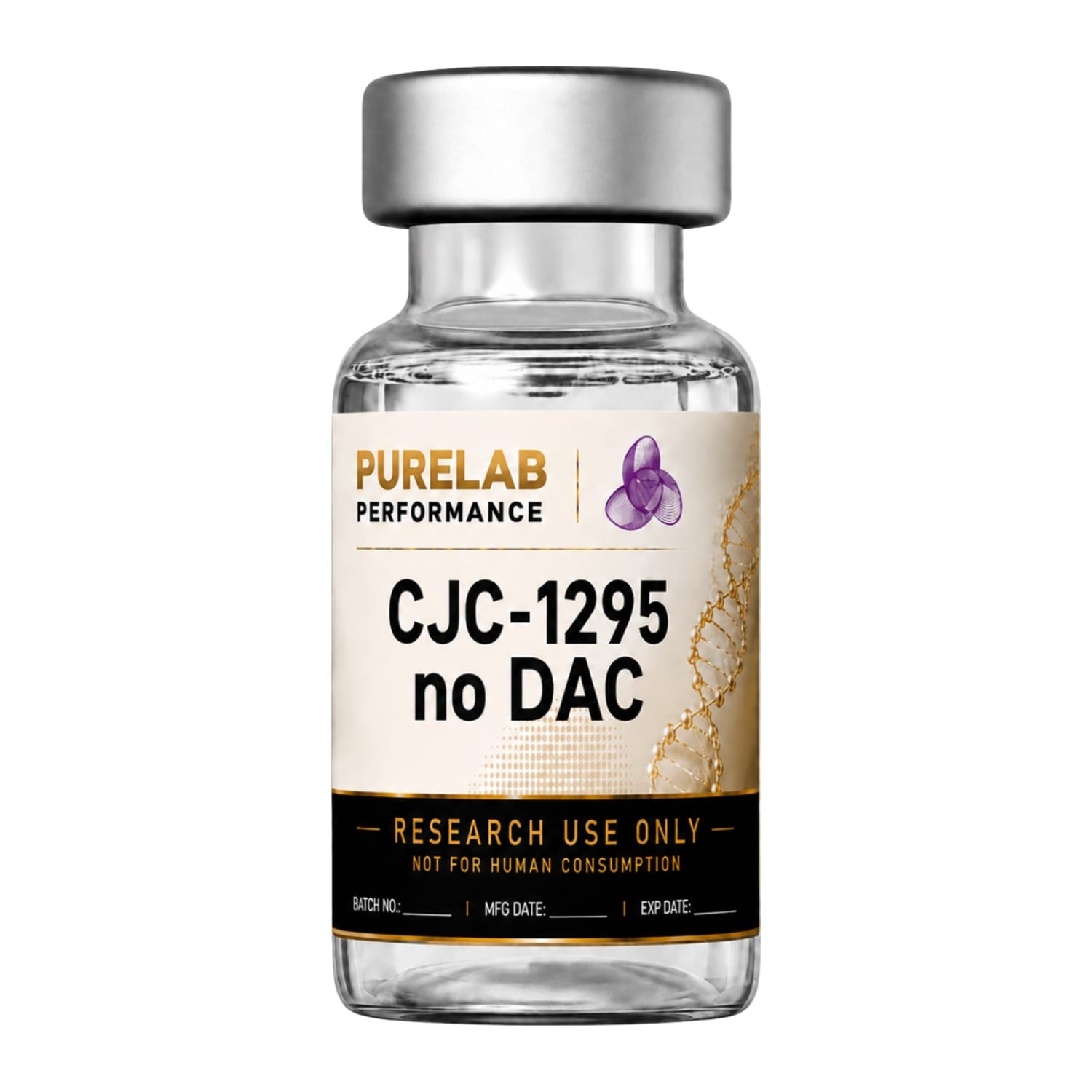
What CJC-1295 no-DAC is
CJC-1295 without DAC — sold across this market as “Mod GRF 1-29” — is the 29-residue backbone of CJC-1295 without the drug affinity complex. It is the first 29 amino acids of human growth hormone-releasing hormone, carrying four substitutions (D-Ala at position 2, Gln at 8, Ala at 15, Leu at 27) chosen to slow enzymatic breakdown, with a C-terminal amide.
Removing the DAC linker removes the albumin conjugation. Removing the albumin conjugation removes the multi-day half-life. What is left is a GHRH analogue with a short duration of action — which is exactly why people buy it, and exactly why almost nothing is known about it.
This page is organised around one uncomfortable fact: there is no published human clinical trial of this specific molecule. Every human number you will see quoted for “CJC-1295” comes from studies of the DAC form. They are not the same drug.
Structure and identity
The mass difference between this molecule and the DAC form is 279.3 g/mol — one lysine plus one maleimidopropionyl group. That difference is the whole pharmacological story, and it is the only thing that reliably distinguishes the two on a mass spectrum.
Why the CAS field says N/A
PubChem’s compound record for CJC1295 Without DAC (CID 91976842) carries no CAS registry number. Its depositor-supplied synonym list is also internally inconsistent — it contains both “CJC1295 Without DAC” and “CJC1295 With DAC,” and a systematic name that includes the maleimidopropionyl linker this molecule does not have.
Multiple CAS numbers circulate in vendor catalogues for “CJC-1295,” attached to different molecules by different sellers. We could pick one and print it. Every other listing does. Instead we are printing N/A, telling you why, and pointing you at the two identifiers that actually discriminate: the molecular formula (C152H252N44O42) and the molecular weight (3367.9 g/mol). If the mass spectrum on a certificate says 3647, you are not holding this compound.
Where the evidence stands
This is the section most vendors skip. It is the most important one on the page.
GHRH-receptor pharmacology, largely inferred from the GHRH(1-29) classIndirect
PubMed indexes none. ClinicalTrials.gov registers none.None
Three studies, 2005–2009. Different pharmacokinetics. Not transferable.Adjacent
The evidence gap, stated plainly
We searched PubMed and ClinicalTrials.gov for human studies of the DAC-free 29-mer. There are none. A 2026 narrative review in Frontiers in Endocrinology that specifically catalogues “CJC-1295 without DAC” as a compound encountered in clinical practice and online self-administration protocols places it in the tier of peptides where clinical evidence is absent and what circulates instead are self-administration protocols[1]. A 2026 review in Sports Medicine reaches the same conclusion for the gray-market peptide class: animal data, no rigorous human safety data, real potential for harm[2].
What the DAC form showed — and why it isn’t this human
Because this is the data that gets borrowed, here is what it actually says, and where the borrowing breaks.
In two randomised, placebo-controlled, double-blind ascending-dose trials in healthy adults, a single subcutaneous injection of CJC-1295 with DAC raised mean plasma GH 2- to 10-fold for six days or more and mean IGF-1 1.5- to 3-fold for 9–11 days. The estimated half-life was 5.8–8.1 days[3]. In a separate overnight sampling study, trough GH rose 7.5-fold one week after a single injection, with pulse frequency and amplitude unchanged[4].
Every one of those numbers is a consequence of the albumin bond. Remove the linker and you remove the mechanism that produced the multi-day exposure. The half-life data, the sustained IGF-1 data and the trough-GH data do not carry over to the DAC-free molecule. Anyone quoting “CJC-1295 raises IGF-1 for eleven days” on a no-DAC product page is describing a different compound.
The DAC form’s Phase 2 clinical trial in HIV-associated visceral obesity (NCT00267527) is registered as terminated, with no results ever posted[5]. A contemporaneous news report states the study was halted in July 2006 following the death of a participant, with causality never publicly determined[6]. We record that here because the two molecules are marketed as siblings, and if the family history is going to be invoked for the good numbers it should be invoked for this too.
The parent molecule: GRF(1-29) human
The unmodified 29-residue GHRH fragment is sermorelin, a molecule with a real regulatory history — and one that is named on the WADA Prohibited List alongside CJC-1295 in the same clause[7]. PubChem records sermorelin as C149H246N44O42S, 3357.9 g/mol (CID 16132413)[8]. It is a related but chemically distinct compound: it retains the methionine at position 27 that Mod GRF replaces with leucine, and it lacks the D-Ala2 substitution. Sermorelin data are not Mod GRF data either.
Detection and doping controls
Unlike the DAC form, which conjugates to plasma proteins and defeats top-down peptide screening[9], an unconjugated 29-mer is a conventional analytical target. GHRH(1-29) and CJC-1295 have both been included in validated immunoaffinity–LC-MS doping-control assays with detection limits in the low pg/mL range in urine and plasma[10]. A 2026 harmonised dried-blood-spot and plasma workflow covers 54 prohibited peptidic and non-peptidic compounds[11].
Limitations of the literature
There is no literature on this molecule. That is not a rhetorical flourish. It is the finding. The compound has a PubChem record, a WADA listing, and an active retail market, and no published human study.
Data transfer is doing all the work. The entire market narrative for this product is built on borrowing numbers from the DAC form and from sermorelin. Both borrowings are pharmacologically unsound for the reasons above.
Adverse effects reported in self-administration are not a safety database. The 2026 Frontiers review lists what turns up in clinic when people present after using these compounds: prolactin and cortisol elevations, dysglycaemia, fluid retention, myalgia and arthralgia, injection-site reactions[1]. That is a case-series signal, not a controlled safety profile. It is the only human safety information that exists.
Regulatory and anti-doping status
CJC-1295 is named explicitly on the WADA Prohibited List under S2.2.4, Growth Hormone Releasing Factors — “growth hormone-releasing hormone (GHRH) and its analogues (e.g. CJC-1293, CJC-1295, sermorelin and tesamorelin)”[7]. The listing does not distinguish between the DAC and DAC-free forms; both are GHRH analogues, and the clause covers analogues. Section S2 substances are prohibited at all times, in and out of competition.
This compound has not been approved for any indication by the FDA or any other regulatory authority. Anti-doping lists change annually and by governing body. If you compete under any tested organisation, the only reliable source is that organisation’s current prohibited list — not this page, and not any vendor’s.
What we don’t know
- The pharmacokinetics of this molecule in humans. No published study has measured them.
- The pharmacodynamics of this molecule in humans. Same answer.
- Whether the substitutions that distinguish it from sermorelin change anything measurable in a person.
- Anything at all about long-term safety. There is no long-term human exposure data of any kind.
- Per-kilogram dosing in animals does not scale to humans, and nothing on this page should be read as implying that it does.
We supply this compound for laboratory research. It is a well-defined chemical entity with a clean structural rationale and an empty clinical file. We are not going to pretend it is more than it is.
CJC-1295 no-DAC supplied by PureLab Performance is furnished strictly for in-vitro laboratory research. It is not a medicine or a drug and has not been approved by the FDA to prevent, treat, or cure any medical condition, ailment, or disease. Bodily introduction of any kind into humans or animals is strictly forbidden by law. Per-kilogram dosing in animal models does not scale to humans. Purchasers must be 18 or older and qualified to handle research chemicals.
References
Retrieved from PubMed, ClinicalTrials.gov, PubChem and the World Anti-Doping Agency. DOIs link to the original publications.
- Dominikowski A, Rękoś Z, Olejarz M, Szczepanek-Parulska E, Domin R, Ruchała M. “The emerging landscape of performance-enhancing peptides modulating GH-IGF1 axis: bridging the gap between clinical evidence and patient self-administration.” Front Endocrinol. 2026;17:1822475. DOI
- Mendias CL, Awan TM. “Safety and Efficacy of Approved and Unapproved Peptide Therapies for Musculoskeletal Injuries and Athletic Performance.” Sports Med. 2026. DOI
- Teichman SL, Neale A, Lawrence B, Gagnon C, Castaigne JP, Frohman LA. “Prolonged stimulation of growth hormone (GH) and insulin-like growth factor I secretion by CJC-1295, a long-acting analog of GH-releasing hormone, in healthy adults.” J Clin Endocrinol Metab. 2006;91(3):799–805. DOI
- Ionescu M, Frohman LA. “Pulsatile secretion of growth hormone (GH) persists during continuous stimulation by CJC-1295, a long-acting GH-releasing hormone analog.” J Clin Endocrinol Metab. 2006;91(12):4792–97. DOI
- ConjuChem. Phase 2 study of CJC-1295 in HIV-associated visceral obesity. ClinicalTrials.gov identifier NCT00267527. Status: Terminated. Registry record
- Bernard EJ. “Lipodystrophy study halted after patient death.” NAM aidsmap, 31 July 2006. Article — contemporaneous news report; no causality determination was ever published.
- World Anti-Doping Agency. The Prohibited List, Section S2.2.4 — Growth Hormone Releasing Factors. wada-ama.org
- National Center for Biotechnology Information. PubChem Compound Summary for CID 16132413, Sermorelin. PubChem
- Timms M, Ganio K, Forbes G, Bailey S, Steel R. “An immuno polymerase chain reaction screen for the detection of CJC-1295 and other growth-hormone-releasing hormone analogs in equine plasma.” Drug Test Anal. 2019;11(6):804–12. DOI
- Thomas A, Schänzer W, Delahaut P, Thevis M. “Immunoaffinity purification of peptide hormones prior to liquid chromatography-mass spectrometry in doping controls.” Methods. 2012;56(2):230–35. DOI
- Mazzarino M, Colpaert T, Deventer K, Van Eenoo P. “Rapid and harmonized analytical workflow for the determination of peptidic and non-peptidic doping agents in dried and liquid blood matrices.” Analyst. 2026. DOI
- National Center for Biotechnology Information. PubChem Compound Summary for CID 91976842, CJC1295 Without DAC. PubChem
Reviews
There are no reviews yet.