
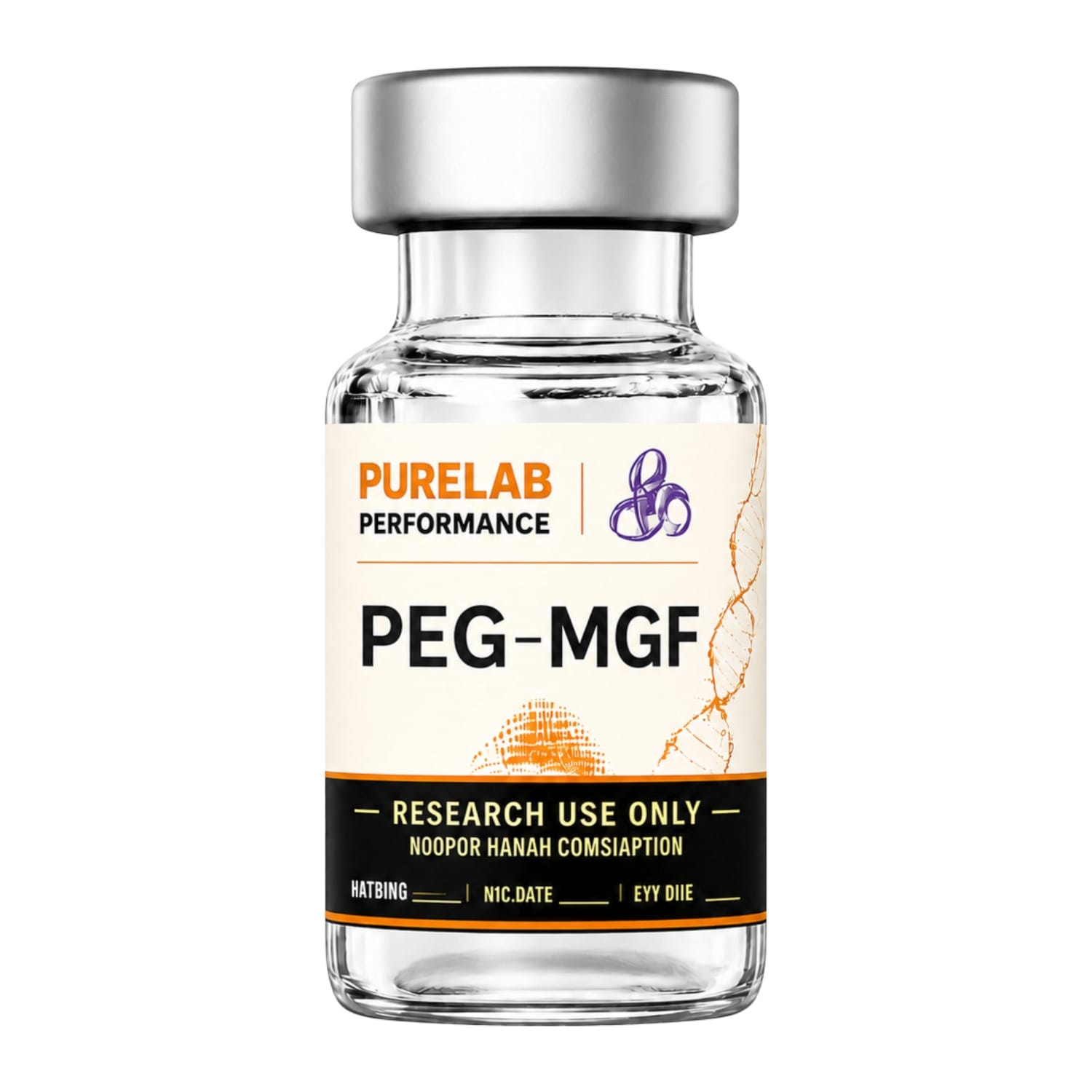
What PEG-MGF is supposed to be
The story runs like this. The IGF-1 gene produces multiple splice variants. One of them, IGF-1Eb (IGF-1Ec in humans), is upregulated in muscle after mechanical loading or injury. Its 24-amino-acid C-terminal extension — cleaved, in theory, from the mature IGF-1 protein — was named mechano growth factor, and was proposed to enhance satellite cell proliferation and delay myoblast fusion. PEG-MGF is that peptide with a polyethylene glycol chain attached to slow clearance.
Every element of that paragraph is a claim. Below, we go through what happened when people tested them. This page is organised around one question: what has actually been measured, and in what.
Identity — every field is N/A
CAS number: none exists. Not “we couldn’t find it” — there is no CAS registry number for PEG-MGF. Any vendor displaying one is displaying something they cannot substantiate. Ask them which registry issued it.
PubChem CID: none. We queried the PubChem compound database by name. No record was returned. PEG-MGF is not in PubChem.
Molecular formula: none exists. This is not an administrative gap — it is a chemical one. PEGylation is not a single defined reaction. The PEG chain length, its branching, the conjugation chemistry, and the attachment site all vary between suppliers, and none of it is standardised. A PEG chain is itself a polydisperse polymer — a distribution of chain lengths, not a single molecular species. There is therefore no molecular formula to state, because the material is not one molecule.
Molecular weight: undefined. For the same reason. A “PEG-MGF” from one supplier and a “PEG-MGF” from another may differ in mass by thousands of daltons and in behaviour by an unknown amount. They are not the same product wearing the same name — they are different products wearing the same name.
There is no reference standard. Identity confirmation by mass spectrometry requires something authentic to compare against. For PEG-MGF, that thing does not exist.
We have left these fields blank rather than filled them, and we want to be explicit about why. Printing a CAS number and a molecular weight in a spec table communicates that a molecule has been characterised and registered. For PEG-MGF, no such characterisation exists. Filling those fields would be the single most misleading thing we could do on this page.
Where the evidence stands
This is the section most vendors skip. It is the most important one on the page.
Not “few”. Zero. The PEGylated form has never been studied.ZERO
Attempted replication by two pharmaceutical companies. Failed on every endpoint. See §5.Failed replication
Never achieved, in any cell, tissue or fluid. See §6.NEVER
Delayed resolution of pro-inflammatory macrophages; no improvement in regeneration. See §7.Negative
Prohibited by name, S2.3, non-SpecifiedProhibited
Zero papers on PEG-MGF
Search the peer-reviewed literature for studies of PEG-MGF — the PEGylated compound that is actually sold — and you will find none.
Not a small number. Not a handful of low-quality ones. None. There is no published study of PEG-MGF’s pharmacokinetics, no study of its stability, no study of its activity in any cell type, no animal study, and no human study. The PEGylation is asserted to extend half-life. That assertion has never been tested and published for this molecule.
Everything below concerns the unPEGylated MGF peptide — a different substance from the one in the vial — and it is the entirety of what is known.
Two pharma companies tried and failed in vitro
This is the most important study on this page.
In 2014, a team spanning Novartis Institutes for Biomedical Research and GSK published in the American Journal of Physiology — Endocrinology and Metabolism an attempt to reproduce the foundational MGF findings. Their framing is unusually direct: MGF, if real, “could represent a promising strategy to improve muscle regeneration”, and so, in their words, “at our two pharmaceutical companies, we attempted to reproduce the claimed effect of MGF peptides on human and mouse muscle myoblast proliferation and differentiation in vitro.”[1]
What they found:
- MGF peptide at concentrations up to 500 ng/mL failed to increase proliferation of C2C12 cells or primary human skeletal muscle myoblasts
- By contrast, all the same cell types did respond to mature IGF-1 and to full-length IGF-1Eb — so the assay worked; the peptide didn’t
- MGF failed to inhibit the differentiation of myoblasts into myotubes
- In primary mouse skeletal muscle stem cells — testing whether the response had simply been lost in immortalised lines — MGF again showed no significant effect
- Testing a separate previously-reported effect, activation of p-ERK in cardiac myocytes: a robust response to IGF-1 was seen, and no activating response to either native or stabilised MGF peptide
“These results call in to question whether there is a physiological role for MGF.”[1]
Understand what this is. Two large pharmaceutical companies, with strong commercial motivation to find a working muscle-regeneration agent, with better assays and more resources than the original groups, ran the experiments independently. They tested every major published effect. They included the positive controls that prove the assay works. They found nothing, on every endpoint they measured.
This is not a hostile paper. It is a straightforward negative replication published by people who wanted the result to be positive.
The peptide has never been isolated foundational
The problem is more fundamental than a failed replication, and this is the part that almost nobody encounters.
A 2010 review in Endocrinology by Matheny, Nindl and Adamo works carefully through the relationship between the Igf1 gene and the thing called MGF. Its central observation is this: the MGF mRNA splice variant is real and is genuinely upregulated after muscle injury. But the MGF peptide — the 24-residue C-terminal fragment that is supposed to be cleaved off and act as a growth factor — has, in the authors’ words:
“…no analogous peptide product of the Igf1 gene has been identified in or isolated from cultured cells, their conditioned medium, or in vivo animal tissues or biological fluids.”[2]
Read that again slowly. The molecule PEG-MGF is a PEGylated analogue of has never been demonstrated to exist as an actual peptide in any living system. Not in cells. Not in the medium those cells were grown in. Not in animal tissue. Not in blood or any other biological fluid.
The review explicitly sets out to “differentiate actions of synthetic MGF from any known product of Igf1” — because those are two different things, and the literature has been conflating them for two decades. What people call “MGF” in a vial is a synthetic peptide designed from a predicted sequence. Whether the body ever makes it is an open question, and the current answer is: no one has ever caught it doing so.
So the chain of reasoning behind this product is: a splice variant exists (true) → therefore a peptide is cleaved from it (never observed) → therefore that peptide is a growth factor (failed replication) → therefore PEGylating it makes a useful drug (never studied).
Sun 2018 — overexpression made it worse mouse
The most direct in-vivo test came from Sun et al., Frontiers in Physiology, 2018. The investigators overexpressed MGF in cardiotoxin-injured mouse skeletal muscle and measured what happened to inflammation, macrophage populations, and regeneration[3].
The findings:
- MGF overexpression delayed the resolution of macrophages — particularly the pro-inflammatory phenotype
- This coincided with upregulation of inflammatory markers
- Flow cytometry indicated MGF overexpression likely delayed macrophage resolution by limiting macrophage apoptosis
- And the punchline: MGF overexpression “did not obviously affect muscle regeneration outcomes”
The compound is sold on a promise of accelerated muscle repair. When it was overexpressed directly in injured muscle, it prolonged the pro-inflammatory phase and did not improve regeneration. That is not a null result. It runs the wrong way.
The human data — all of it
There is none. No trial, no case series, no registered study, no pharmacokinetics, no toxicology, no published human exposure — for either MGF or PEG-MGF.
Why this page is short
You may have noticed that this page has less on it than the others in this catalogue. That is not an oversight and it is not laziness. The thinness is the finding.
A product page’s length is usually a function of how much its seller wants to say, not how much is known. We could pad this one out — cite the splice-variant biology at length, discuss PEGylation in the abstract, gesture at IGF-1’s well-established anabolic role and let you draw the inference. Every vendor of this compound does exactly that, and the result is a page that feels substantial while containing nothing about PEG-MGF at all.
What is actually known about PEG-MGF fits in a short page, because what is actually known about PEG-MGF is almost nothing, and what is known about its parent peptide is largely negative. Anything longer would be construction, not reporting.
Limitations of the literature
There is no literature on the product being sold. Zero papers on PEG-MGF. §4.
The parent peptide failed independent replication. Novartis and GSK, every endpoint. §5.
The parent peptide may not exist endogenously. Never isolated from any biological source. §6.
The one direct in-vivo test went the wrong way. §7.
The material has no defined chemical identity. §2. You cannot verify what you have received, and neither can we in the way we would normally want to.
Regulatory and anti-doping status
Mechano growth factors are prohibited by name on the WADA 2025 Prohibited List under Section S2.3 — Growth Factors and Growth Factor Modulators, where “Mechano Growth Factors (MGFs)” appear as a named entry alongside IGF-1 and its analogues, FGFs, HGF, PDGF, VEGF and thymosin-β4. It is non-Specified and prohibited at all times, in and out of competition.
Note the asymmetry this creates, stated as neutrally as we can manage. There is no peer-reviewed evidence that MGF does anything. There is peer-reviewed evidence that it does not. And it is nonetheless explicitly banned by name in every tested sport in the world — an anti-doping sanction attaching to a molecule whose physiological role two pharmaceutical companies have called into question.
Anti-doping lists change annually and by governing body. If you compete under any tested organisation, the only reliable source is that organisation’s current prohibited list — not this page, and not any vendor’s.
PEG-MGF has not been approved by the FDA or any other regulator for any use.
What we don’t know
- What this molecule is. No CAS, no formula, no defined mass, no reference standard. §2.
- Whether PEGylation does anything to it. Never studied.
- Whether the MGF peptide has any physiological role at all — a question its would-be replicators explicitly raised[1].
- Whether the endogenous peptide exists. Never isolated from anything[2].
- Anything whatsoever about its behaviour in a human.
- What is actually in a vial sold under this name by any supplier, ours included, in the absence of a standard to check it against.
We supply this compound for laboratory research.
PEG-MGF supplied by PureLab Performance is furnished strictly for in-vitro laboratory research. It is not a medicine or a drug and has not been approved by the FDA to prevent, treat, or cure any medical condition, ailment, or disease. Bodily introduction of any kind into humans or animals is strictly forbidden by law. Per-kilogram dosing in animal models does not scale to humans. Purchasers must be 18 or older and qualified to handle research chemicals.
References
Retrieved from PubMed. DOIs link to the original publications. No PubChem or CAS record exists for PEG-MGF; see §2.
- Fornaro M, Hinken AC, Needle S, Hu E, Trendelenburg AU, Mayer A, Rosenstiel A, Chang C, Meier V, Billin AN, Becherer JD, Brace AD, Evans WJ, Glass DJ, Russell AJ. “Mechano-growth factor peptide, the COOH terminus of unprocessed insulin-like growth factor 1, has no apparent effect on myoblasts or primary muscle stem cells.” Am J Physiol Endocrinol Metab. 2014;306(2):E150–6. DOI
- Matheny RW Jr, Nindl BC, Adamo ML. “Minireview: Mechano-growth factor: a putative product of IGF-I gene expression involved in tissue repair and regeneration.” Endocrinology. 2010;151(3):865–75. DOI
- Sun KT, Cheung KK, Au SWN, Yeung SS, Yeung EW. “Overexpression of Mechano-Growth Factor Modulates Inflammatory Cytokine Expression and Macrophage Resolution in Skeletal Muscle Injury.” Front Physiol. 2018;9:999. DOI
- World Anti-Doping Agency. “The 2025 Prohibited List — International Standard.” Section S2.3, Growth Factors and Growth Factor Modulators — “Mechano Growth Factors (MGFs)”. WADA

Reviews
There are no reviews yet.