
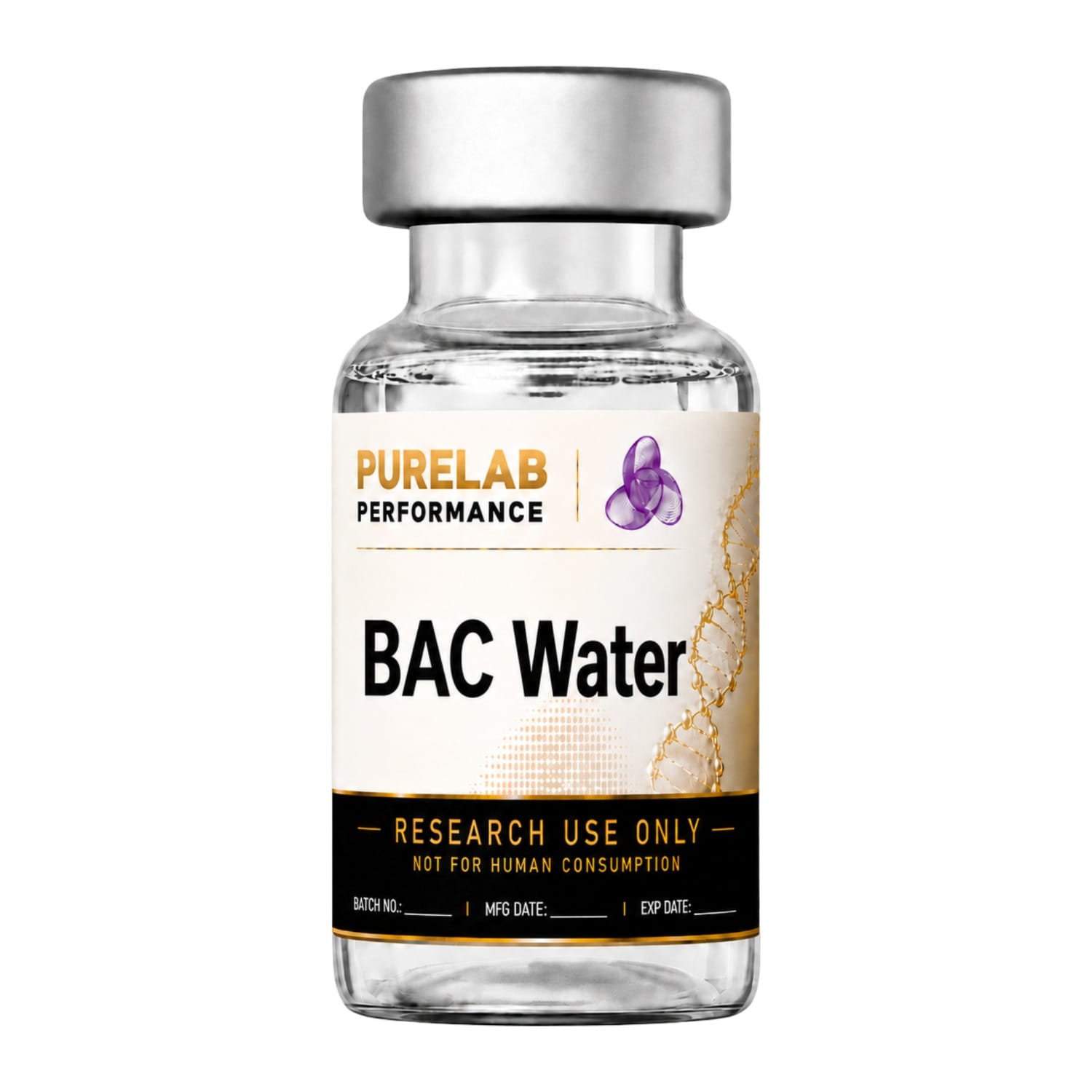
What bacteriostatic water is
Bacteriostatic water is sterile water containing a bacteriostatic preservative — in this case benzyl alcohol at 0.9% weight/volume. That is the whole description.
It is a solvent, not a compound. It has no pharmacology, no mechanism, no target and no evidence base, because there is nothing to have an evidence base about. Its job is to dissolve a lyophilised powder and to inhibit bacterial growth in the vial between withdrawals. Nothing on this page claims that it does anything else, and we make no efficacy claims of any kind for it.
“Bacteriostatic” means growth-inhibiting, not sterilising. The preservative suppresses the multiplication of organisms that may be introduced when a needle punctures the stopper. It does not sterilise the vial, it does not rescue a contaminated preparation, and it is not a substitute for aseptic technique.
A note on identifiers: the solution is a mixture, so it has no CAS number, no molecular formula and no molecular weight of its own — those describe single chemical substances. We print N/A above rather than inventing something. The two constituents do have identifiers, and they are listed: water (CAS 7732-18-5) and benzyl alcohol (CAS 100-51-6, PubChem CID 244)[1].
Why benzyl alcohol
Benzyl alcohol is one of a small set of antimicrobial preservatives used in multi-dose parenteral products; it has been in that role for decades, and the alternatives (phenol, m-cresol, parabens, thimerosal) are a short list[2]. The United States Pharmacopeia has a monograph for Bacteriostatic Water for Injection, which specifies sterile water containing one or more suitable antimicrobial agents; the 0.9% benzyl alcohol formulation is the common commercial expression of it[3]. Preservative content and preservative-effectiveness expectations for multi-dose containers are set out in the USP general chapters[3].
Two properties matter for peptide work. Benzyl alcohol is effective at a low concentration, so it contributes little to the ionic or osmotic character of the solution. And it is a mild solubilising agent, which is why it is a conventional choice for reconstituting lyophilised material intended to be drawn from more than once.
It is not inert. Benzyl alcohol has a well-documented toxicology, and the most important entry in it is gasping syndrome: in 1982 a group in New Orleans reported a cluster of deaths in premature neonates in whom benzyl-alcohol-preserved flush solutions produced metabolic acidosis, respiratory depression, seizures and death[4]. The American Academy of Pediatrics responded by recommending against benzyl-alcohol-containing solutions in neonatal units[5]. This is a fact about the preservative, and it is the reason preservative-free water exists as a separate product.
Correct reconstitution practice
Standard aseptic technique for a lyophilised peptide. None of this is novel; it is simply done properly or not.
- Let the vial equilibrate. Bring the lyophilised vial to room temperature before adding solvent. Condensation on cold glass is water you did not intend to add.
- Disinfect both stoppers. Wipe the rubber septum of the peptide vial and of the bacteriostatic water vial with 70% isopropanol and let it dry. Wet alcohol does not disinfect; evaporating alcohol does.
- Add the solvent slowly, down the glass wall. Do not aim the stream at the cake. Peptides are surface-active and shear-sensitive; a jet of liquid onto a lyophilisate drives foaming, and foaming is an air–liquid interface, which is where aggregation and denaturation happen[6].
- Do not shake. Swirl. Rotate the vial gently until the cake dissolves. Vortexing and vigorous agitation are the two most common ways of damaging a peptide before the experiment starts[6].
- Inspect. The reconstituted solution should be clear and free of visible particulates. If it is cloudy, hazy or has visible matter, do not use it.
- Record the concentration. Concentration is stated label mass divided by solvent volume added. Write it on the vial. The single most common error in this category is arithmetic, not chemistry.
Volume choice is a trade-off, not a rule: more solvent gives a lower concentration and finer volumetric resolution; less solvent gives a higher concentration and a smaller draw. Neither is more correct.
Storage
- Unopened bacteriostatic water: store at controlled room temperature, protected from light. Do not freeze.
- Lyophilised powder, before reconstitution: the dry cake is the stable form — that is the entire reason material ships lyophilised. Keep it cold and dry.
- After reconstitution: refrigerate. Peptides in solution are less stable than peptides in a dry cake, and the dominant degradation routes in aqueous solution — hydrolysis, deamidation, oxidation, aggregation — are all temperature-dependent[6].
- Avoid repeated freeze–thaw cycles. Freeze–thaw is a recognised physical stress on peptides and proteins in solution and is a standard item in stability testing for exactly that reason[6].
- Multi-dose does not mean indefinite. The preservative inhibits growth; it does not confer permanence. Discard on the schedule your protocol specifies, and discard immediately if the solution is discoloured, cloudy or particulate.
What it is not
These are separate USP articles with separate monographs. They are not interchangeable, and substituting one for another is a real error, not a technicality.
- It is not Sterile Water for Injection. Sterile Water for Injection is preservative-free. It is a different USP monograph, and it is single-use: once the stopper is punctured, there is nothing in it inhibiting growth[3]. It is also the correct choice where benzyl alcohol must be avoided.
- It is not saline. Sodium Chloride Injection USP is 0.9% sodium chloride in water — an isotonic salt solution. Bacteriostatic water is 0.9% benzyl alcohol in water and contains no sodium chloride at all. The two products share the number “0.9%” and nothing else. Confusing them is the single most common mistake in this category[3].
- It is not a drug, an active ingredient, or a therapy. It is a vehicle. It has no biological activity that anyone is claiming and none is claimed here.
- It is not on the WADA Prohibited List. Benzyl alcohol and water are not prohibited substances. Note separately that WADA prohibits intravenous infusions and/or injections of more than 100 mL per 12-hour period as a method (M2.2), irrespective of what is in the syringe[7] — that is a rule about volume and route, not about this product.
That is the entire page. A solvent does not need a long article, and padding one out with mechanism and mystique would tell you something about us rather than about the water.
Bacteriostatic Water supplied by PureLab Performance is furnished strictly for in-vitro laboratory research. It is not a medicine or a drug and has not been approved by the FDA to prevent, treat, or cure any medical condition, ailment, or disease. Bodily introduction of any kind into humans or animals is strictly forbidden by law. Per-kilogram dosing in animal models does not scale to humans. Purchasers must be 18 or older and qualified to handle research chemicals.
References
Retrieved from PubMed and PubChem. DOIs link to the original publications. Pharmacopoeial monographs and general chapters are not DOI-registered; they are cited by name and linked to the issuing body.
- PubChem. “Benzyl alcohol.” Compound Summary, CID 244. National Library of Medicine. PubChem CID 244
- Meyer BK, Ni A, Hu B, Shi L. “Antimicrobial preservative use in parenteral products: past and present.” J Pharm Sci. 2007;96(12):3155–67. DOI
- United States Pharmacopeia. Monographs: Bacteriostatic Water for Injection; Sterile Water for Injection; Sodium Chloride Injection. General chapters <51> Antimicrobial Effectiveness Testing, <71> Sterility Tests, <85> Bacterial Endotoxins Test. USP–NF. No DOI is issued for pharmacopoeial monographs. usp.org
- Gershanik J, Boecler B, Ensley H, McCloskey S, George W. “The gasping syndrome and benzyl alcohol poisoning.” N Engl J Med. 1982;307(22):1384–88. DOI
- American Academy of Pediatrics, Committee on Fetus and Newborn and Committee on Drugs. “Benzyl alcohol: toxic agent in neonatal units.” Pediatrics. 1983;72(3):356–58. DOI
- Manning MC, Chou DK, Murphy BM, Payne RW, Katayama DS. “Stability of protein pharmaceuticals: an update.” Pharm Res. 2010;27(4):544–75. DOI
- World Anti-Doping Agency. Prohibited List 2026 — M2.2, Chemical and Physical Manipulation: intravenous infusions and/or injections of more than a total of 100 mL per 12-hour period. wada-ama.org/en/prohibited-list
Reviews
There are no reviews yet.