
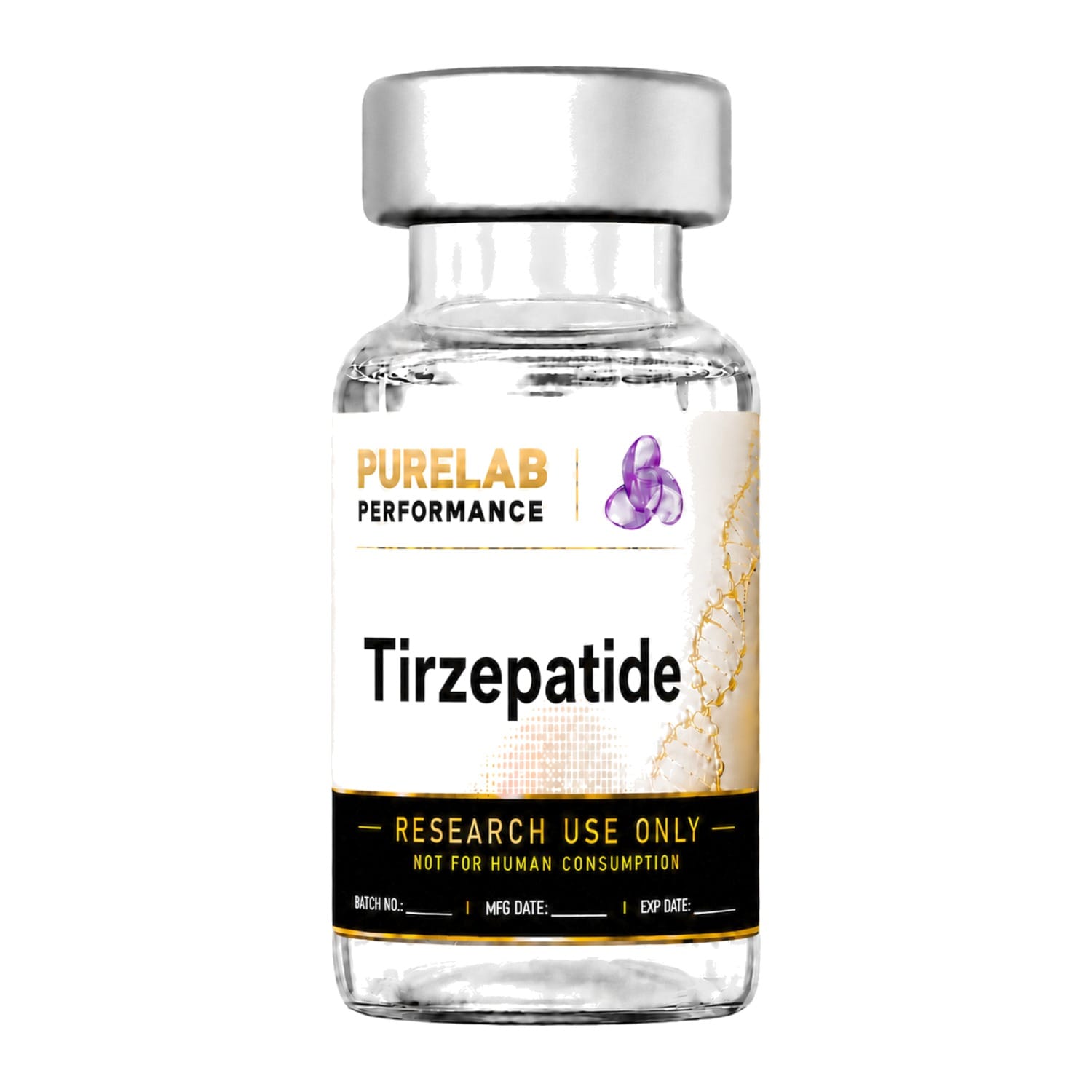
What tirzepatide is
Tirzepatide is a synthetic 39-residue peptide that acts as an agonist at two incretin receptors at once — the glucose-dependent insulinotropic polypeptide (GIP) receptor and the glucagon-like peptide-1 (GLP-1) receptor[1]. It was developed by Eli Lilly and Company[1].
Unlike most compounds in this catalogue, tirzepatide is an approved drug substance. That changes what this page has to do: the regulatory record belongs to a regulated medicine, and none of it transfers to material bought as a research chemical.
Structure and identity
Molecular formula, molecular weight, CAS registry number and the structure above were retrieved directly from the PubChem PUG-REST API, not transcribed from a secondary source[9]. The Aib substitutions confer resistance to dipeptidyl peptidase-4 cleavage; the fatty diacid chain drives albumin binding and extends the molecule’s half-life.
Every batch we supply is assayed by an independent laboratory using HPLC-UV-MS. The mass spectrum is compared against an authentic reference standard to confirm molecular identity; the peptide’s peak area is measured against the total chromatogram area to establish chromatographic purity; and total peptide mass in the vial is measured against the stated label claim.
The current testing reference is published. See certificate q8txw6p for supplier batch 0411 and the original laboratory sample results linked above.
An approved drug substance, sold for research use
Tirzepatide is an FDA-approved drug substance. What PureLab supplies is not that product. It is bulk research material, sold under research-use-only terms, with no NDA, no pharmacy chain of custody, no prescribing information, and no clinician in the loop. Published clinical data describe the approved medicine under clinical protocols. They are not, and cannot be, a description of laboratory material, and we do not summarise them on this page.
Where the evidence stands
This is the section most vendors skip. It is the most important one on the page.
Dual receptor binding and signalling at GIP-R and GLP-1REstablished
Rodent carcinogenicity studies, including thyroid C-cell tumour findings in ratsEstablished
Exists for the approved medicine; not a description of laboratory research material and not summarised on this pageNot summarised
Approved as a prescription drug substance. The material on this page is not that product.Yes
Mechanism at the receptor in vitro
Tirzepatide’s defining pharmacology is co-agonism: a single molecule engaging both the GIP receptor and the GLP-1 receptor[1]. Dual incretin engagement is compared against GLP-1 receptor agonism alone in receptor-pharmacology research. That is a statement about receptor pharmacology established in binding and signalling assays. On its own it says nothing about any outcome in a person.
Preclinical safety finding
Rodent thyroid C-cell tumours rodent
In rodent carcinogenicity studies, tirzepatide was associated with thyroid C-cell tumours in rats at clinically relevant exposures. Its relevance beyond rodents has not been determined, and the approved product labelling carries a boxed warning on it[8].
Limitations of the literature
The published record has one principal sponsor. The key clinical publications were funded by Eli Lilly and Company, with Lilly employees as co-authors[1]. This is normal for a registrational programme and does not make the results wrong, but it limits independent replication.
Clinical data are not data about research material. Published results were generated with pharmaceutical-grade drug product under clinical protocols, which does not describe a research vial.
Regulatory and anti-doping status
Tirzepatide is an FDA-approved drug substance. The material sold on this page is supplied as a research chemical and is not an approved drug product; it has not been reviewed, released, or labelled as a medicine, and no part of the branded product’s approval extends to it[8]. An approved drug sold research-use-only is a different animal from an unapproved one, and it is worth being precise about which animal you are looking at: the molecule has a regulatory dossier; the vial does not.
WADA status appears as a neutral data line in the specification block above — Not listed — in the same register as the CAS number. Anti-doping lists change annually and by governing body. If you compete under any tested organisation, the only reliable source is that organisation’s current prohibited list — not this page, and not any vendor’s.
What we don’t know
- Whether the rat thyroid C-cell tumour finding has any relevance beyond rodents. It has not been determined[8].
- Anything about the stability, content, or behaviour of research-grade material outside a validated pharmaceutical supply chain.
We supply this compound for laboratory research. It is not a dataset about the vial we are selling you.
Tirzepatide supplied by PureLab Performance is furnished strictly for in-vitro laboratory research. It is not a medicine or a drug and has not been approved by the FDA to prevent, treat, or cure any medical condition, ailment, or disease. Purchasers must be 18 or older and qualified to handle research chemicals.
References
Retrieved from PubMed. DOIs link to the original publications. Chemical identity retrieved from PubChem.
- Rosenstock J, Wysham C, Frías JP, et al. “Efficacy and safety of a novel dual GIP and GLP-1 receptor agonist tirzepatide (SURPASS-1).” Lancet. 2021;398(10295):143–155. DOI
- U.S. Food and Drug Administration. Approved prescribing information for tirzepatide, including the boxed warning for thyroid C-cell tumours observed in rodents and the medullary thyroid carcinoma / MEN 2 contraindication. Drugs@FDA. Regulatory document; no DOI assigned.
- National Center for Biotechnology Information. PubChem Compound Summary for CID 166567236, Tirzepatide. PubChem. Database record; no DOI assigned.
Reviews
There are no reviews yet.