
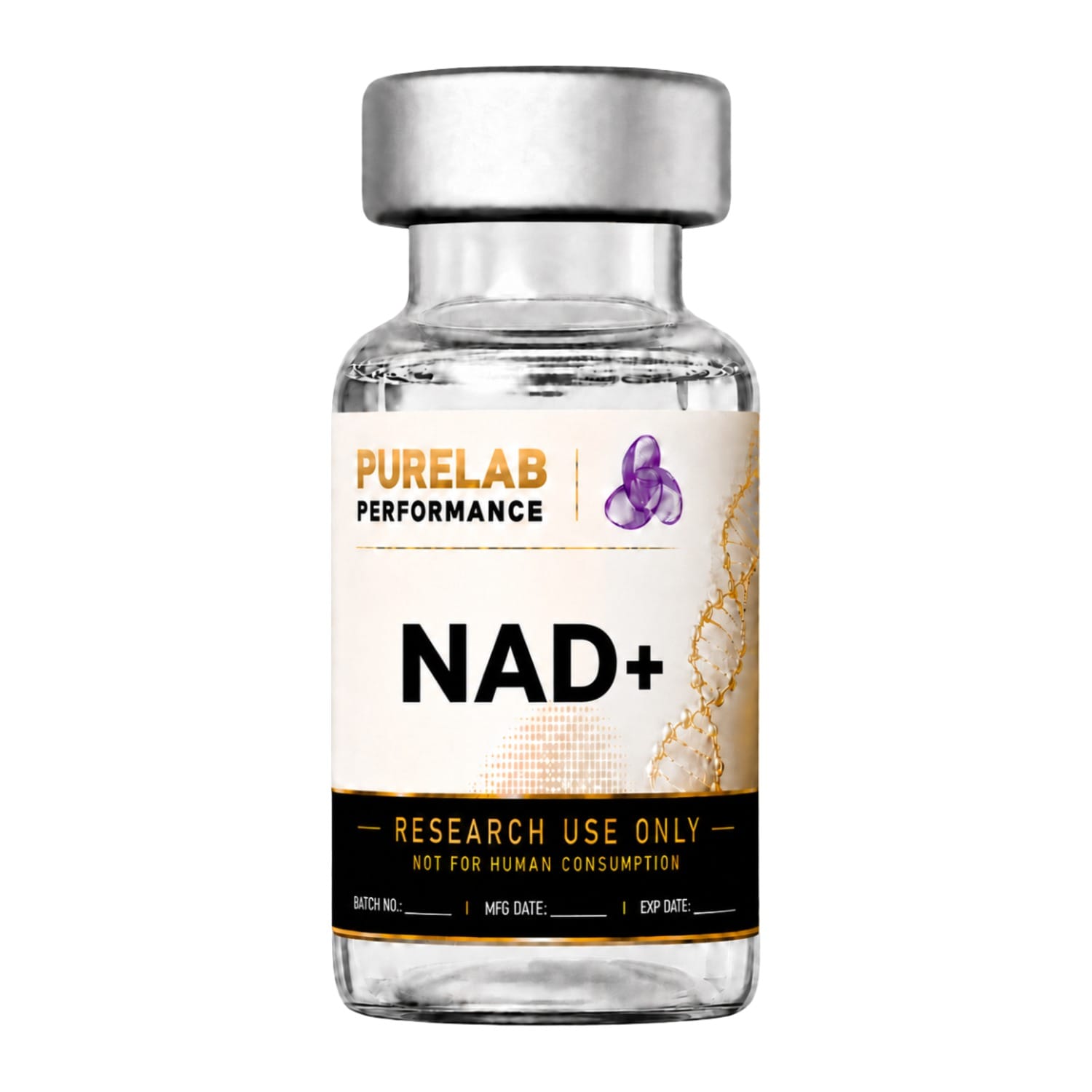
What NAD+ is
NAD+ is not a research peptide, a designer molecule, or a novel chemical entity. It is one of the most thoroughly characterised coenzymes in biochemistry — the cell’s principal hydrogen carrier for redox enzymes, present in every living cell, and the substrate for a family of NAD-consuming enzymes including the sirtuins, PARPs and CD38[1].
Nothing on this page disputes the biochemistry. The biochemistry is not in question and never has been. What is in question is a much narrower and much more commercially loaded claim: that administering NAD+ or its precursors to a human produces a measurable benefit. This page is organised around that distinction.
Structure and identity
Identity fields above are drawn from PubChem and are independently checkable at the link. Unusually for this catalogue, NAD+ is a well-established reference chemical with an INN (nadide) and a long analytical history — identity confirmation is not the hard part here.
For the current lot, the certificate of analysis is pending. We will publish it in full when it is issued. Until then we print no purity number.
Where the evidence stands
This is the section most vendors skip. It is the most important one on the page.
Redox role, sirtuin/PARP/CD38 substrate biology. Textbook-grade.Definitive
Extensive; NAD+ repletion reported to affect many endpoints in aged or diseased rodentsExtensive
Randomised, placebo-controlled, repeatedly demonstratedEstablished
Small trials, mixed results, several outright null on their objective endpointsUnproven
Almost the entire human literature uses NR or NMN, not NAD+Minimal
Not an approved drug. Precursors are marketed as supplements.None
The underlying biology established
NAD+ operates in two distinct capacities. In its classical role it cycles between oxidised (NAD+) and reduced (NADH) states, carrying electrons through central metabolism. More recently it has been recognised as a signalling substrate: sirtuins, PARPs and CD38 consume NAD+, cleaving it as part of their catalytic cycles[1].
The second role is what generated the field. If NAD+-consuming enzymes govern processes relevant to ageing, and if NAD+ concentrations fall with age, then restoring NAD+ becomes an intervention hypothesis. A 2018 review in Cell Metabolism lays out the in-vivo evidence for that hypothesis and the search for safe NAD+-boosting molecules that followed[1].
Note the structure of that argument. It is a chain of inferences, each plausible, ending in a clinical claim that has to be tested separately. It has been tested. The results are below.
Precursors versus NAD+ itself
Essentially every controlled human trial in this field administers a precursor — nicotinamide riboside (NR) or nicotinamide mononucleotide (NMN) — not NAD+ itself. NAD+ is a large, charged dinucleotide with poor oral bioavailability; the precursor strategy exists precisely because giving NAD+ directly is pharmacokinetically awkward. When you read “the NAD+ trials”, you are almost always reading NR trials.
This means the human evidence discussed below is evidence about NR and NMN, and its applicability to administered NAD+ is an assumption, not a finding.
Can you raise NAD+? Yes. human
This half of the thesis is genuinely established, and we should say so plainly.
Martens et al. (2018), in Nature Communications, ran a 2 × 6-week randomised, double-blind, placebo-controlled crossover trial of NR in healthy middle-aged and older adults. NR was well tolerated and effectively stimulated NAD+ metabolism[2]. Elhassan et al. (2019), in Cell Reports, gave 1 g/day NR to twelve aged men for 21 days in a placebo-controlled crossover design and showed by targeted metabolomics that NR elevated the skeletal muscle NAD+ metabolome[3].
So: the pharmacology works. The molecule gets in, and the metabolite pool moves. That is a real result and it is not disputed.
Does raising it do anything? Unclear. human
Here the picture changes sharply, and the honest summary is that the field has struggled to convert a biochemical effect into a functional one.
Martens 2018. The trial’s own framing of its functional findings is conspicuously cautious. It reports that the results “suggest that, in particular, future clinical trials should further assess the potential benefits of NR for reducing blood pressure and arterial stiffness in this group”[2]. That is the language of a hypothesis for the next study, not a demonstrated outcome in this one. A trial that had found a robust functional effect would not phrase it that way.
Elhassan 2019. This is the one to read closely. NR raised the muscle NAD+ metabolome — and then did not alter mitochondrial bioenergetics[3]. Muscle RNA sequencing showed NR-mediated downregulation of energy metabolism and mitochondrial pathways. The paper did identify a decrease in circulating inflammatory cytokines. But the central mechanistic prediction of the whole NAD+-for-ageing hypothesis — raise NAD+, improve mitochondrial function — was tested directly in human muscle and was not observed.
The negative and null results
Elhassan et al. supplemented aged human skeletal muscle with NR, confirmed by metabolomics that the NAD+ metabolome had risen, and found no change in mitochondrial bioenergetics — the exact endpoint the theory predicts[3]. The transcriptomic signature ran opposite to prediction, with downregulation of mitochondrial and energy-metabolism pathways.
This is not a fringe or hostile study. It is a well-conducted placebo-controlled crossover trial by researchers working within the field, including Charles Brenner — one of NR’s discoverers. When a field’s own proponents run the decisive experiment and it comes back null, that is the most informative result available.
Where positive human signals do exist, they are narrow and in specific populations. Shoji et al. (2025), in Aging Cell, ran a randomised crossover trial of NR in Werner syndrome — a rare hereditary progeroid disorder in which NAD+ depletion has been specifically documented. NR was safe, and arterial stiffness (CAVI) improved[4]. That is a genuine finding. It is also a finding in a rare monogenic disease characterised by a specific NAD+ deficit, and it tells you very little about a healthy person.
Similarly, a phase-II trial in Alzheimer’s disease reported cognitive changes — but the intervention was a four-component combined metabolic activator (L-serine, NR, N-acetyl-L-cysteine and L-carnitine tartrate), in which NR was 5% of the formulation by mass[5]. Attributing that trial’s result to NAD+ repletion is not something the study design permits.
A different regulatory posture
NAD+ sits in a different regulatory position from the rest of this catalogue, and we want to be precise about it rather than exploit it.
NAD+ precursors — NR and NMN — are widely sold as dietary supplements. NAD+ itself is administered in some clinics by intravenous infusion. Neither of these facts constitutes FDA approval, and neither constitutes evidence of efficacy. “Sold in shops” and “shown to work” are different propositions, and the supplement-adjacent status of this category has done a great deal of work in blurring them.
The material we supply is a research chemical, sold for laboratory research. It is not a supplement, we do not market it as one, and we make no structure/function claim about it of any kind.
Limitations of the literature
The human trials are small. Twelve men. Werner syndrome cohorts. Crossover designs with modest n. These are pilot-scale studies, and pilot-scale studies are not powered to detect the modest effects that would be plausible here.
Surrogate endpoints dominate. Most trials measure NAD+ metabolite concentrations, transcriptomic signatures, or vascular-stiffness indices. Almost none measure things a person would actually notice.
Animal-to-human translation has been poor. The rodent literature on NAD+ repletion is broad and enthusiastic. The human literature is narrow and equivocal. That divergence is the defining feature of this field and it is rarely acknowledged in the marketing.
The trials are of precursors, not of NAD+. See §5. This is a substitution the category makes constantly and silently.
Regulatory and anti-doping status
NAD+ is not listed on the WADA 2025 Prohibited List, and neither are nicotinamide riboside or nicotinamide mononucleotide. As an endogenous coenzyme it does not fall under S0 (Non-Approved Substances) in the way a novel synthetic peptide would.
One point of genuine relevance to tested athletes, stated neutrally: WADA prohibits intravenous infusions and/or injections of more than 100 mL per 12-hour period under M2.2 (Chemical and Physical Manipulation), except for those legitimately received in the course of hospital treatments, surgical procedures or clinical diagnostic investigations. NAD+ is commonly administered clinically by IV drip in volumes that would exceed that threshold. The substance is not prohibited; the method, at that volume, is.
Anti-doping lists change annually and by governing body. If you compete under any tested organisation, the only reliable source is that organisation’s current prohibited list — not this page, and not any vendor’s.
NAD+ has not been approved by the FDA as a drug for any indication.
What we don’t know
- Whether raising NAD+ produces any functional benefit in a healthy human. The most direct test of the core mechanism came back null[3].
- Whether administered NAD+ behaves like an administered precursor. Almost no human data exist on NAD+ itself.
- The bioavailability of NAD+ by any route outside intravenous administration.
- Whether the rodent lifespan and healthspan results translate. So far, they have not.
- Long-term safety of sustained NAD+ elevation in humans, including any consequence for NAD+-consuming enzyme activity.
We supply this compound for laboratory research. The biochemistry is bedrock. The clinical thesis built on top of it is, as of now, unproven.
NAD+ supplied by PureLab Performance is furnished strictly for in-vitro laboratory research. It is not a medicine or a drug and has not been approved by the FDA to prevent, treat, or cure any medical condition, ailment, or disease. Bodily introduction of any kind into humans or animals is strictly forbidden by law. Per-kilogram dosing in animal models does not scale to humans. Purchasers must be 18 or older and qualified to handle research chemicals.
References
Retrieved from PubMed. DOIs link to the original publications. Chemical identity data retrieved from PubChem.
- Rajman L, Chwalek K, Sinclair DA. “Therapeutic Potential of NAD-Boosting Molecules: The In Vivo Evidence.” Cell Metab. 2018;27(3):529–547. DOI
- Martens CR, Denman BA, Mazzo MR, et al. “Chronic nicotinamide riboside supplementation is well-tolerated and elevates NAD+ in healthy middle-aged and older adults.” Nat Commun. 2018;9(1):1286. DOI
- Elhassan YS, Kluckova K, Fletcher RS, et al. “Nicotinamide Riboside Augments the Aged Human Skeletal Muscle NAD+ Metabolome and Induces Transcriptomic and Anti-inflammatory Signatures.” Cell Rep. 2019;28(7):1717–1728.e6. DOI
- Shoji M, Kato H, Koshizaka M, et al. “Nicotinamide Riboside Supplementation Benefits in Patients With Werner Syndrome: A Double-Blind Randomized Crossover Placebo-Controlled Trial.” Aging Cell. 2025;24(8):e70093. DOI
- Yulug B, Altay O, Li X, et al. “Combined metabolic activators improve cognitive functions in Alzheimer’s disease patients: a randomised, double-blinded, placebo-controlled phase-II trial.” Transl Neurodegener. 2023;12(1):4. DOI
- National Center for Biotechnology Information. “PubChem Compound Summary for CID 5892, NAD (nadide).” PubChem
- World Anti-Doping Agency. “The 2025 Prohibited List — International Standard.” Section M2.2, Chemical and Physical Manipulation. WADA
Reviews
There are no reviews yet.