
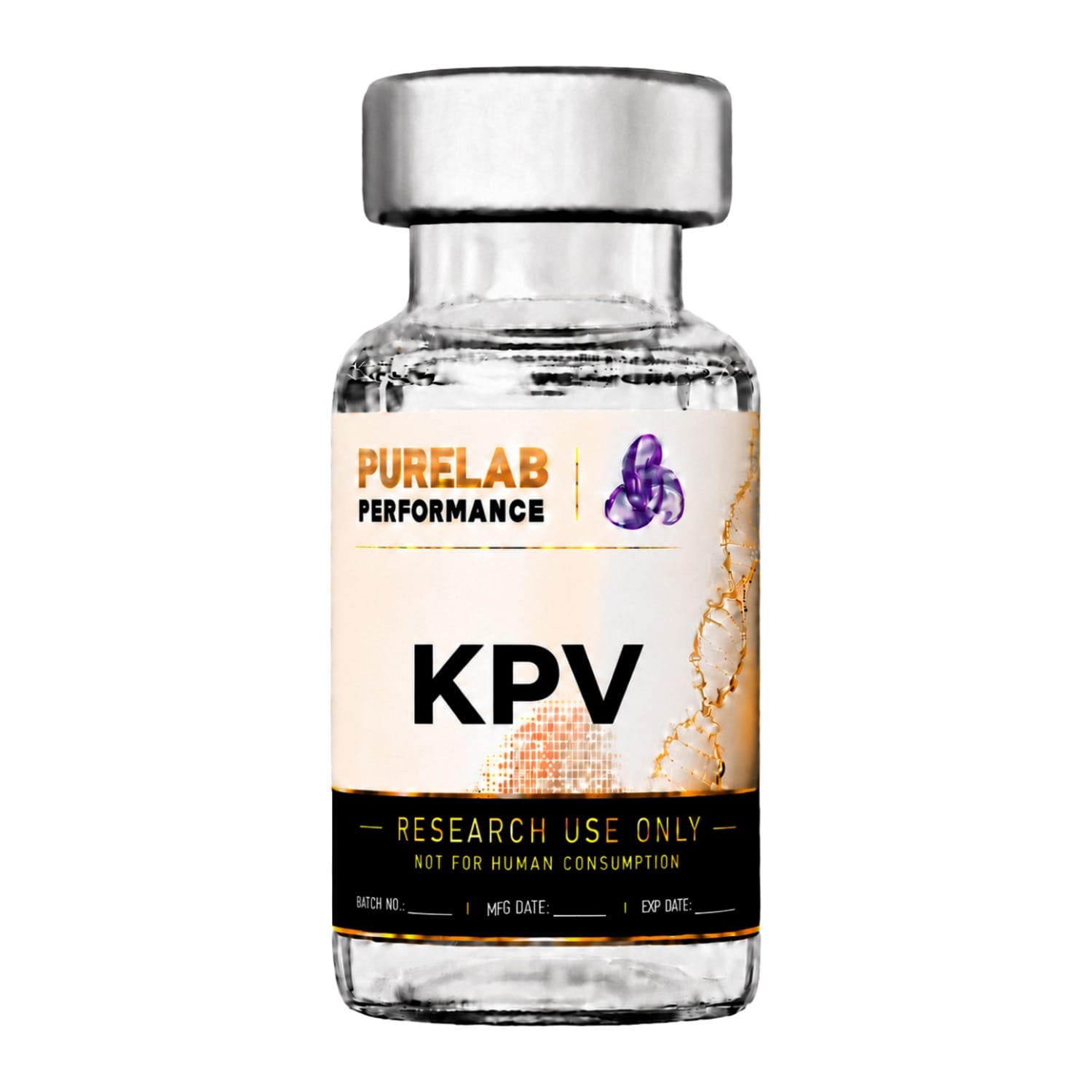
What KPV is
KPV is a tripeptide: lysine-proline-valine. It corresponds to residues 11 to 13 of alpha-melanocyte-stimulating hormone (α-MSH) — the C-terminal end of that hormone, isolated from the rest of it[1]. PubChem lists it under the synonyms α-MSH(11-13) and ACTH-(11-13), which reflects the same three residues appearing in both parent sequences.
It is the smallest compound in this catalogue, and it has among the cleanest stories: a well-characterised transport mechanism, a plausible molecular target, consistent results in two independent murine colitis models — and, so far, not a single human trial.
Structure and identity
A caution on identity, because this one is a genuine trap: searching “KPV” in a chemical database will return unrelated compounds that happen to share the abbreviation. The compound you want is CAS 67727-97-3, L-lysyl-L-prolyl-L-valine, C16H30N4O4. Anything with a different formula is not this molecule. Our COA confirms the mass and the sequence.
Every batch is assayed by an independent laboratory using HPLC-UV-MS. Measured purity for the current lot is Certificate pending. We publish the certificate in full when the analysis returns.
Where the evidence stands
Short version: this is a preclinical compound. That is not a euphemism.
NF-κB and MAP kinase inhibition in human intestinal epithelial and T-cell lines; PepT1 transport kineticsGood
DSS-induced and TNBS-induced colitis; nanoparticle-delivered oral formulationsModerate
No published trials of any kind — not randomised, not pilot, not case seriesNone
Not approved for human therapeutic use by FDA or any other regulatorNone
Mechanism at the cell in vitro
In a 2008 study in Gastroenterology, human intestinal epithelial cell lines (Caco2-BBE, HT29-Cl.19A) and a human T-cell line (Jurkat) were stimulated with pro-inflammatory cytokines in the presence or absence of KPV. At nanomolar concentrations, KPV inhibited activation of the NF-κB and MAP kinase inflammatory signalling pathways and reduced pro-inflammatory cytokine secretion, as measured by NF-κB luciferase reporter, Western blot, real-time RT-PCR and ELISA[1].
Nanomolar potency in a cell line is a genuinely notable result for a three-residue peptide. It is also a result in a cell line.
PepT1 and why route matters in vitro
The same study established how KPV gets into cells. PepT1 is a di- and tripeptide transporter, normally expressed in the small intestine and induced in the colon during inflammatory bowel disease. Using cold KPV as a competitor for a radiolabelled PepT1 substrate, and separately using tritiated KPV to determine uptake kinetics, the authors showed that KPV is transported into cells by PepT1, and that this transporter is the route by which it reaches its intracellular targets in both epithelial and immune cells[1].
This is mechanistically satisfying and it has a consequence people tend to skip past. The mechanism is predicated on a gut transporter. A model in which KPV works by being carried across intestinal epithelium by PepT1 is a model with a great deal to say about oral delivery to the gut, and rather little to say about any other route. Vendors who market this compound for systemic, non-intestinal purposes are extrapolating well beyond the mechanism they cite as support.
Murine colitis models murine
KPV was added to the drinking water of mice in two chemically distinct, well-established models of colitis: DSS-induced and TNBS-induced. In both murine models, oral administration of KPV was associated with a reduced incidence of colitis, accompanied by decreased expression of pro-inflammatory cytokine mRNA, assessed histologically[1].
The use of two mechanistically different colitis models is a real strength — DSS and TNBS injure the colon by different routes, and a compound that shows an effect in both is less likely to be exploiting a quirk of one model. This is better preclinical design than most compounds in this category can claim.
The delivery problem murine
A 2017 study in Molecular Therapy illustrates the practical obstacle. The authors loaded KPV into hyaluronic-acid-functionalised polymeric nanoparticles (~272 nm), then encapsulated those nanoparticles in a chitosan/alginate hydrogel, specifically so that the payload would survive transit and be released in the colonic lumen. In a mouse model of ulcerative colitis, this hydrogel system was associated with a greater reduction in mucosal damage and TNF-α downregulation than a nanoparticle system without the hydrogel[2].
Read that as an engineering result, because that is what it is. Considerable formulation work was required to get a plain tripeptide to the tissue where it acts. That effort is itself evidence that naive administration of the raw peptide is not a solved problem — a point worth holding on to when a vendor sells you a vial of lyophilised powder and implies the hard part is over.
The human data — all of it human
There is none.
We searched for and could not find a single published human clinical study of KPV — no randomised trial, no pilot, no open-label series, no published pharmacokinetic study. The human-derived evidence that exists is entirely from immortalised human cell lines studied in a dish[1], which is not the same thing and should never be presented as though it were.
Consequently: human safety is uncharacterised. Human dosing is unestablished. Human bioavailability by any route is unmeasured. Anyone quoting a human protocol for this compound invented it.
Limitations of the literature
The literature is small. Unlike some compounds in this catalogue, KPV does not have a large body of work that merely lacks human trials — it has a modest body of work that lacks human trials. Fewer independent groups have worked on it.
The mechanism is gut-specific. PepT1-mediated uptake is the mechanistic core of this compound’s story. Claims that reach beyond the intestine are not supported by the mechanism that the same claims cite.
Preclinical breadth is not clinical depth. Two colitis models in mice are two mouse results. They are not the beginning of a human evidence base; they are a reason someone might, one day, choose to build one.
Regulatory and anti-doping status
KPV is not listed by name on the World Anti-Doping Agency Prohibited List. Section S0, Non-Approved Substances, however, prohibits at all times “any pharmacological substance which is not addressed by any of the subsequent sections of the List and with no current approval by any governmental regulatory health authority for human therapeutic use”[3]. KPV has no such approval, and substances captured by S0 are Specified Substances. “Not listed by name” is not the same as “permitted.” Athletes competing under any tested organisation should consult that organisation’s current list, not this page.
KPV has not been approved for human therapeutic use by the FDA or any other governmental regulatory health authority.
What we don’t know
- Whether KPV does anything at all in a human being. No trial has been run.
- Human bioavailability by any route, oral or otherwise — unmeasured.
- Whether the PepT1-dependent mechanism permits any meaningful activity outside the gastrointestinal tract.
- Human safety, at any dose, over any duration — entirely uncharacterised.
- Per-kilogram dosing in rodents does not scale to humans, and nothing on this page should be read as implying that it does.
We supply this compound for laboratory research. The PepT1 mechanism is elegant and the two-model colitis data are better designed than most. It remains a compound that has never been given to a human in a published study, and we are not going to write around that.
KPV supplied by PureLab Performance is furnished strictly for in-vitro laboratory research. It is not a medicine or a drug and has not been approved by the FDA to prevent, treat, or cure any medical condition, ailment, or disease. Bodily introduction of any kind into humans or animals is strictly forbidden by law. Per-kilogram dosing in animal models does not scale to humans. Purchasers must be 18 or older and qualified to handle research chemicals.
References
Retrieved from PubMed. DOIs link to the original publications.
- Dalmasso G, Charrier-Hisamuddin L, Nguyen HTT, Yan Y, Sitaraman S, Merlin D. “PepT1-mediated tripeptide KPV uptake reduces intestinal inflammation.” Gastroenterology. 2008;134(1):166–78. DOI
- Xiao B, Xu Z, Viennois E, Zhang Y, Zhang Z, Zhang M, Han MK, Kang Y, Merlin D. “Orally Targeted Delivery of Tripeptide KPV via Hyaluronic Acid-Functionalized Nanoparticles Efficiently Alleviates Ulcerative Colitis.” Mol Ther. 2017;25(7):1628–40. DOI
- World Anti-Doping Agency. Prohibited List — S0, Non-Approved Substances. wada-ama.org/en/prohibited-list
Reviews
There are no reviews yet.