
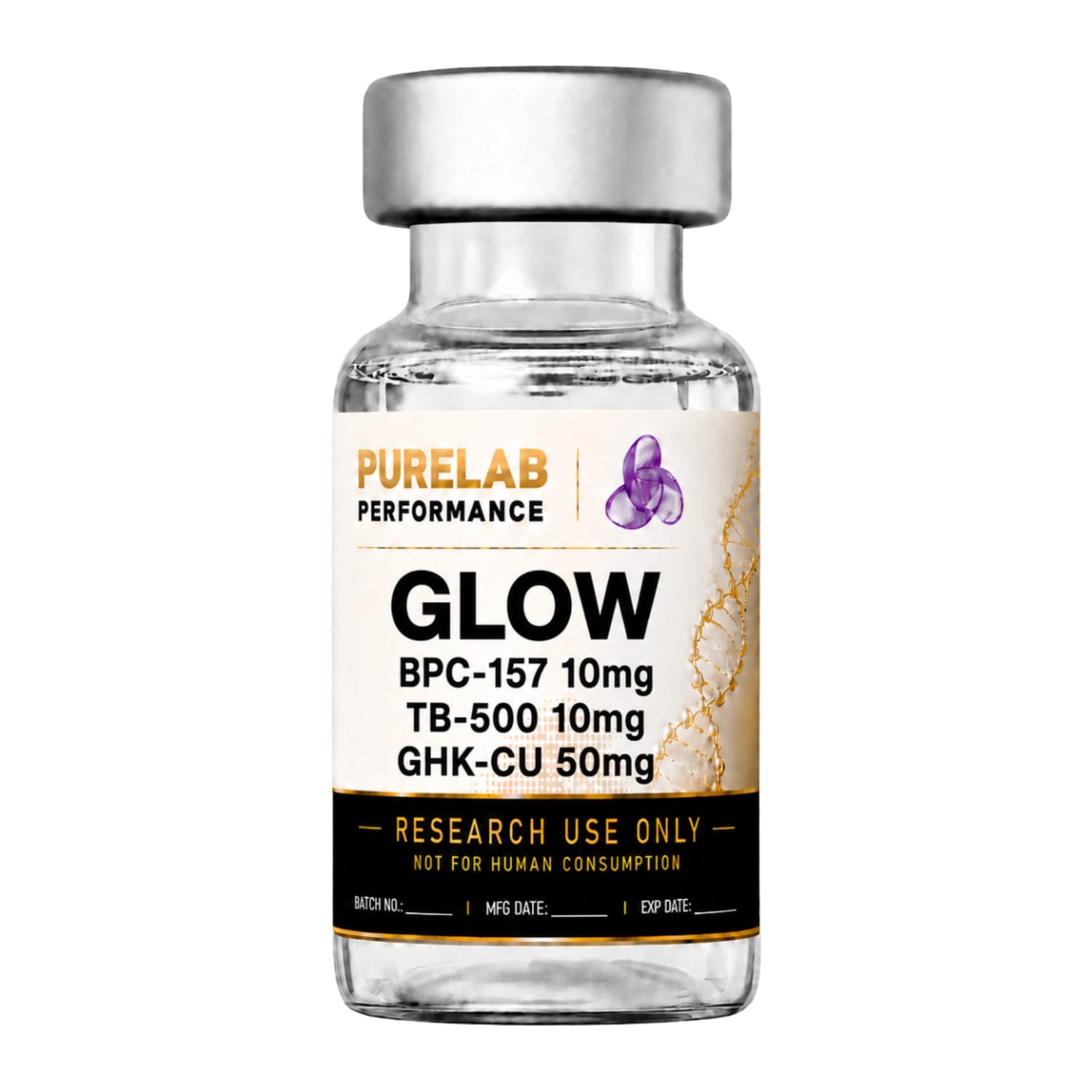
What GLOW is
GLOW is a convenience product. It is three separate peptides — BPC-157, TB-500 and GHK-Cu — co-lyophilised into a single vial at a fixed ratio of 10 mg : 10 mg : 50 mg. It is a physical mixture. Nothing in the vial is a new molecule, no chemistry has occurred between the components, and the blend is not a compound in its own right.
That is the entire technical description. Everything else on this page is about what is, and is not, known about the three things in it.
No study has ever tested this combination
No study has ever tested this combination. Not in humans. Not in animals. Not in cell culture. Not once.
There is no published trial, no published animal experiment, and no published in-vitro experiment in which BPC-157, TB-500 and GHK-Cu were administered together. The evidence base for this product is per-component only. No synergy between these three peptides has been demonstrated. No additive effect has been demonstrated. No pharmacokinetic interaction between them has been characterised — nobody has measured whether co-administration changes the absorption, distribution, metabolism or elimination of any of the three.
Any claim that these three peptides “work better together” is an assertion for which no evidence exists. We are not going to make it, and you should treat anyone who does with suspicion.
The word “blend” implies that someone worked out a ratio. Nobody did. The ratio in this vial reflects the doses at which the three components are conventionally sold as singles, not the output of any experiment.
Component specifications
Because a blend is a mixture and not a compound, the blend itself has no CAS number, no molecular formula, no molecular weight and no PubChem CID. Those identifiers describe single chemical substances. Printing one for a three-component mixture would be a fabrication. We print N/A above and give the real identifiers for each component below. Every value is drawn from PubChem.
| Sequence | GEPPPGKPADDAGLV |
| CAS | 137525-51-0 |
| Formula | C62H98N16O22 |
| M.W. | 1419.5 g/mol |
| PubChem CID | 9941957 |
| WADA status | Prohibited — S0, named |
| Specified? | Specified Substance |
| Chromatographic purity | Certificate pending |
| Sequence | Ac-LKKTETQ |
| CAS | 885340-08-9 |
| Formula | C38H68N10O14 |
| M.W. | 889.0 g/mol |
| PubChem CID | 62707662 |
| WADA status | Prohibited — S2.3, named |
| Specified? | non-Specified Substance |
| Chromatographic purity | Certificate pending |
| Sequence | Gly-His-Lys · Cu(II) |
| CAS | 89030-95-5 |
| Formula | C14H23CuN6O4+ |
| M.W. | 402.92 g/mol |
| PubChem CID | 71587328 |
| WADA status | Not listed by name — S0 applies |
| Specified? | Specified Substance (S0) |
| Chromatographic purity | Certificate pending |
The WADA lines above are data, not advice. They are reproduced from the 2026 Prohibited List[12]. See the anti-doping section for what they mean.
Where the evidence stands
Per component. There is no other way to state it, because there is no combination evidence to state.
Human, animal, in vitro — all tiers, all speciesNo studies
Extensive rodent and cell-culture work; three human pilot studies in total; a 2025 review calls it investigationalInvestigational
Zero human studies of the heptapeptide. Consistent oncology signal for the parent protein Tβ4No human data
One randomised evaluator-blinded human trial. The copper tripeptide arm did not beat inert vehicleNegative RCT
Component 1 — BPC-157 rodent
BPC-157 is a synthetic pentadecapeptide corresponding to a partial sequence of a protein isolated from human gastric juice[1]. It has the largest preclinical literature of anything in this vial: transected rat Achilles tendon models[1], fibroblast migration and FAK–paxillin phosphorylation in cell culture[2], and a broad soft-tissue literature that a 2019 review found consistently positive across injury types while noting that the majority of the work is in small rodent models and that efficacy in humans is yet to be confirmed[3].
The key negative finding
A 2025 narrative review in Current Reviews in Musculoskeletal Medicine assessed the musculoskeletal literature and found that human data are extremely limited — three pilot studies in total, covering intraarticular knee pain, interstitial cystitis, and an intravenous safety and pharmacokinetics assessment. The authors state that until well-designed clinical trials are conducted, BPC-157 should be considered investigational[4]. There is no large randomised controlled trial. There is no FDA approval. A related structural problem: a large fraction of the positive findings originate from a single research group, so the evidence base has had far less independent replication than its volume suggests[3].
Component 2 — TB-500 in vitro rodent
The vial contains Ac-LKKTETQ, a seven-residue fragment — not the 43-amino-acid thymosin β4 that the literature studied. Analytical chemists who characterised commercial TB-500 preparations by high-resolution mass spectrometry identified the active ingredient as the N-acetylated 17–23 fragment of Tβ4[5]. Nearly everything cited in support of “TB-500” was done with the full-length 43-residue protein: a different molecule, a different mass, a different pharmacokinetic profile.
There are zero human studies of TB-500. Not a randomised trial, not a pilot, not a case series. The only human-relevant analytical work is a doping-control method-development paper[5] — a paper about detecting the compound in people who have used it, not about whether it does anything.
The key negative finding — the oncology signal
Thymosin β4 overexpression in SW480 human colon carcinoma cells markedly increased invasiveness, with increased levels and enzymatic activity of matrix metalloproteinase-7 (MMP-7); in matched patient samples, Tβ4, β-catenin, c-Myc and MMP-7 were all higher in metastatic liver lesions than in the primary colorectal tumours they came from[6]. Overexpression also triggered epithelial-mesenchymal transition — E-cadherin loss, cytosolic β-catenin accumulation — via integrin-linked kinase[7]. The converse experiment points the same way: disrupting Tβ4 expression with TALEN gene editing in B16F10 murine melanoma cells significantly decreased lung metastasis in a murine model[8].
These are studies of endogenous Tβ4 inside tumour cells, not of exogenous TB-500 in a healthy organism, and we are not going to overstate the difference away. But the mechanism implicated is the same mechanism by which this peptide family is claimed to promote repair. Nobody has run the experiment that would settle it.
TB-500 is prohibited by WADA by name, at all times, under S2.3[12].
Component 3 — GHK-Cu human
GHK-Cu is the copper(II) complex of the tripeptide glycyl-L-histidyl-L-lysine, known in cosmetic nomenclature as copper tripeptide-1[9]. It is the only component in this vial that has been through a randomised controlled trial in humans. That trial is the most informative fact on this page, and it is not the result the marketing literature would lead you to expect.
The key negative finding — the 1992 RCT
In 1992, a group at the University of Texas Medical Branch published a prospective, randomised, evaluator-blinded trial in the Journal of Vascular Surgery (Bishop et al., 16(2):251–57). Patients with chronic venous stasis ulcers were randomised between silver sulfadiazine 1% cream, a biologically active tripeptide copper complex 0.4% cream, and an inert vehicle placebo. Eighty-six evaluable patients completed it. In the authors’ own words, silver sulfadiazine “proved to statistically reduce the ulcer size compared with a biologically active tripeptide copper complex 0.4% cream formulation or the placebo. There was no difference between the latter two treatments.“[10]
The copper tripeptide arm did not separate from inert vehicle, and was outperformed by a cheap, decades-old antimicrobial cream. This is the highest-quality human evidence that exists for this compound, and it is negative.
And a conflict of interest you should know about
Much of the enthusiastic secondary literature on GHK — the reviews describing it as capable of regulating thousands of human genes — is authored from Skin Biology, Research & Development Department, Bellevue, WA[11]. Skin Biology is a commercial company that sells copper-peptide products. The affiliation is printed in the papers themselves. This is not an accusation of fraud; the disclosure was made openly. But a reader who does not know it will systematically overweight that literature.
The fixed-ratio problem
This is a real methodological limitation, not a disclaimer, and it applies to every fixed-ratio blend on the market.
- You cannot attribute an effect to a component. If something is observed in a preparation containing three peptides, the observation cannot be assigned to any one of them. It could be the BPC-157, the TB-500, the GHK-Cu, an interaction, or the vehicle. A blend destroys attribution by construction.
- You cannot vary the doses independently. The ratio is fixed at 10 : 10 : 50. Doubling the GHK-Cu means doubling everything else. Dose–response for any single component is unobtainable from this product.
- You cannot run a component-controlled comparison. Without single-component arms, there is nothing to compare against.
A researcher who wants interpretable data buys the singles. A blend is a convenience format, and convenience is what it is for. We sell it, we will tell you what it is, and we will not pretend it is a scientific instrument.
Regulatory and anti-doping status
Reproduced from the WADA 2026 Prohibited List[12], effective 1 January 2026:
- BPC-157 — named explicitly in S0, Non-Approved Substances. Prohibited at all times. Specified Substance.
- TB-500 — named explicitly in S2.3, Growth Factors and Growth Factor Modulators (“Thymosin-β4 and its derivatives e.g. TB-500”). Prohibited at all times. non-Specified Substance.
- GHK-Cu — not listed by name. S0 prohibits at all times any pharmacological substance with no current approval by any governmental regulatory health authority for human therapeutic use. GHK-Cu has no such approval; cosmetic ingredient status is not therapeutic approval.
A vial containing all three therefore contains two substances named on the List and one captured by its residual clause. WADA’s List changes annually, and individual federations may differ from it. The only authoritative source is the athlete’s own federation’s current prohibited list — not this page, and not any vendor’s.
No component of GLOW has been approved for human therapeutic use by the FDA or by any other governmental regulatory health authority.
What we don’t know
- Whether these three peptides interact at all. Nobody has looked.
- Whether co-administration alters the pharmacokinetics of any one of them. Uncharacterised.
- Whether the ratio in this vial is a good ratio, a bad ratio, or a meaningless one. No experiment has compared it to any other.
- Whether the oncology signal associated with full-length Tβ4 transfers to the Ac-LKKTETQ fragment — with or without two other peptides present.
- Long-term safety of the combination in any species — entirely uncharacterised.
- Per-kilogram dosing in animal models does not scale to humans, and nothing on this page should be read as implying that it does.
We supply this blend for laboratory research. The per-component science is genuinely interesting in places. The combination has never been studied, and we are not going to write around that.
GLOW supplied by PureLab Performance is furnished strictly for in-vitro laboratory research. It is not a medicine or a drug and has not been approved by the FDA to prevent, treat, or cure any medical condition, ailment, or disease. Bodily introduction of any kind into humans or animals is strictly forbidden by law. Per-kilogram dosing in animal models does not scale to humans. Purchasers must be 18 or older and qualified to handle research chemicals.
References
Retrieved from PubMed. DOIs link to the original publications.
- Staresinic M, Sebecic B, Patrlj L, et al. “Gastric pentadecapeptide BPC 157 accelerates healing of transected rat Achilles tendon and in vitro stimulates tendocytes growth.” J Orthop Res. 2003;21(6):976–83. DOI
- Chang CH, Tsai WC, Lin MS, Hsu YH, Pang JHS. “The promoting effect of pentadecapeptide BPC 157 on tendon healing involves tendon outgrowth, cell survival, and cell migration.” J Appl Physiol. 2011;110(3):774–80. DOI
- Gwyer D, Wragg NM, Wilson SL. “Gastric pentadecapeptide body protection compound BPC 157 and its role in accelerating musculoskeletal soft tissue healing.” Cell Tissue Res. 2019;377(2):153–59. DOI
- McGuire FP, Martinez R, Lenz A, Skinner L, Cushman DM. “Regeneration or Risk? A Narrative Review of BPC-157 for Musculoskeletal Healing.” Curr Rev Musculoskelet Med. 2025;18(12):611–19. DOI
- Esposito S, Deventer K, Goeman J, Van der Eycken J, Van Eenoo P. “Synthesis and characterization of the N-terminal acetylated 17-23 fragment of thymosin beta 4 identified in TB-500, a product suspected to possess doping potential.” Drug Test Anal. 2012;4(9):733–38. DOI
- Wang WS, Chen PM, Hsiao HL, Wang HS, Liang WY, Su Y. “Overexpression of the thymosin beta-4 gene is associated with increased invasion of SW480 colon carcinoma cells and the distant metastasis of human colorectal carcinoma.” Oncogene. 2004;23(39):6666–71. DOI
- Huang HC, Hu CH, Tang MC, Wang WS, Chen PM, Su Y. “Thymosin beta4 triggers an epithelial-mesenchymal transition in colorectal carcinoma by upregulating integrin-linked kinase.” Oncogene. 2007;26(19):2781–90. DOI
- Lee JW, Ryu YK, Ji YH, Kang JH, Moon EY. “Hypoxia/reoxygenation-experienced cancer cell migration and metastasis are regulated by Rap1- and Rac1-GTPase activation via the expression of thymosin beta-4.” Oncotarget. 2015;6(12):9820–33. DOI
- PubChem. “Prezatide copper (Copper tripeptide-1, GHK-Cu).” Compound Summary, CID 71587328. National Library of Medicine. PubChem CID 71587328
- Bishop JB, Phillips LG, Mustoe TA, VanderZee AJ, Wiersema L, Roach DE, Heggers JP, Hill DP, Taylor EL, Robson MC. “A prospective randomized evaluator-blinded trial of two potential wound healing agents for the treatment of venous stasis ulcers.” J Vasc Surg. 1992;16(2):251–57. DOI
- Pickart L, Vasquez-Soltero JM, Margolina A. “GHK Peptide as a Natural Modulator of Multiple Cellular Pathways in Skin Regeneration.” Biomed Res Int. 2015;2015:648108. Authors’ stated affiliation: Skin Biology, Research & Development Department, Bellevue, WA. DOI
- World Anti-Doping Agency. Prohibited List 2026 — S0 (BPC-157, named); S2.3 (Thymosin-β4 and its derivatives e.g. TB-500). Effective 1 January 2026. wada-ama.org/en/prohibited-list
Reviews
There are no reviews yet.