Description
REF PLP-RTT-010 · SUPPLIER BATCH 0394 · COA jfwj6ve
| Class |
GIP / GLP-1 / glucagon triple agonist |
| Development code |
LY3437943 |
| CAS |
2381089-83-2 |
| Formula |
C221H342N46O68 |
| M.W. |
4731.33 g/mol |
| PubChem CID |
No record returned |
| Regulatory status |
Investigational — not approved |
| WADA status |
Prohibited at all times — S0 (Non-Approved Substances) |
| Chromatographic purity |
>99.9% |
| Measured content |
See original sample certificate |
| Identity |
Confirmed — mass spectrometry vs. authentic standard |
| Method |
HPLC-UV-MS |
| Standard |
USP/NF 621 |
| Laboratory |
Krause Analytical |
| Endotoxin |
Not detected (reporting limit: 1 EU/vial) |
| Supplier batch |
0394 |
| Report issued |
September 17, 2026 |
What retatrutide is
Retatrutide (development code LY3437943) is a single synthetic peptide with agonist activity at three receptors: the glucose-dependent insulinotropic polypeptide (GIP) receptor, the glucagon-like peptide-1 (GLP-1) receptor, and the glucagon receptor[1]. The third arm is what distinguishes it from the dual agonists. It is being developed by Eli Lilly and Company, which funded both phase 2 trials cited on this page[1][2].
Retatrutide is investigational. It is not approved by the FDA, the EMA, or any other regulator, for any indication, anywhere. Its published literature is largely sponsor-funded, and much of the most recent material exists as sponsor announcements and conference presentations rather than peer-reviewed papers. Everything below should be read against that distinction.
Structure and identity — the gap unverified
NO PUBLIC STRUCTURE DEPICTION AVAILABLE
PubChem returns no compound record for “retatrutide” or “LY3437943”
Retatrutide · No PubChem record · Formula, M.W. and CAS not in any public database · Queried:
PubChem PUG-REST
PubChem returns no record for this compound. The formula and mass we list come from supplier documentation, not a public chemical database, and we label them that way rather than pretending otherwise
We queried the PubChem PUG-REST API by compound name (“retatrutide”), by development code (“LY3437943”), by word-match, and against the substance database. Every query returned no record. There is therefore no PubChem-verifiable molecular formula, molecular weight, CAS registry number, or canonical structure depiction for retatrutide. The CAS number, formula and molecular weight printed in the specification block above come from our manufacturer’s documentation. We publish them labelled as supplier-supplied rather than presenting them as independently confirmed, and they stay labelled that way until a public record exists.Any vendor showing you a confident CAS number and molecular formula for retatrutide is showing you something they did not get from PubChem. That does not automatically make it wrong. It does mean you cannot check it, and neither can they.
What is established, from the peer-reviewed literature rather than from a chemical database, is the pharmacology: a single peptide with agonist activity at the GIP, GLP-1 and glucagon receptors[1][2].
Every batch we supply is assayed by an independent laboratory using HPLC-UV-MS: mass spectrum against an authentic reference standard for identity, peak area against total chromatogram area for chromatographic purity, and total peptide mass against the stated label claim. The current testing reference is certificate jfwj6ve for supplier batch 0394. Earlier sample results remain available in the testing history.
Where the evidence stands
This is the section most vendors skip. It is the most important one on the page.
Retatrutide — evidence by tier
Verified chemical identity
Identity confirmed in certificate jfwj6ve for supplier batch 0394. No PubChem compound record exists, so CAS, formula and MW remain supplier-supplied and are not independently verifiable.Lot-level only
In vitro / cell culture
Triple receptor agonism at GIP-R, GLP-1R and glucagon receptorEstablished
Animal models
Preclinical package not published in the peer-reviewed literature cited hereNot public
Published clinical literature
Exists, is sponsor-funded, and is not a description of laboratory research material; it is not summarised on this pageNot summarised
Regulatory approval
Not approved by FDA or any other regulator, for any indicationNone
Mechanism at the receptor in vitro
Retatrutide’s distinguishing feature is the glucagon receptor arm added on top of GIP and GLP-1 agonism[1]. Glucagon receptor agonism is a distinct mechanism from GIP and GLP-1 receptor agonism and is a subject of ongoing receptor-pharmacology research. This is receptor pharmacology characterised in assay systems. It is not a statement about anything happening in a person.
Limitations of the literature
The peer-reviewed evidence base is thin and sponsor-funded. The key published papers come from a single development programme funded by Eli Lilly and Company, with Lilly employees as co-authors[1][2][3]. Independent replication is limited.
The chemical identity gap is not cosmetic. A compound with no public chemical database record is a compound whose identity you cannot independently verify against anything. For a molecule this new, that is not surprising. It is still a real limitation.
Regulatory and anti-doping status
Retatrutide has not been approved by the FDA, the EMA, or any other regulatory authority, for any indication, in any jurisdiction. It is an investigational compound[4].
Because no regulator anywhere has approved it, it falls under WADA category S0, Non-Approved Substances — prohibited at all times, in and out of competition. That is not a technicality, and it is not conditional on retatrutide appearing by name on any list. Anti-doping lists change annually and by governing body, and investigational compounds can be captured by catch-all provisions covering substances with no current regulatory approval. If you compete under any tested organisation, the only reliable source is that organisation’s current prohibited list — not this page, and not any vendor’s.
What we don’t know
- Independent database confirmation of the molecular formula and mass. Suppliers consistently publish C221H342N46O68 at 4731.33 g/mol under CAS 2381089-83-2, and those figures agree across sources, but supplier documentation is not the same thing as a public chemical-database record and we distinguish between the two.
- Whether sponsor-reported results will hold up under peer review. A topline sponsor announcement is not the same evidentiary object as a published paper and we do not treat it as one.
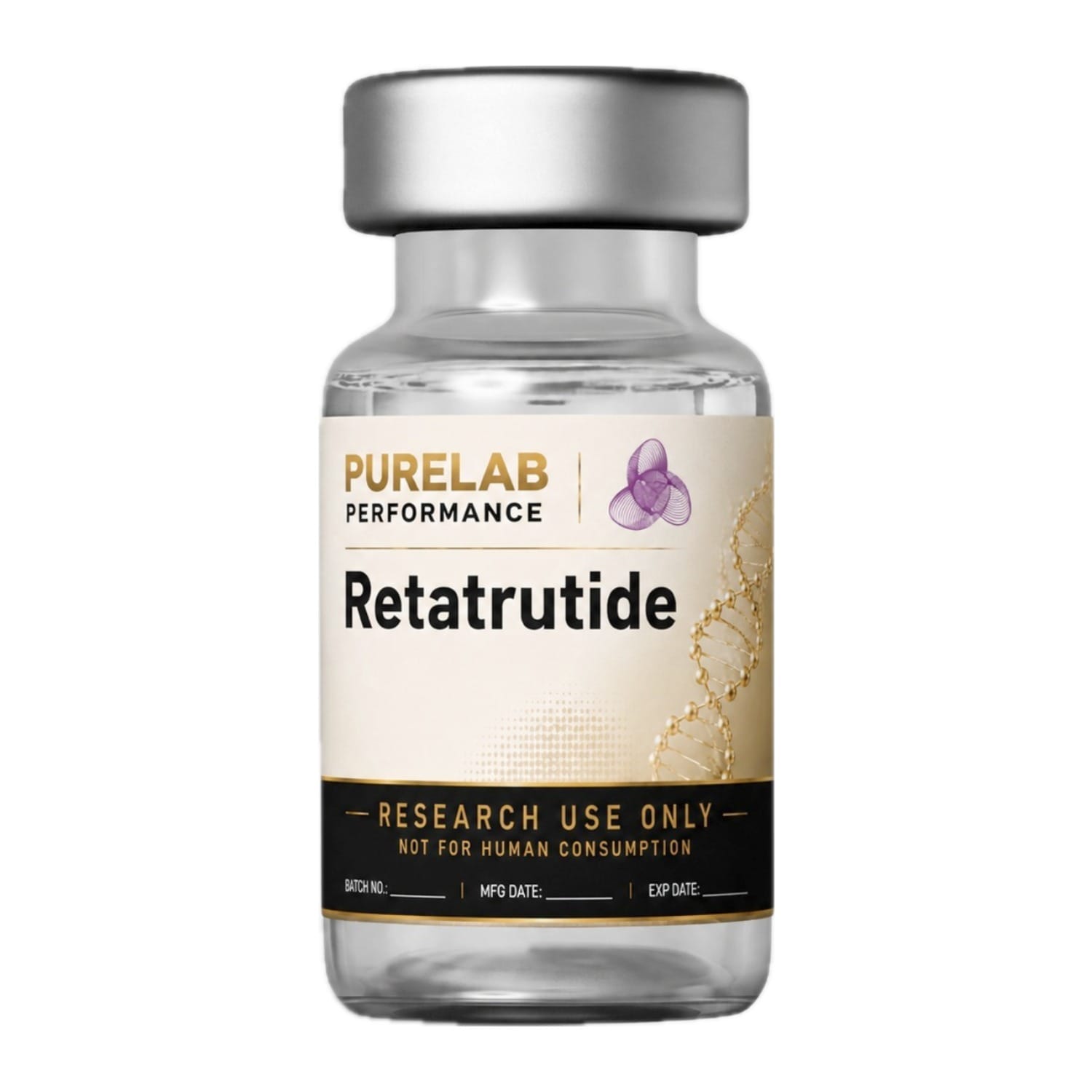
We supply this compound for laboratory research.
RESEARCH USE ONLY
Retatrutide supplied by PureLab Performance is furnished strictly for in-vitro laboratory research. It is not a medicine or a drug and has not been approved by the FDA to prevent, treat, or cure any medical condition, ailment, or disease. Purchasers must be 18 or older and qualified to handle research chemicals.
References
Retrieved from PubMed. DOIs link to the original publications. Chemical identity queried against PubChem — no record returned.
- Jastreboff AM, Kaplan LM, Frías JP, et al. “Triple-Hormone-Receptor Agonist Retatrutide for Obesity — A Phase 2 Trial.” N Engl J Med. 2023;389(6):514–526. DOI
- Rosenstock J, Frias J, Jastreboff AM, et al. “Retatrutide, a GIP, GLP-1 and glucagon receptor agonist, for people with type 2 diabetes: a randomised, double-blind, placebo and active-controlled, parallel-group, phase 2 trial conducted in the USA.” Lancet. 2023;402(10401):529–544. DOI
- Sanyal AJ, Kaplan LM, Frias JP, et al. “Triple hormone receptor agonist retatrutide for metabolic dysfunction-associated steatotic liver disease: a randomized phase 2a trial.” Nat Med. 2024;30(7):2037–2048. DOI
- U.S. National Library of Medicine. ClinicalTrials.gov registry entries for retatrutide (LY3437943), including NCT04881760 and NCT04867785. ClinicalTrials.gov. Registry record; no DOI assigned.
- National Center for Biotechnology Information. PubChem PUG-REST queries for “retatrutide” and “LY3437943” returned no compound record at the time of retrieval. PubChem. Database query; no DOI assigned.
For research use only. Not for human or veterinary use.

Reviews
There are no reviews yet.