
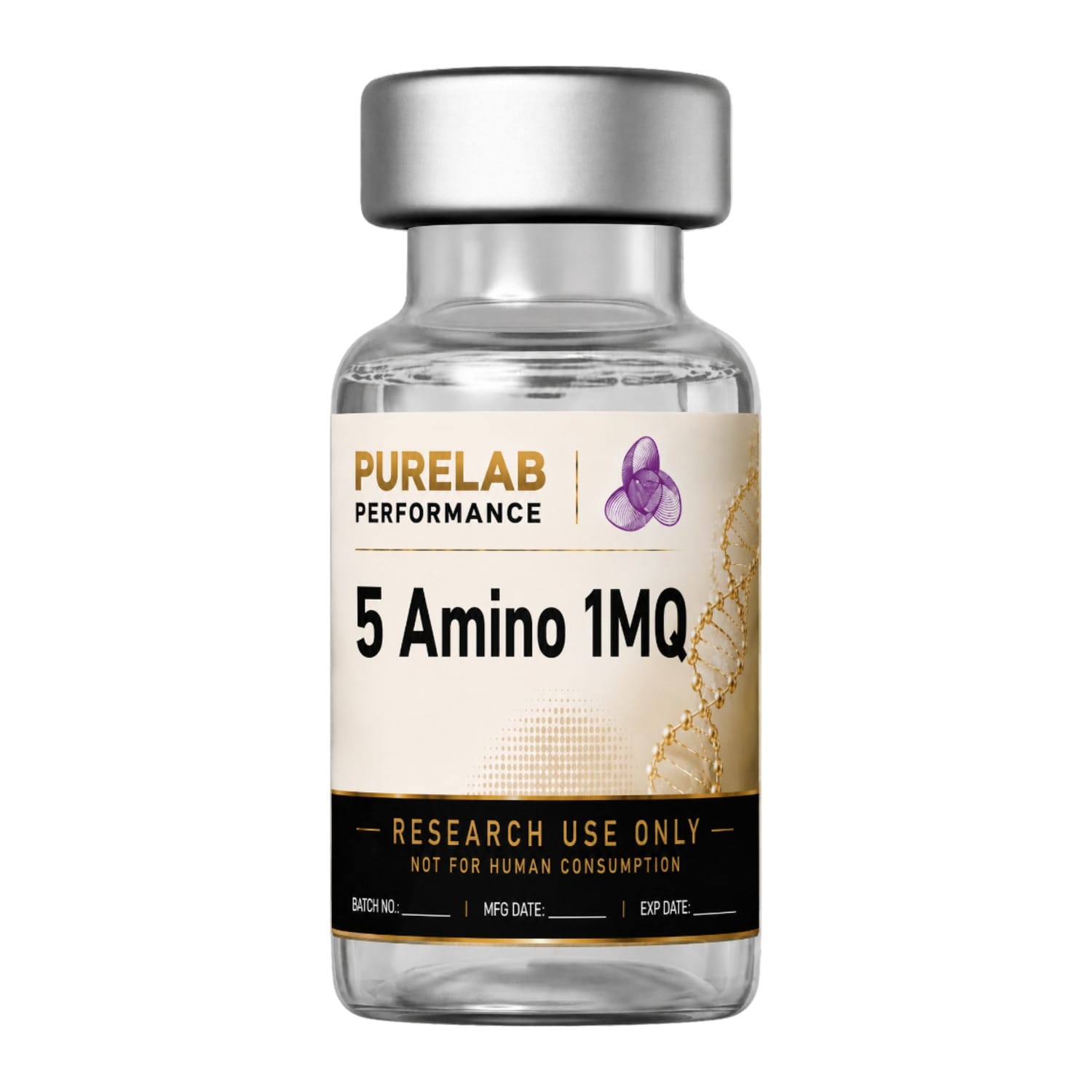
What 5-Amino-1MQ is
It is not a peptide. 5-Amino-1MQ is a small-molecule quinolinium cation with a molecular weight of 159.21 g/mol — roughly one-ninth the mass of a peptide like BPC-157. It is sold alongside research peptides and is routinely described as one. It isn’t, and the distinction is not cosmetic: it has different chemistry, different pharmacokinetics, different stability, and a different regulatory character.
It is a cell-permeable inhibitor of nicotinamide N-methyltransferase (NNMT), an enzyme that methylates nicotinamide. This page is organised around one question: what has actually been measured, and in what.
Structure and identity
Identity fields above are drawn from PubChem and are independently checkable at the links. Note that two distinct PubChem records exist — the free cation and the iodide salt — and they have different masses. See §10.
For the current lot, the certificate of analysis is pending. We will publish it in full when it is issued. Until then we print no purity number.
Where the evidence stands
This is the section most vendors skip. It is the most important one on the page.
NNMT inhibition characterised in cell-free and cell-culture systemsSome
Diet-induced obese mice, and only in combination with a diet switch. See §5.Limited
Not a single one. No efficacy, no safety, no tolerability.ZERO
Unknown. No absorption, distribution, metabolism or excretion data in humans.NONE
Uncharacterised. No dose-ranging, no NOAEL, no organ-toxicity screen in humans.NONE
No trial of 5-Amino-1MQ is registered anywhereNONE
The NNMT target in vitro
Nicotinamide N-methyltransferase transfers a methyl group from S-adenosylmethionine onto nicotinamide, producing 1-methylnicotinamide. NNMT is expressed at high levels in adipose tissue and liver, and its activity consumes both nicotinamide (an NAD+ precursor) and methyl groups.
The intervention hypothesis writes itself: inhibit NNMT, spare nicotinamide, raise NAD+ in fat cells, shift adipocyte metabolism. 5-Amino-1MQ is a cell-permeable inhibitor built to test exactly that. It is a well-posed hypothesis and the enzymology is real.
A well-posed hypothesis is not a result. What follows is the result.
The Sampson 2021 study — read this mouse
The single most cited study behind this compound is Sampson et al., Scientific Reports, 2021[1]. Its title is worth quoting in full, because the title alone answers the most important question about the compound:
The study design was: diet-induced obese mice were given an NNMT inhibitor combined with a substitution to a lean (reduced-calorie) diet. The comparator was the lean diet substitution alone.
The finding is that the inhibitor plus a diet switch outperformed the diet switch alone. The study reports that the combination “accelerated and improved body weight and fat loss” and “normalized body composition” — relative to the lean diet substitution, not relative to nothing.
There is no arm in which the compound is given without the diet change. The fat-loss result has never been demonstrated for the drug alone, in any species.
The most misrepresented result in the category
5-Amino-1MQ is sold, almost universally, on the implication that it drives fat loss on its own. That implication is not supported by the study everyone cites — it is contradicted by the study’s own design.
What Sampson et al. actually demonstrated is that NNMT inhibition enhanced the effect of eating less, in mice. Strip out the calorie restriction and the study is silent, because that experiment was not run. A reader who takes “NNMT inhibitor causes fat loss in obese mice” away from this paper has taken away something the paper does not say.
We are not aware of any published study in any species demonstrating that 5-Amino-1MQ produces fat loss as a monotherapy. If you are buying it on that basis, you are buying a result that does not exist.
The single-lab problem
Nearly the entire pro-metabolic literature on NNMT inhibition originates from one research group — that of Stanley J. Watowich at the University of Texas Medical Branch. The Sampson 2021 author list includes Watowich as senior author, and a co-author (H. Neelakantan) is affiliated to Ridgeline Therapeutics, a commercial spinout founded to develop NNMT inhibitors[1].
This is disclosed in the paper and is not misconduct. It is, however, exactly the situation in which independent replication matters most — and independent replication is what this literature does not have. A body of positive findings from a single group with a commercial stake in the outcome is a hypothesis with a publication record, not an established fact.
The human data — all of it
There is none.
That is the whole section. No randomised trial. No open-label study. No case series. No phase 1. No pharmacokinetic study. No tolerability study. No registered trial in any registry. No published human exposure of any kind, for any endpoint, at any dose.
This means the following are all unknown in humans: oral bioavailability, half-life, route of clearance, metabolites, tissue distribution, effective dose, maximum tolerated dose, interaction profile, and every category of toxicity. Not “poorly characterised” — unknown.
Limitations of the literature
The key result is a combination result. §5. The compound has never been shown to work alone.
The literature is single-source. §7. One lab, one commercial spinout, no adversarial replication.
NNMT inhibition has consequences beyond fat. NNMT is not an adipose-specific enzyme; it sits at the junction of NAD+ metabolism and one-carbon/methyl-group metabolism, both of which are systemically important. Chronic inhibition of a methyltransferase in a whole organism is not a locally-contained intervention, and nobody has measured what it does over time in a human.
The mouse model is a diet-induced obesity model. Even taken at face value, the finding is about obese mice switching diets. It is not about a lean person seeking body-composition change, and no study addresses that population.
A note on salt form and dose
Two PubChem records exist for this compound: the free cation (CID 950107, MW 159.21) and the iodide salt (CID 66522933). They are not the same mass. Material is generally supplied as a salt, and a “50 mg” quantity of salt contains less than 50 mg of the active cation.
Any certificate of analysis that does not state which species was assayed is not telling you what you have. We will state it on ours. We mention this because it is a routine and unremarked source of error in this corner of the market.
Regulatory and anti-doping status
5-Amino-1MQ is not listed by name on the WADA 2025 Prohibited List. It is nonetheless captured by Section S0 (Non-Approved Substances), which prohibits at all times any pharmacological substance not addressed by another section of the List and with no current approval by any governmental regulatory health authority for human therapeutic use. 5-Amino-1MQ holds no such approval anywhere. On a plain reading of S0 it is prohibited at all times, in and out of competition.
Anti-doping lists change annually and by governing body. If you compete under any tested organisation, the only reliable source is that organisation’s current prohibited list — not this page, and not any vendor’s.
5-Amino-1MQ has not been approved by the FDA or any other regulator for any human use, and has never been administered to a human in a published study.
What we don’t know
- Whether 5-Amino-1MQ does anything at all in a human. It has never been given to one in a study.
- Whether it produces fat loss without concurrent calorie restriction. Never demonstrated, in any species[1].
- Its human pharmacokinetics — every parameter.
- Its toxicology in humans — every category, including whether it is safe at all.
- The systemic consequences of chronically inhibiting a methyltransferase involved in one-carbon metabolism.
- Whether the findings replicate outside the originating lab.
We supply this compound for laboratory research. The enzymology is legitimate and the hypothesis is interesting. The product it has been turned into is running roughly a decade ahead of its evidence.
5-Amino-1MQ supplied by PureLab Performance is furnished strictly for in-vitro laboratory research. It is not a medicine or a drug and has not been approved by the FDA to prevent, treat, or cure any medical condition, ailment, or disease. Bodily introduction of any kind into humans or animals is strictly forbidden by law. Per-kilogram dosing in animal models does not scale to humans. Purchasers must be 18 or older and qualified to handle research chemicals.
References
Retrieved from PubMed. DOIs link to the original publications. Chemical identity data retrieved from PubChem.
- Sampson CM, Dimet AL, Neelakantan H, Ogunseye KO, Stevenson HL, Hommel JD, Watowich SJ. “Combined nicotinamide N-methyltransferase inhibition and reduced-calorie diet normalizes body composition and enhances metabolic benefits in obese mice.” Sci Rep. 2021;11(1):5637. DOI
- National Center for Biotechnology Information. “PubChem Compound Summary for CID 950107, 5-amino-1-methylquinolinium.” PubChem
- National Center for Biotechnology Information. “PubChem Compound Summary for CID 66522933, 5-amino-1-methylquinolinium iodide.” PubChem
- World Anti-Doping Agency. “The 2025 Prohibited List — International Standard.” Section S0, Non-Approved Substances. WADA
Reviews
There are no reviews yet.