
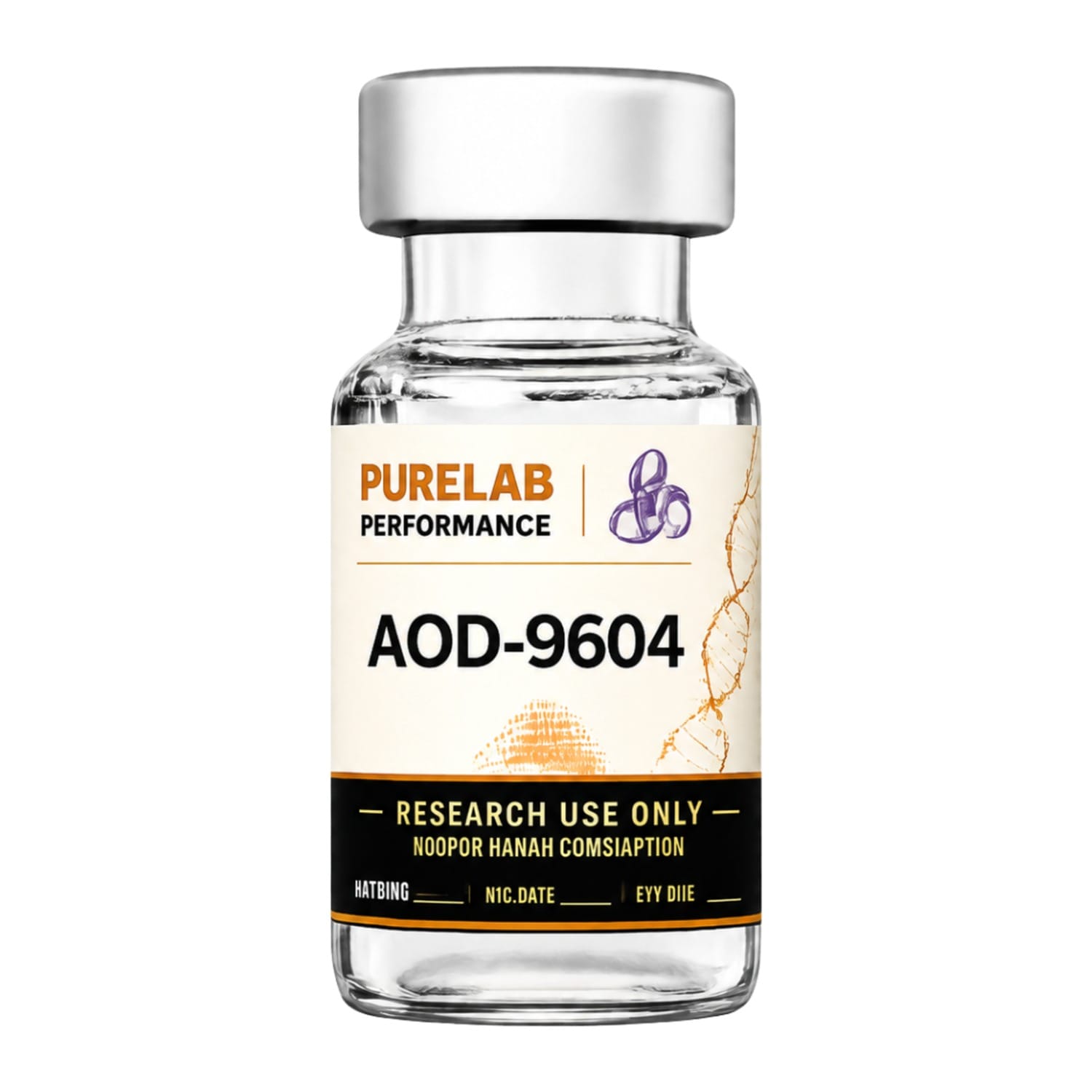
What AOD-9604 is
AOD-9604 — “Anti-Obesity Drug 9604” — is a synthetic peptide corresponding to the C-terminal fragment of human growth hormone, residues 177–191, with an additional tyrosine added at the N-terminus. It carries an internal disulfide bond and is commonly written as hGH fragment 176-191[1].
The design idea was elegant: isolate the region of growth hormone associated with fat metabolism, discard the rest, and get the metabolic activity without the diabetogenic and growth-promoting effects of the whole molecule. Metabolic Pharmaceuticals took it into human trials for obesity.
It did not work. That sentence is the most important one on this page and it is the one every other listing for this compound omits.
Structure and identity
Sixteen residues; two cysteines forming the disulfide that accounts for both sulfur atoms in the formula. The anti-doping literature describes it precisely as “a peptide consisting of the C-terminal fragment of human growth hormone from amino acids 177–191 with an additional tyrosine residue at the N-terminus”[1].
One practical stability note from the analytical literature, which matters for handling: in a 2026 validation study, AOD9604 and hGH 176-191 were among the compounds extensively degraded after one week in serum and plasma at 4 °C and 22 °C, while remaining stable for at least two months at −20 °C[2]. This is not a robust peptide in solution at room temperature.
Where the evidence stands
This is the section most vendors skip. It is the most important one on the page.
Adipocyte lipid metabolism; in-vitro metabolite profiling in serum and urinePresent
Obese and knockout mice; intra-articular injection in a rabbit osteoarthritis modelModerate
Phase 2 programme run. Did not deliver an approvable weight-loss effect. Development discontinued.Failed
Not indexed in PubMed. See “A gap in the primary literature” below.Absent
The obesity programme that failed human
AOD-9604 entered Phase 2a trials for obesity by February 2002[3]. Through the mid-2000s it appears repeatedly in reviews of the obesity pipeline — listed alongside rimonabant, cetilistat and lorcaserin as a “human growth hormone fragment” in clinical development for weight loss[4][5].
Then it disappears from those reviews. It never reached Phase 3. It was never approved by any regulator anywhere for any indication. Metabolic Pharmaceuticals discontinued it as an obesity drug candidate.
A 2026 narrative review in Frontiers in Endocrinology, stratifying performance-enhancing peptides by evidence tier, places AOD9604 (hGH 176-191) among the GH-axis compounds lacking regulatory approval for physique or performance indications, with uncertainty around composition, dose and stacking in unregulated supply[6]. A 2026 review in Sports Medicine classifies it explicitly as one of the unapproved peptides in a parallel “gray market” operating outside regulatory oversight — favourable animal data, scarce human safety data, potential for serious harm[7].
A gap in the primary literature
We searched PubMed for a peer-reviewed report of AOD-9604’s pivotal obesity efficacy trial. We could not find one. PubMed indexes 23 records for AOD9604; none is a published Phase 2 efficacy result. ClinicalTrials.gov returns no registered trials for AOD-9604 at all — the programme was run in Australia and predates the era of mandatory registration on that registry.
So the specific claim “the Phase 2b trial missed its primary weight-loss endpoint” is one we cannot source to a peer-reviewed primary document, and we will not assert it as if we could. What we can source, and do assert: the compound entered Phase 2 in 2002[3], appeared in obesity-pipeline reviews for several years[4][5], never reached Phase 3, was never approved, and is now catalogued in the 2026 literature as an unapproved gray-market peptide[6][7]. A drug that goes into Phase 2 for its lead indication and comes out with nothing has not succeeded.
Animal models animal
In a collagenase-induced knee osteoarthritis model in 32 New Zealand white rabbits, weekly ultrasound-guided intra-articular injections of 0.25 mg AOD9604, alone or with hyaluronic acid, were compared against saline and against hyaluronic acid alone. Gross morphological and histopathological scores were significantly lower (less cartilage degeneration) in all three treatment groups than in saline controls, and lowest in the combined AOD9604 + hyaluronic acid group; the lameness period was shortest in that group[8].
That is a rabbit joint injection study with n=8 per group. It is not an obesity result, it is not a human result, and it is the strongest positive animal finding in the recent AOD-9604 literature. The distance between “cartilage scores in collagenase-injected rabbit knees” and anything a person would experience is very large, and we are not going to pretend otherwise.
What it does not do to GH signalling
One genuinely useful and well-verified finding: AOD-9604 does not interfere with the WADA hGH isoform immunoassay[9]. That is a technical result about anti-doping test performance. It is often mis-sold as evidence that AOD-9604 “doesn’t affect growth hormone” or “doesn’t raise IGF-1.” It is not that. It is a statement about whether a particular antibody-based test cross-reacts with the fragment. Do not read it as a pharmacological or safety claim.
Detection and doping controls
AOD9604 is a routine anti-doping target. A validated solid-phase-extraction method detects it in urine down to 50 pg/mL. Six potential metabolites were identified after incubation in serum and urine; one — the fragment CRSVEGSCG — is substantially more stable than the parent compound and may extend the detection window[1]. AOD9604 has been identified by Belgian authorities in seized pharmaceutical preparations[10] and is included in multi-analyte screens covering prohibited peptides under 2 kDa[11].
Limitations of the literature
The pivotal human data are not in the public scientific record. The most important experiment ever done with this compound — does it cause weight loss in obese humans — has no peer-reviewed publication that we can find. Whatever it showed, it was not enough to continue.
The mechanism story outran the clinical result. “The lipolytic domain of growth hormone” is a compelling sentence. It is a hypothesis about a fragment. The fragment was tested and the drug was abandoned.
Human safety data are thin. There is no published long-term human safety dataset. The 2026 reviews describe the human safety evidence for this class as scarce[6][7].
Regulatory and anti-doping status
AOD-9604 is named by name on the WADA Prohibited List under S2.2.3, Growth Hormone (GH), its analogues and fragments — the clause reads “growth hormone fragments, e.g. AOD-9604 and hGH 176-191”[12]. Section S2 substances are prohibited at all times, in and out of competition. There is no ambiguity here and no annual drift to hope for: it is on the list by name.
AOD-9604 has not been approved as a drug for any indication by the FDA or any other regulatory authority. Anti-doping lists change annually and by governing body. If you compete under any tested organisation, the only reliable source is that organisation’s current prohibited list — not this page, and not any vendor’s.
What we don’t know
- What the human obesity trials actually measured. The results were never published in the indexed literature.
- Whether the rabbit intra-articular cartilage finding means anything in any other species. No follow-up work exists.
- What repeated subcutaneous exposure does in a human over months. No study.
- Long-term safety in humans is uncharacterised. Per-kilogram dosing in animal models does not scale to humans, and nothing on this page should be read as implying that it does.
We supply this compound for laboratory research. The design rationale is interesting and the anti-doping chemistry is well characterised. The clinical file is a discontinued obesity programme with no published result. We are not going to pretend it is more than it is.
AOD-9604 supplied by PureLab Performance is furnished strictly for in-vitro laboratory research. It is not a medicine or a drug and has not been approved by the FDA to prevent, treat, or cure any medical condition, ailment, or disease. Bodily introduction of any kind into humans or animals is strictly forbidden by law. Per-kilogram dosing in animal models does not scale to humans. Purchasers must be 18 or older and qualified to handle research chemicals.
References
Retrieved from PubMed, ClinicalTrials.gov, PubChem and the World Anti-Doping Agency. DOIs link to the original publications.
- Cox HD, Smeal SJ, Hughes CM, Cox JE, Eichner D. “Detection and in vitro metabolism of AOD9604.” Drug Test Anal. 2015;7(1):31–8. DOI
- Mazzarino M, Colpaert T, Deventer K, Van Eenoo P. “Rapid and harmonized analytical workflow for the determination of peptidic and non-peptidic doping agents in dried and liquid blood matrices.” Analyst. 2026. DOI
- Wilding J. “AOD-9604 Metabolic.” Curr Opin Investig Drugs. 2004;5(4):436–40. PubMed — “Metabolic is developing AOD-9604 for the potential treatment of obesity. By February 2002, phase IIa trials were underway.”
- Halford JCG. “Obesity drugs in clinical development.” Curr Opin Investig Drugs. 2006;7(4):312–18. PubMed
- Jensen MD. “Potential role of new therapies in modifying cardiovascular risk in overweight patients with metabolic risk factors.” Obesity (Silver Spring). 2006;14 Suppl 3:143S–149S. DOI
- Dominikowski A, Rękoś Z, Olejarz M, Szczepanek-Parulska E, Domin R, Ruchała M. “The emerging landscape of performance-enhancing peptides modulating GH-IGF1 axis: bridging the gap between clinical evidence and patient self-administration.” Front Endocrinol. 2026;17:1822475. DOI
- Mendias CL, Awan TM. “Safety and Efficacy of Approved and Unapproved Peptide Therapies for Musculoskeletal Injuries and Athletic Performance.” Sports Med. 2026. DOI
- Kwon DR, Park GY. “Effect of Intra-articular Injection of AOD9604 with or without Hyaluronic Acid in Rabbit Osteoarthritis Model.” Ann Clin Lab Sci. 2015;45(4):426–32. PubMed
- Orlovius AK, Thomas A, Schänzer W, Thevis M. “AOD-9604 does not influence the WADA hGH isoform immunoassay.” Drug Test Anal. 2013;5(11-12):850–52. DOI
- Vanhee C, Moens G, Deconinck E, De Beer JO. “Identification and characterization of peptide drugs in unknown pharmaceutical preparations seized by the Belgian authorities: case report on AOD9604.” Drug Test Anal. 2014;6(9):964–68. DOI
- Thomas A, Görgens C, Guddat S, et al. “Simplifying and expanding the screening for peptides <2 kDa by direct urine injection, liquid chromatography, and ion mobility mass spectrometry.” J Sep Sci. 2016;39(2):333–41. DOI
- World Anti-Doping Agency. The Prohibited List, Section S2.2.3 — Growth Hormone (GH), its analogues and fragments: “growth hormone fragments, e.g. AOD-9604 and hGH 176-191.” wada-ama.org
- National Center for Biotechnology Information. PubChem Compound Summary for CID 71300630, AOD-9604. PubChem
Reviews
There are no reviews yet.