
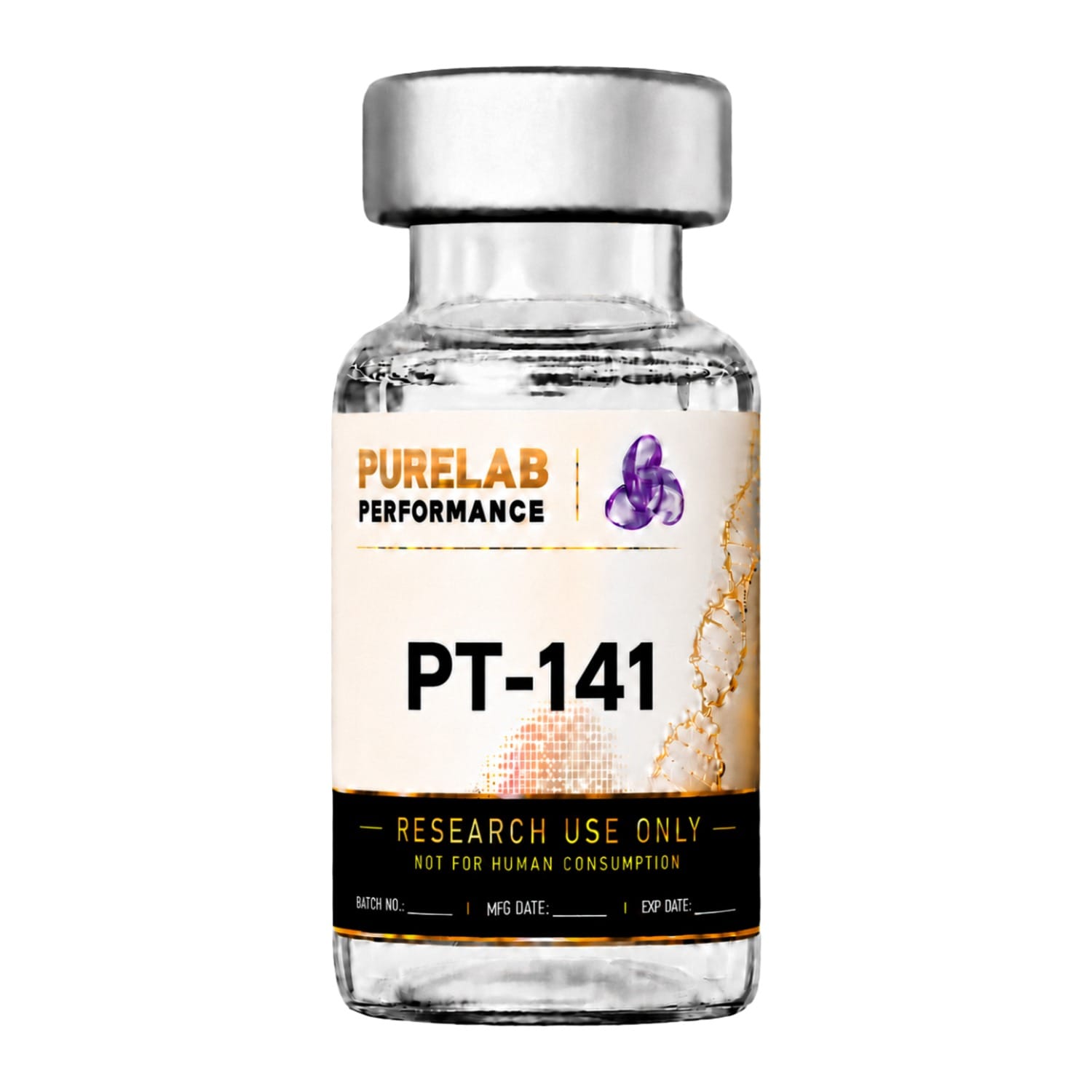
What PT-141 is
PT-141, generic name bremelanotide, is a cyclic heptapeptide agonist at melanocortin receptors, principally MC3R and MC4R. It is a metabolite-derived analogue of the melanocortin peptide family, developed by Palatin Technologies.
Unlike almost everything else in this catalogue, bremelanotide is an approved drug. The FDA approved it as Vyleesi for acquired, generalised hypoactive sexual desire disorder in premenopausal women. It went through Phase 1, Phase 2b dose-ranging, and two identically-designed Phase 3 registration trials with 1,267 randomised participants. A clinical development programme of 3,500 subjects across 43 completed studies underpins it[4].
That means there is a great deal we can tell you about this molecule — including the things a marketer would rather not.
Structure and identity
An N-acetylated norleucine followed by a seven-residue ring closed by a lactam bridge between the aspartate and lysine side chains. The cyclisation is what confers stability and receptor selectivity, and it is what an identity assay must confirm — a linear impurity of identical mass composition is a different molecule with different pharmacology.
The molecule has an FDA dossier. This vial does not.
Bremelanotide the molecule has been through the FDA. It has an approved label, a defined 1.75 mg subcutaneous dose delivered by a specific autoinjector, a manufacturing process inspected under cGMP, a stability programme, a defined impurity profile, contraindications, drug-interaction data, and a post-marketing surveillance obligation. All of that is attached to Vyleesi as manufactured and packaged by its licence holder.
None of it is attached to a research-grade powder in a glass vial from a chemical supplier. Not ours, not anyone’s. What an FDA approval certifies is not “this chemical is safe” — it is “this product, made this way, at this dose, in this population, under this label, has an acceptable benefit-risk profile.” Change the manufacturer, the excipients, the sterility assurance, the concentration, the population or the indication, and the dossier does not travel with you.
The approval is a reason to trust the data below. It is not a reason to trust the vial above. We sell the vial and we are telling you the difference.
Where the evidence stands
MC3R / MC4R agonismEstablished
Dose-ranging, premenopausal women with HSDD and mixed HSDD/FSADPositive
Two identical randomised double-blind placebo-controlled trials, n=1,267 randomisedPositive, small effect
52 weeks; 684 enrolled, 272 completedHigh attrition
40.0% on drug vs 1.3% on placebo; most common reason for discontinuationSubstantial
Small, transient, statistically significant increases on ambulatory monitoringReal
Approved as Vyleesi for acquired, generalised HSDD in premenopausal womenYes
RECONNECT — the pivotal Phase 3 trials human
RECONNECT comprised two identically designed Phase 3 randomised, double-blind, placebo-controlled, multicentre trials — Study 301 (NCT02333071) and Study 302 (NCT02338960) — of bremelanotide 1.75 mg administered subcutaneously as needed before sexual activity, in premenopausal women with hypoactive sexual desire disorder. Participants were randomised 1:1 to 24 weeks of treatment. Of 1,267 randomised, 1,247 were in the safety population and 1,202 in the modified intent-to-treat efficacy population. Mean age 39; 85.6% white; 96.6% from US sites[1].
The co-primary endpoints were change from baseline to end of study in (a) the Female Sexual Function Index desire-domain score and (b) item 13 of the Female Sexual Distress Scale-Desire/Arousal/Orgasm.
The effect size, in the trial’s own units human
Both endpoints reached statistical significance. Here are the numbers, as reported[1]:
- FSFI desire-domain score, change vs placebo: Study 301 +0.30 (P < .001); Study 302 +0.42 (P < .001); integrated +0.35 (P < .001).
- FSDS-DAO item 13 (distress related to low desire), change vs placebo: Study 301 −0.37 (P < .001); Study 302 −0.29 (P = .005); integrated −0.33 (P < .001).
Those are the real, published, regulator-reviewed effect sizes. They are statistically significant and they are small. The FSFI desire domain runs from 1.2 to 6.0. A separate responder-analysis paper was published specifically to establish what magnitude of change on these instruments counts as clinically meaningful[3] — which tells you something about how the field regarded the raw numbers.
A 52-week open-label extension followed the core phase. Of 856 eligible patients who completed the core phase, 684 elected to enter the extension and 272 completed it[2]. In the double-blind portion of the integrated Phase 3 studies, 70% of the bremelanotide group proceeded to the open-label phase versus 87% of those on placebo[4]. People on the drug were less likely to continue than people on placebo. That is in the safety review, and it is worth sitting with.
Nausea, flushing, headache human
In the integrated double-blind Phase 3 population (n=1,247), the most common adverse events, bremelanotide versus placebo, were:
Nausea — 40.0% vs 1.3%. Flushing — 20.3% vs 1.3%. Headache — 11.3% vs 1.9%. Injection-site reactions — 5.4% vs 0.5%[4].
Nausea was the most common reason for discontinuing the drug. In the 52-week open-label extension, nausea was the only severe treatment-emergent adverse event experienced by more than one participant in both studies[2].
This is not a footnote. It is the dominant feature of the tolerability profile of this molecule, it is in the approved label, and it is derived from more than a thousand people.
Blood pressure — the signal that shaped the label human
Melanocortin-4 receptor agonists can raise blood pressure. This was recognised early and studied directly.
A randomised, double-blind, placebo-controlled, parallel-arm ambulatory blood pressure monitoring trial enrolled 397 premenopausal women with normotension or controlled hypertension, across three doses of bremelanotide (0.75, 1.25, 1.75 mg)[5]. What it found:
- Ambulatory systolic BP increased relative to placebo by 3.1 and 3.2 mmHg at the 1.75 mg dose (P = 0.006 and 0.027) over the 0–4 hour post-dose interval, following two doses separated by 24 hours; and by 2.4 and 3.0 mmHg at 1.25 mg.
- Similar increases were seen in diastolic BP.
- Peak increases typically lasted less than 15 minutes.
- The BP rise was accompanied by a fall in heart rate of 4.6 to 4.7 bpm at 1.75 mg (P < 0.001).
- Twenty-six participants discontinued after randomisation because of prespecified increases in blood pressure — although the proportions were similar across the four treatment groups.
The results of that trial led directly to in-clinic BP monitoring being built into the larger development programme. The 2022 safety review across the whole clinical development programme concludes that although the BP changes were “not deemed clinically important,” bremelanotide should be used with caution in patients at risk of cardiovascular disease, and blood pressure should be well controlled during treatment[4].
The direction of the effect is up. A compound sold across the gray market to men, often alongside vasodilators, is a compound with a documented pressor effect that was studied only in premenopausal women with controlled blood pressure. Nobody has characterised what it does in an uncontrolled-hypertensive 55-year-old man, because that trial was never run.
Focal hyperpigmentation human
Melanocortin receptor agonism affects melanocytes. In the clinical programme, focal hyperpigmentation was rare when bremelanotide was dosed in accordance with the label. It occurred in more than one-third of subjects following up to 16 consecutive daily dosings[4].
The label limits dosing frequency for a reason, and the reason is in that sentence. Dosing frequency is not a detail that can be adjusted upward without consequence.
Limitations of the literature
The population studied is narrow. Premenopausal women with a clinical diagnosis of acquired, generalised HSDD. Every efficacy number on this page comes from that group. Subgroup analyses across age, weight, BMI and bioavailable testosterone were prespecified and mostly held[6] — but they are subgroups of that population.
The endpoints are patient-reported instruments. FSFI and FSDS-DAO are validated questionnaires, not physiological measurements. The trials were designed with a single-blind run-in specifically to account for placebo response[3], which was substantial.
Most drug-drug interaction data are reassuring, with exceptions. Interactions that lowered plasma concentrations of indomethacin and naltrexone were clinically relevant[4].
Regulatory and anti-doping status
Bremelanotide does not appear on the 2026 WADA Prohibited List[7]. Note that Section S0 of that list prohibits any pharmacological substance with no current approval by any governmental regulatory health authority for human therapeutic use; bremelanotide has such approval, so S0 does not capture it either. Our spec block records this as a neutral data field, in the same register as the CAS number.
Anti-doping lists change annually and by governing body. If you compete under any tested organisation, the only reliable source is that organisation’s current prohibited list — not this page, and not any vendor’s.
The FDA approval of bremelanotide (Vyleesi) applies to a specific finished product, at a specific dose, for a specific indication and population. It does not extend to research-grade material, to other doses, to other populations, or to other indications.
What we don’t know
- What bremelanotide does in men. The registration programme did not study them for this indication.
- What it does in people with uncontrolled hypertension or established cardiovascular disease. Those people were excluded from the BP study.
- What sustained or frequent dosing does beyond the label’s limits, other than that hyperpigmentation appears in over a third of people at 16 consecutive daily doses.
- What research-grade powder of unverified provenance does in any of the above. That is not a knowledge gap in the literature. It is a knowledge gap in the vial.
We supply this compound for laboratory research. It is one of the very few molecules in this catalogue with a real, large, regulator-reviewed human dataset. That dataset includes a 40% nausea rate and a documented pressor effect, and we have put both on the page.
PT-141 (bremelanotide) supplied by PureLab Performance is furnished strictly for in-vitro laboratory research. It is not a medicine or a drug and has not been approved by the FDA to prevent, treat, or cure any medical condition, ailment, or disease. Bodily introduction of any kind into humans or animals is strictly forbidden by law. Per-kilogram dosing in animal models does not scale to humans. Purchasers must be 18 or older and qualified to handle research chemicals.
References
Retrieved from PubMed, ClinicalTrials.gov, PubChem and the World Anti-Doping Agency. DOIs link to the original publications.
- Kingsberg SA, Clayton AH, Portman D, Williams LA, Krop J, Jordan R, Lucas J, Simon JA. “Bremelanotide for the Treatment of Hypoactive Sexual Desire Disorder: Two Randomized Phase 3 Trials.” Obstet Gynecol. 2019;134(5):899–908. DOI · ClinicalTrials.gov NCT02333071, NCT02338960
- Simon JA, Kingsberg SA, Portman D, Williams LA, Krop J, Jordan R, Lucas J, Clayton AH. “Long-Term Safety and Efficacy of Bremelanotide for Hypoactive Sexual Desire Disorder.” Obstet Gynecol. 2019;134(5):909–17. DOI
- Althof S, Derogatis LR, Greenberg S, Clayton AH, Jordan R, Lucas J, Spana C. “Responder Analyses from a Phase 2b Dose-Ranging Study of Bremelanotide.” J Sex Med. 2019;16(8):1226–35. DOI
- Clayton AH, Kingsberg SA, Portman D, Sadiq A, Krop J, Jordan R, Lucas J, Simon JA. “Safety Profile of Bremelanotide Across the Clinical Development Program.” J Womens Health (Larchmt). 2022;31(2):171–82. DOI
- White WB, Myers MG, Jordan R, Lucas J. “Usefulness of ambulatory blood pressure monitoring to assess the melanocortin receptor agonist bremelanotide.” J Hypertens. 2017;35(4):761–68. DOI
- Simon JA, Kingsberg SA, Portman D, Jordan R, Lucas J, Sadiq A, Krop J, Clayton AH. “Prespecified and Integrated Subgroup Analyses from the RECONNECT Phase 3 Studies of Bremelanotide.” J Womens Health (Larchmt). 2022;31(3):391–400. DOI
- World Anti-Doping Agency. The Prohibited List. Bremelanotide is not named on the 2026 List. wada-ama.org
- Revicki DA, Althof SE, Derogatis LR, et al. “Reliability and validity of the elements of desire questionnaire in premenopausal women with hypoactive sexual desire disorder.” J Patient Rep Outcomes. 2020;4(1):82. DOI
- National Center for Biotechnology Information. PubChem Compound Summary for CID 9941379, Bremelanotide. PubChem
Reviews
There are no reviews yet.