
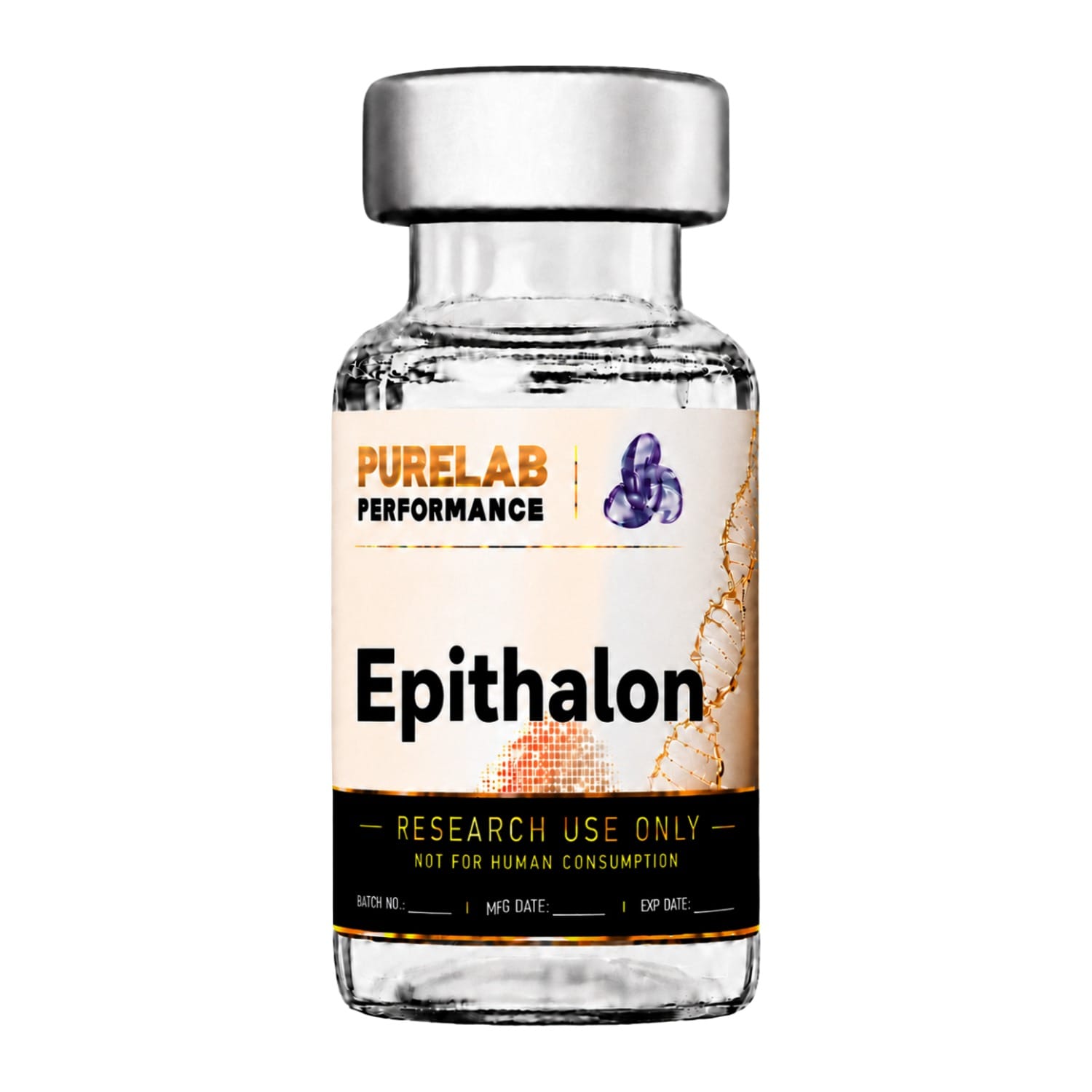
What Epitalon is
Epitalon — also written Epithalon or Epithalone — is a tetrapeptide, Ala-Glu-Asp-Gly (AEDG). It was synthesised in Russia on the basis of the amino acid composition of Epithalamin, a bovine pineal gland extract, and was subsequently identified within the pineal polypeptide complex itself[1].
It is marketed almost entirely on one claim: that it activates telomerase and lengthens telomeres. That claim is not fabricated — there are real papers reporting exactly that. Whether those papers constitute a body of evidence, or a single group’s findings repeated, is the question this page is organised around.
Structure and identity
A note on nomenclature, because it causes real confusion. Epitalon (AEDG) is the synthetic tetrapeptide listed above. Epithalamin is the bovine pineal extract from which it was derived — a complex biological mixture, not a defined molecule. Much of the older Russian literature, including several of the lifespan studies, concerns Epithalamin rather than Epitalon. Vendors routinely cite the extract literature in support of the peptide. They are not the same substance.
Every batch is assayed by an independent laboratory using HPLC-UV-MS. Measured purity for the current lot is Certificate pending. We publish the certificate in full when the analysis returns.
Where the evidence stands
Telomerase induction and telomere elongation in human fetal fibroblasts — one groupLimited
Murine lifespan and spontaneous tumour incidence; largely one instituteLimited
We were unable to identify replication by a group unconnected to the originatorsNot found
Described as “quite limited” in a 2025 independent reviewSparse
The telomerase claim in vitro
Here is the actual evidence, stated precisely.
In 2003, a paper in Bulletin of Experimental Biology and Medicine reported that adding Epithalon to a culture of telomerase-negative human fetal fibroblasts induced expression of the catalytic subunit of telomerase, produced telomerase enzymatic activity, and elongated telomeres. The authors attributed this to reactivation of the telomerase gene in somatic cells[2].
In 2004, the same group published a follow-up in the same journal. Primary pulmonary fibroblasts from a 24-week fetus normally lost proliferative capacity at passage 34. With Epithalon added, telomeres elongated toward the length seen at early passages, and the treated cells underwent ten additional divisions — reaching passage 44 — and continued dividing. The authors described this as overcoming the Hayflick limit[3].
Taken at face value, that is a striking result. Now look at what it is and is not.
Two papers. Same first author (V. Kh. Khavinson). Same institute — the St Petersburg Institute of Bioregulation and Gerontology. Same journal — Bulletin of Experimental Biology and Medicine. Same cell type. Published a year apart. That is not two independent confirmations of a finding; it is one laboratory reporting a result twice. We searched for replication of the telomerase finding by a group with no connection to the originators and were unable to find it. Reactivating telomerase in somatic cells would be a major result in cell biology, and a major result that no independent laboratory has reproduced in more than two decades is a result that should be held loosely.
The replication problem
This is the honest core of the Epitalon story, and it is why we are not going to sell this compound with the word “telomerase” in a headline.
The Epitalon literature is geographically and institutionally concentrated to an unusual degree. A large share of the foundational papers — the telomerase work, the lifespan work, much of the mechanistic work — originate from a single research institute in St Petersburg, frequently with the same handful of authors, and frequently in the same Russian journals. Several are published only in Russian, with English abstracts[4].
We want to be careful and fair here. Concentration is not fraud. Russian gerontology has a long and serious tradition, and a finding is not wrong because of where it was published or in what language. But independent replication is the mechanism by which science distinguishes real effects from artefacts, enthusiasm and error — and on this compound, that mechanism has essentially not run. A 2025 review in the International Journal of Molecular Sciences, written by an independent group at the Medical University of Warsaw, surveyed 25 years of Epitalon research and noted that despite the considerable volume of work on its biological and pharmacodynamic characteristics, it “remains uncertain whether these are the sole mechanisms of action of this compound,” and that the quantity of physico-chemical and structural investigation of the peptide is “quite limited”[1].
That is what a careful outside assessment of this compound looks like. It is a good deal more tentative than the vendor consensus.
Murine lifespan work murine
In a study published in 2001 in a Russian physiological journal, female CBA mice were given subcutaneous synthetic Epithalon from six months of age until death. The peptide did not affect body weight, food consumption, physical activity or behavioural parameters. In this murine model, it was associated with slowed age-related loss of oestrus function, decreased body temperature, decelerated free-radical processes, a prolonged lifespan, and a lower incidence of spontaneous tumours[4].
Two observations. First, this is a genuinely interesting result and the tumour-incidence finding, if real, is reassuring rather than alarming — which is not something we can say about every compound in this catalogue. Second, the senior authors are the same St Petersburg group discussed above, and the paper is in Russian in a journal with limited international circulation. It has the same replication problem as everything else here.
Other reported mechanisms in vitro preclinical
The 2025 independent review catalogues the range of effects attributed to Epitalon across the literature: a direct influence on melatonin synthesis; alteration of interleukin-2 mRNA levels; modulation of the mitogenic activity of murine thymocytes; and enhancement of the activity of various enzymes including acetylcholinesterase, butyrylcholinesterase and telomerase. The review characterises the reported geroprotective and neuroendocrine effects as arising from antioxidant, neuroprotective and antimutagenic actions, through both specific and non-specific mechanisms[1].
The breadth of that list is itself worth pausing on. A four-residue peptide reported to modulate melatonin synthesis, cytokine expression, thymocyte mitogenesis, cholinesterases and telomerase is either a remarkably pleiotropic molecule or the subject of a literature that has not been stress-tested. We do not know which, and neither does anyone else.
The human data — all of it human
There is no published randomised controlled trial of Epitalon in humans.
The human-derived evidence consists of cell-culture work on human fetal fibroblast lines[2][3] — cells in a dish, not people. Human safety, human dosing, human pharmacokinetics and human bioavailability are all uncharacterised. Any human protocol you have seen for this compound was not derived from a clinical trial, because there isn’t one.
Limitations of the literature
One group, repeated. The telomerase findings — the entire commercial rationale for this compound — rest on two papers from one institute, in one journal, in one cell type, and have not been independently replicated in over twenty years.
The extract and the peptide are conflated. Epithalamin (bovine pineal extract) and Epitalon (AEDG tetrapeptide) are different substances. Literature about the former is routinely marshalled in support of the latter.
The basic chemistry is thin. An independent 2025 review found the physico-chemical and structural characterisation of this peptide to be “quite limited”[1] — an unusual state of affairs for a compound that has been sold for decades.
The mechanism, if real, cuts both ways. Telomerase reactivation in somatic cells is not self-evidently benign. Sustained telomerase activity is a feature of the majority of human cancers. A compound that genuinely did what Epitalon is claimed to do would require serious long-term oncological safety data before anyone could call it safe, and no such data exist for this compound in humans. We raise this not because we have evidence of harm — we do not — but because the claim and the risk are the same claim, and nobody selling this compound seems willing to say so.
Regulatory and anti-doping status
Epitalon is not listed by name on the World Anti-Doping Agency Prohibited List. Section S0, Non-Approved Substances, prohibits at all times “any pharmacological substance which is not addressed by any of the subsequent sections of the List and with no current approval by any governmental regulatory health authority for human therapeutic use”[5]. Epitalon has no such approval, and substances captured by S0 are Specified Substances. Athletes under a tested organisation should not read “not listed by name” as “permitted,” and should verify against their governing body’s current list rather than this page.
Epitalon has not been approved for human therapeutic use by the FDA or any other governmental regulatory health authority.
What we don’t know
- Whether the telomerase finding replicates in any laboratory independent of the group that reported it. As far as we can establish, this has not been tested.
- Whether Epitalon does anything at all in a human being — no controlled trial has been run.
- Human safety, dosing, bioavailability and pharmacokinetics — entirely uncharacterised.
- The long-term oncological consequences of a compound claimed to activate telomerase in somatic cells. This is the question that most needs answering and the one nobody has asked.
- Per-kilogram dosing in mice does not scale to humans, and nothing on this page should be read as implying that it does.
We supply this compound for laboratory research. We will sell it to you, and we will tell you plainly that its headline claim rests on two papers from one institute that nobody else has reproduced. If that changes, we will update this page.
Epitalon supplied by PureLab Performance is furnished strictly for in-vitro laboratory research. It is not a medicine or a drug and has not been approved by the FDA to prevent, treat, or cure any medical condition, ailment, or disease. Bodily introduction of any kind into humans or animals is strictly forbidden by law. Per-kilogram dosing in animal models does not scale to humans. Purchasers must be 18 or older and qualified to handle research chemicals.
References
Retrieved from PubMed. DOIs link to the original publications.
- Araj SK, Brzezik J, Mądra-Gackowska K, Szeleszczuk Ł. “Overview of Epitalon — Highly Bioactive Pineal Tetrapeptide with Promising Properties.” Int J Mol Sci. 2025;26(6):2691. DOI
- Khavinson VKh, Bondarev IE, Butyugov AA. “Epithalon peptide induces telomerase activity and telomere elongation in human somatic cells.” Bull Exp Biol Med. 2003;135(6):590–92. DOI
- Khavinson VKh, Bondarev IE, Butyugov AA, Smirnova TD. “Peptide promotes overcoming of the division limit in human somatic cell.” Bull Exp Biol Med. 2004;137(5):503–06. DOI
- Anisimov VN, Khavinson VKh, Zavarzina NIu, et al. “[Effect of pineal peptide on parameters of the biological age and life span in mice].” Ross Fiziol Zh Im I M Sechenova. 2001;87(1):125–36. Published in Russian. PubMed
- World Anti-Doping Agency. Prohibited List — S0, Non-Approved Substances. wada-ama.org/en/prohibited-list
Reviews
There are no reviews yet.