
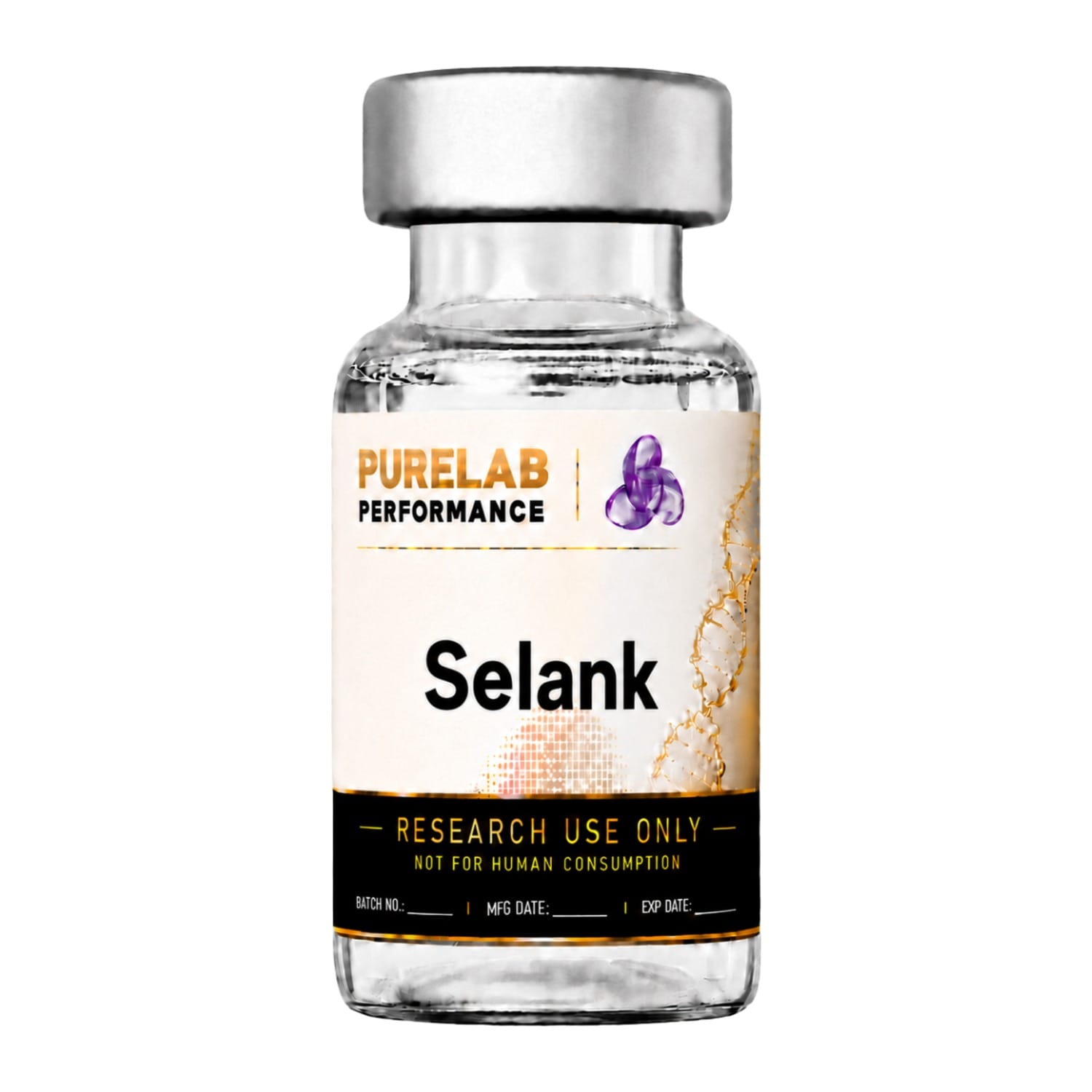
What Selank is
Selank is a synthetic heptapeptide developed at the Institute of Molecular Genetics of the Russian Academy of Sciences. It is a stabilised analogue of the endogenous immunomodulatory tetrapeptide tuftsin, extended at the C-terminus with a Pro-Gly-Pro tripeptide to resist enzymatic degradation. It carries the laboratory code TP-7.
Selank is a registered medicine in Russia. It is not approved anywhere in the EU, the UK, or the United States. Essentially the entire evidence base was generated by, or in close collaboration with, the institutions that developed it. This page is organised around one question: what has actually been measured, and in what.
Structure and identity
Identity fields above are drawn from PubChem and are independently checkable at the link. Every batch we supply is assayed by an independent laboratory using HPLC-UV-MS against an authentic reference standard.
For the current lot, that certificate is pending. We will publish it in full when it is issued. Until then we print no purity number, because we do not have one we can stand behind.
Where the evidence stands
This is the section most vendors skip. It is the most important one on the page.
Proposed GABAergic and monoaminergic modulation; mechanism not settledLimited
Anxiety-like behaviour paradigms, largely from the originating institutionsModerate
Russian-language trials, small, mostly as an add-on to a benzodiazepine rather than as monotherapyLimited
No adequately powered trial outside the originating research networkNone
Explicitly flagged as unstudied in the peer-reviewed pharmacology literatureNone
The tuftsin backbone in vitro
Selank’s first four residues (Thr-Lys-Pro-Arg) are tuftsin, a naturally occurring fragment of the immunoglobulin G heavy chain with described immunomodulatory activity. The appended Pro-Gly-Pro extends plasma half-life by resisting peptidase cleavage.
That design rationale is sound and uncontroversial. It is a statement about molecular stability. It is not, on its own, evidence of any behavioural or physiological effect.
Proposed mechanism preclinical
Selank is characterised in a 2021 review in the Journal of Clinical Pharmacology as one of a group of agents with a GABA-receptor-related mechanism of action[1]. The same review is blunt that the mechanism is not properly worked out.
Note carefully what is and is not being said. A GABAergic mechanism is proposed. Binding affinity, receptor subtype selectivity, and functional consequence in humans are not established. Descriptions of Selank as a clean, targeted GABA modulator are running well ahead of the data.
Animal models rodent
The rodent literature reports effects in anxiety-like behavioural paradigms — elevated plus maze, open field, and similar. Almost all of it originates from the Institute of Molecular Genetics and the Mental Health Research Center in Moscow, or from groups directly connected to them.
These are rodent behavioural endpoints. Rodent anxiety-like behaviour is a model, not a disease, and it translates to human outcomes poorly across the whole field of anxiolytic drug development — not just here.
The human data — all of it human
The most substantial human study is a Russian trial published in Zhurnal Nevrologii i Psikhiatrii in 2015, comparing phenazepam monotherapy (30 patients) against phenazepam plus Selank (40 patients) in anxiety-spectrum disorders[2]. The reported result was that adding Selank brought the benzodiazepine’s effect forward in time and reduced the benzodiazepine’s side-effect burden.
This is not a study of Selank. It is a study of phenazepam plus Selank versus phenazepam, in 70 patients total, unblinded to the investigators’ own product, published in the journal of the institution that developed the compound, in a country where the compound is a commercial medicine. It contains no arm in which Selank is given alone. Whatever this trial shows, it does not show that Selank does anything by itself — that arm was not run.
There is no adequately powered, independently conducted, placebo-controlled monotherapy trial of Selank anywhere in the literature. Anyone quoting Selank’s “clinical trial evidence” without stating that it is add-on data from the originating network is not telling you the shape of the evidence.
The published critique
The most useful thing written about Selank in the Western literature is not a study of its efficacy — it is a pharmacology review that treats it as a regulatory and safety problem.
Doyno and White, writing in the Journal of Clinical Pharmacology in 2021, group Selank with phenibut and describe both as “poorly studied Russian drugs with GABAergic mechanisms that are inexplicably sold to US consumers as dietary supplements”[1]. The review’s central argument is that agents acting on GABA systems carry characteristic risks — tolerance, dependence, and withdrawal syndromes — and that these risks have not been evaluated for Selank at all. The authors’ explicit conclusion is that substances with GABAergic properties should undergo abuse-potential evaluation before public access, not after.
Abuse potential: not evaluated. Dependence liability: not evaluated. Withdrawal syndrome: not characterised. Interaction with benzodiazepines, alcohol, or other CNS depressants: not characterised, despite the only substantial human trial having been run in combination with a benzodiazepine. Long-term human safety: not established.
Sold as a supplement in the US
Selank appears on the US market in products marketed as dietary supplements. The 2021 review flags this directly as an anomaly[1]: a synthetic peptide drug, registered as a medicine in one jurisdiction, unapproved in the US, arriving on shelves via a route intended for food-derived ingredients. We note it here because it is the single most important context for understanding how this compound reaches people, and it is not a context that favours the buyer.
Limitations of the literature
The literature is captured. Effectively all of the positive evidence originates from the network that developed and commercialised the compound. That does not make the work wrong. It does mean it has had almost no adversarial scrutiny, which is the scrutiny that matters.
The key human trial has no monotherapy arm. This is not a minor design quibble. It means the compound’s standalone effect in humans has never been isolated.
The language barrier is doing work. Much of the Selank literature is in Russian and has not been subject to the sort of methodological review that English-language psychiatric trials routinely receive. Sparse translation is not the same thing as rigorous replication, though it can look similar from a distance.
Regulatory and anti-doping status
Selank is not listed by name on the WADA 2025 Prohibited List. Section S0 (Non-Approved Substances) prohibits at all times any pharmacological substance with no current approval by any governmental regulatory health authority for human therapeutic use. Selank’s position under S0 is genuinely ambiguous, because it does hold Russian regulatory registration — and S0’s text turns on approval by “any governmental regulatory health authority”, not specifically a Western one. We are not going to resolve that ambiguity for you and we are not going to pretend it isn’t there.
What we will say plainly: an athlete who assumes Selank is permitted because it is not named on the List is taking a risk they have not measured. Anti-doping lists change annually and by governing body. If you compete under any tested organisation, the only reliable source is that organisation’s current prohibited list — not this page, and not any vendor’s.
Selank has not been approved by the FDA or by EU/UK regulators for any human therapeutic use.
What we don’t know
- What Selank does in humans when given alone. No monotherapy trial has isolated it.
- Its abuse potential, dependence liability, or withdrawal profile — all explicitly unevaluated[1].
- Its receptor pharmacology: subtype, affinity, and functional selectivity are unresolved.
- Its interaction profile with benzodiazepines, alcohol, and other CNS depressants.
- Long-term human safety, at any dose, by any route.
We supply this compound for laboratory research. The molecule is real, the design rationale is coherent, and the evidence base is narrower and more conflicted than its reputation suggests.
Selank supplied by PureLab Performance is furnished strictly for in-vitro laboratory research. It is not a medicine or a drug and has not been approved by the FDA to prevent, treat, or cure any medical condition, ailment, or disease. Bodily introduction of any kind into humans or animals is strictly forbidden by law. Per-kilogram dosing in animal models does not scale to humans. Purchasers must be 18 or older and qualified to handle research chemicals.
References
Retrieved from PubMed. DOIs link to the original publications. Chemical identity data retrieved from PubChem.
- Doyno CR, White CM. “Sedative-Hypnotic Agents That Impact Gamma-Aminobutyric Acid Receptors: Focus on Flunitrazepam, Gamma-Hydroxybutyric Acid, Phenibut, and Selank.” J Clin Pharmacol. 2021;61 Suppl 2:S114–S128. DOI
- Medvedev VE, Tereshchenko ON, Kost NV, et al. “[Optimization of the treatment of anxiety disorders with selank].” Zh Nevrol Psikhiatr Im S S Korsakova. 2015;115(6):33–40. DOI
- National Center for Biotechnology Information. “PubChem Compound Summary for CID 11765600, Selank.” PubChem
- World Anti-Doping Agency. “The 2025 Prohibited List — International Standard.” Section S0, Non-Approved Substances. WADA
Reviews
There are no reviews yet.