
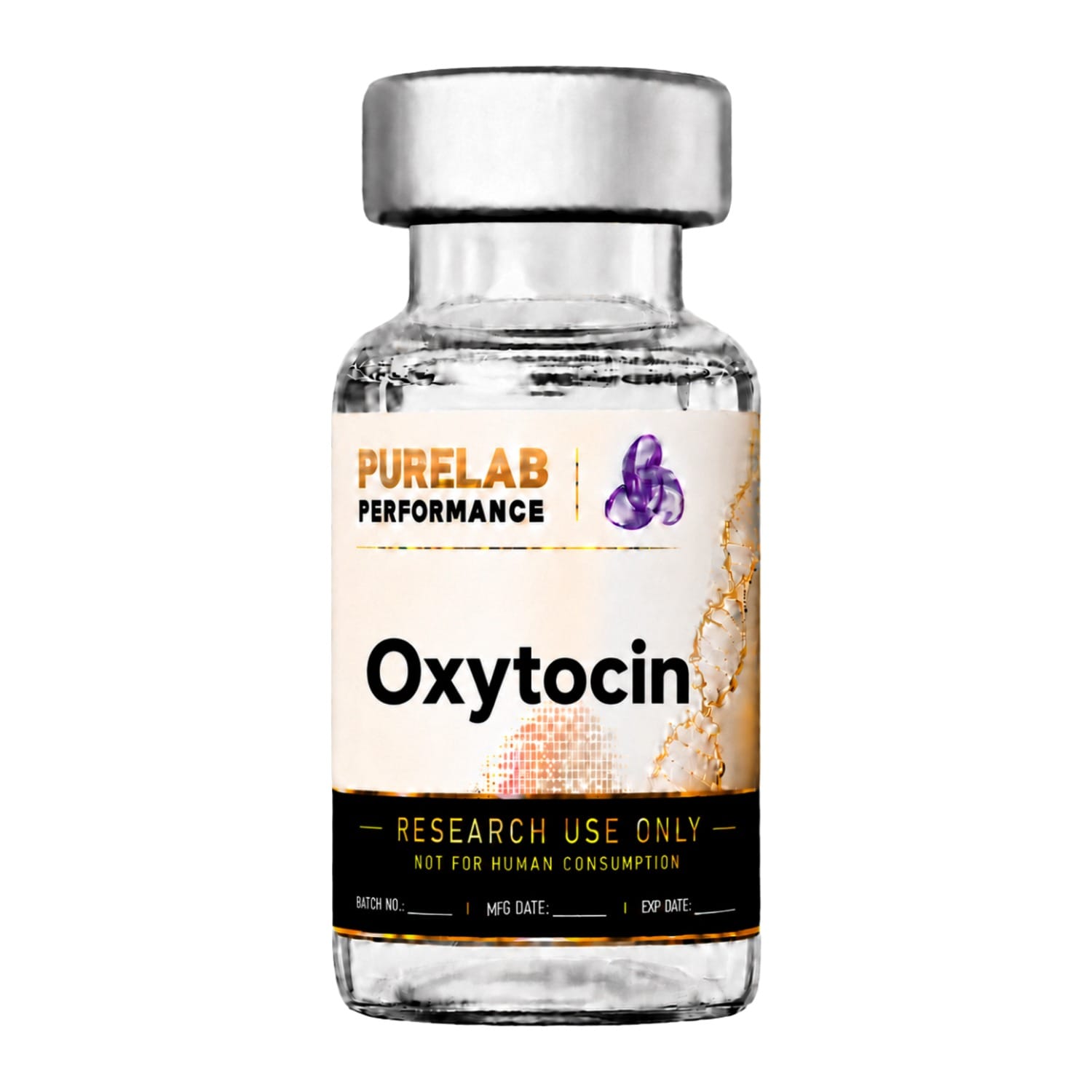
What oxytocin is
Oxytocin is a nine-residue endogenous peptide hormone, synthesised in the hypothalamus and released from the posterior pituitary. It is not a designer research compound. It has been chemically characterised since the 1950s and it is on the World Health Organization’s essential medicines list.
It is also the subject of one of the most instructive scientific reversals of the last twenty years. The story that oxytocin is “the love hormone” or “the bonding molecule” is built on a body of literature that has, when subjected to large, preregistered, adequately powered replication, repeatedly failed to replicate.
We are going to spend most of this page on that, because it is the most honest thing we can tell you about this compound and it is not on any other page you will read.
Structure and identity
Nine residues; a six-residue disulfide-bridged ring with a three-residue tail. It differs from vasopressin at two positions. That two-residue difference matters analytically — vasopressin is the single most consequential impurity to exclude, and an identity assay must resolve it.
The molecule has an FDA dossier. This vial does not.
Oxytocin the molecule is an FDA-approved drug, marketed as Pitocin and as generic oxytocin injection. Its approval is for obstetric use — induction and augmentation of labour, and control of postpartum uterine bleeding — administered intravenously or intramuscularly, in a hospital, by clinicians, with continuous fetal and uterine monitoring.
That dossier covers a sterile injectable finished product made under cGMP, with a defined potency in USP units, a defined impurity profile, a boxed warning, and a monitoring protocol. It is attached to that product, in that setting, for that use.
It is not attached to a research powder in a glass vial. It is not attached to the intranasal route. It is not attached to any social, behavioural, or “bonding” use — oxytocin has never been approved for any psychiatric or behavioural indication by any regulator, anywhere. The existence of an approval for uterine contraction is not evidence for anything else, and the FDA has never evaluated it for anything else.
An approval you can point to is not the same as an approval that covers what you are doing. We sell the vial and we are telling you the difference.
Where the evidence stands
Decades of trials; Cochrane systematic reviews; FDA-approvedEstablished
Uterine tachysystole, fetal distress, need for immediate deliverySerious
Nature; n=128; foundational to the entire social-oxytocin fieldHistoric
n=321, >95% power. No effect on trusting behaviour.Failed to replicate
n=532 pooled. Equivalence testing: effect is within a minimal range.Failed to replicate
NEJM, placebo-controlled, in children and adolescentsNegative
Documented by a laboratory opening its own file drawerDemonstrated
The approved use, and its risks human
A 2018 Cochrane systematic review of intravenous oxytocin in induced labour opens with the following characterisation, which we quote because it is the sober clinical view of this molecule: “Oxytocin is an effective drug for this purpose, but associated with serious adverse effects of which uterine tachysystole, fetal distress and the need for immediate delivery are the most common.”[1]
The review analysed ten randomised trials in 1,888 women. Discontinuing IV oxytocin once the active phase of labour was established probably reduced the risk of uterine tachysystole combined with abnormal fetal heart rate compared with continuing it (RR 0.15, 95% CI 0.05 to 0.46, 3 trials, 486 women, moderate-certainty evidence), and probably reduced abnormal intrapartum cardiotocography (RR 0.65, 95% CI 0.51 to 0.83, 7 trials, 1,390 women)[1].
Read that as what it is: an entire clinical literature dedicated to giving less of this drug, because giving more of it causes the uterus to contract too hard and the fetus to become distressed. This is a powerful pharmacological agent with a narrow therapeutic window in the one setting where it has been rigorously studied.
The social-bonding literature human
In 2005, Nature published “Oxytocin increases trust in humans.” Intranasal oxytocin, versus placebo, increased the money investors transferred to trustees in an economic trust game. The authors concluded that oxytocin “causes a substantial increase in trust among humans,” specifically affecting willingness to accept social risk rather than risk in general[2].
It is one of the most cited papers in social neuroscience. It launched a field, a supplement industry, and the phrase “the cuddle hormone.”
The replication failure — in detail
2020 — Registered replication, Nature Human Behaviour. Declerck and colleagues, including Ernst Fehr (a co-author of the original 2005 paper), ran a large double-blind, placebo-controlled preregistered replication with more than 95% statistical power and n=321, implementing the minimal-social-contact condition of the original design. Result, verbatim: “We find no effect of OT on trusting behaviour in the MSC condition.” An exploratory post-hoc signal in a no-social-contact condition was explicitly flagged as requiring confirmation[3].
2026 — Pooled equivalence testing, Cortex. Kroll and colleagues ran a further large registered-report replication (n=211), then pooled it with the Declerck data for a combined n=532. Result: no evidence that intranasal oxytocin increases trusting behaviour, in either dataset. Equivalence testing in the pooled sample indicated the effect “lies within a minimal range of effects” — i.e. small enough to be of no practical interest. No moderation by baseline trust, reward sensitivity, or punishment sensitivity. The authors call for “a reconsideration of OXT’s involvement in social behaviours and beyond.”[4]
2016 — The file drawer, opened. A research group published an audit of its own unpublished intranasal-oxytocin studies: eight studies, thirteen dependent variables, twenty-five paradigms, 453 subjects, run between 2009 and 2014. Their conclusion: “the results obtained were too often not those that were expected. Only five publications emerged from our studies and only one of these reported a null finding.” They published the drawer contents specifically because their publication portfolio “has become less and less representative of our actual findings.”[5]
That is not one failed study. That is a preregistered high-powered replication, a pooled equivalence analysis across two large replications, and a laboratory publicly documenting that its own positive publications were unrepresentative of its own data. Whatever intranasal oxytocin does to human social behaviour, the effect that launched the field is not there when you look for it properly.
The autism trial human
The largest and most rigorous clinical test of intranasal oxytocin for a social outcome was a randomised, placebo-controlled trial in children and adolescents with autism spectrum disorder, published in the New England Journal of Medicine in 2021[6]. It was designed with the field’s own preferred population, its own preferred outcome, and adequate power.
It did not find a benefit on its primary outcome.
A 2016 review, written by researchers broadly sympathetic to the oxytocin field, had already stated the position plainly: average effect sizes in oxytocin experiments are small to modest, most studies are seriously underpowered, this implies a high risk of publication bias and non-replicability, and “clinical application of oxytocin is premature”[7]. The NEJM trial is what happened when the question was finally asked properly.
Does intranasal oxytocin even reach the brain? pharmacology
Underneath the replication problem sits a pharmacokinetic one. A 2015 review in Biological Psychiatry, titled “Intranasal Oxytocin: Myths and Delusions,” makes the following argument[8]:
- Very little of the large amounts applied intranasally appears to reach the cerebrospinal fluid.
- Peripheral concentrations are raised to supraphysiological levels — with likely effects on the gastrointestinal tract, the heart, and the reproductive tract.
- Claims that peripheral oxytocin measurements reflect central release are, in the authors’ words, “questionable at best.”
- Many oxytocin measurements in the literature were made with “discredited methodology.”
- The authors’ summary: “The wish to believe in the effectiveness of intranasal oxytocin appears to be widespread and needs to be guarded against with scepticism and rigor.”
Note what the second bullet implies. The route that produces the least central exposure produces the most peripheral exposure — to a hormone whose best-documented peripheral action is making smooth muscle contract.
Limitations of the literature
The positive literature is systematically distorted. This is not an accusation; it is documented, by the researchers themselves, with numbers[5]. Any meta-analysis of the intranasal social-oxytocin literature is a meta-analysis of a biased sample, and the people who built the field are the ones saying so.
Small underpowered studies are the norm. The 2016 review notes most studies in this field include small numbers of subjects and are seriously underpowered[7]. Underpowered studies do not merely fail to detect real effects — they systematically overestimate the size of any effect they do report.
The strongest evidence is for the use nobody buying this powder intends. The rigorous, replicated, regulator-reviewed evidence for oxytocin is obstetric, intravenous, hospital-based, and comes with a serious adverse-event profile.
Regulatory and anti-doping status
Oxytocin does not appear on the 2026 WADA Prohibited List[9]. Section S0 of that list prohibits substances with no current approval by any governmental regulatory health authority for human therapeutic use; oxytocin holds such approval, so S0 does not capture it. Our spec block records this as a neutral data field, in the same register as the CAS number.
Anti-doping lists change annually and by governing body. If you compete under any tested organisation, the only reliable source is that organisation’s current prohibited list — not this page, and not any vendor’s.
Oxytocin’s FDA approval covers a sterile injectable finished product for obstetric indications. It has never been approved for any psychiatric, behavioural, social or performance indication, by the FDA or any other regulator, and it has never been approved for intranasal administration in the United States.
What we don’t know
- Whether intranasal oxytocin has any reliable effect on human social behaviour. The best-powered attempts to find one have not found one.
- How much, if any, intranasally administered oxytocin reaches the human brain. The pharmacokinetics remain poorly characterised.
- What supraphysiological peripheral oxytocin exposure does over repeated dosing outside a monitored obstetric setting. Nobody has studied it, because there is no indication that would justify studying it.
- Long-term safety of non-obstetric human exposure is uncharacterised. Per-kilogram dosing in animal models does not scale to humans, and nothing on this page should be read as implying that it does.
We supply this compound for laboratory research. It is a well-characterised, genuinely important molecule with a real approved use and a cautionary tale attached. We are not going to pretend it is more than it is.
Oxytocin supplied by PureLab Performance is furnished strictly for in-vitro laboratory research. It is not a medicine or a drug and has not been approved by the FDA to prevent, treat, or cure any medical condition, ailment, or disease. Bodily introduction of any kind into humans or animals is strictly forbidden by law. Per-kilogram dosing in animal models does not scale to humans. Purchasers must be 18 or older and qualified to handle research chemicals.
References
Retrieved from PubMed, PubChem and the World Anti-Doping Agency. DOIs link to the original publications.
- Boie S, Glavind J, Velu AV, Mol BWJ, Uldbjerg N, de Graaf I, Thornton JG, Bor P, Bakker JJH. “Discontinuation of intravenous oxytocin in the active phase of induced labour.” Cochrane Database Syst Rev. 2018;8(8):CD012274. DOI
- Kosfeld M, Heinrichs M, Zak PJ, Fischbacher U, Fehr E. “Oxytocin increases trust in humans.” Nature. 2005;435(7042):673–76. DOI
- Declerck CH, Boone C, Pauwels L, Vogt B, Fehr E. “A registered replication study on oxytocin and trust.” Nat Hum Behav. 2020;4(6):646–55. DOI
- Kroll CF, Schruers KRJ, Viechtbauer W, Vingerhoets C, Seidel L, Riedl A, Hernaus D. “Absence of a meaningful effect of intranasal oxytocin on trusting behavior: a registered report with pooled equivalence testing.” Cortex. 2026;198:208–33. DOI
- Lane A, Luminet O, Nave G, Mikolajczak M. “Is there a Publication Bias in Behavioural Intranasal Oxytocin Research on Humans? Opening the File Drawer of One Laboratory.” J Neuroendocrinol. 2016;28(4). DOI
- Sikich L, et al. “Intranasal Oxytocin in Children and Adolescents with Autism Spectrum Disorder.” N Engl J Med. 2021;385(16):1462–73. DOI
- van IJzendoorn MH, Bakermans-Kranenburg MJ. “The Role of Oxytocin in Parenting and as Augmentative Pharmacotherapy: Critical Issues and Bold Conjectures.” J Neuroendocrinol. 2016;28(8). DOI
- Leng G, Ludwig M. “Intranasal Oxytocin: Myths and Delusions.” Biol Psychiatry. 2016;79(3):243–50. DOI
- World Anti-Doping Agency. The Prohibited List. Oxytocin is not named on the 2026 List. wada-ama.org
- National Center for Biotechnology Information. PubChem Compound Summary for CID 439302, Oxytocin. CAS 50-56-6. PubChem
Reviews
There are no reviews yet.