
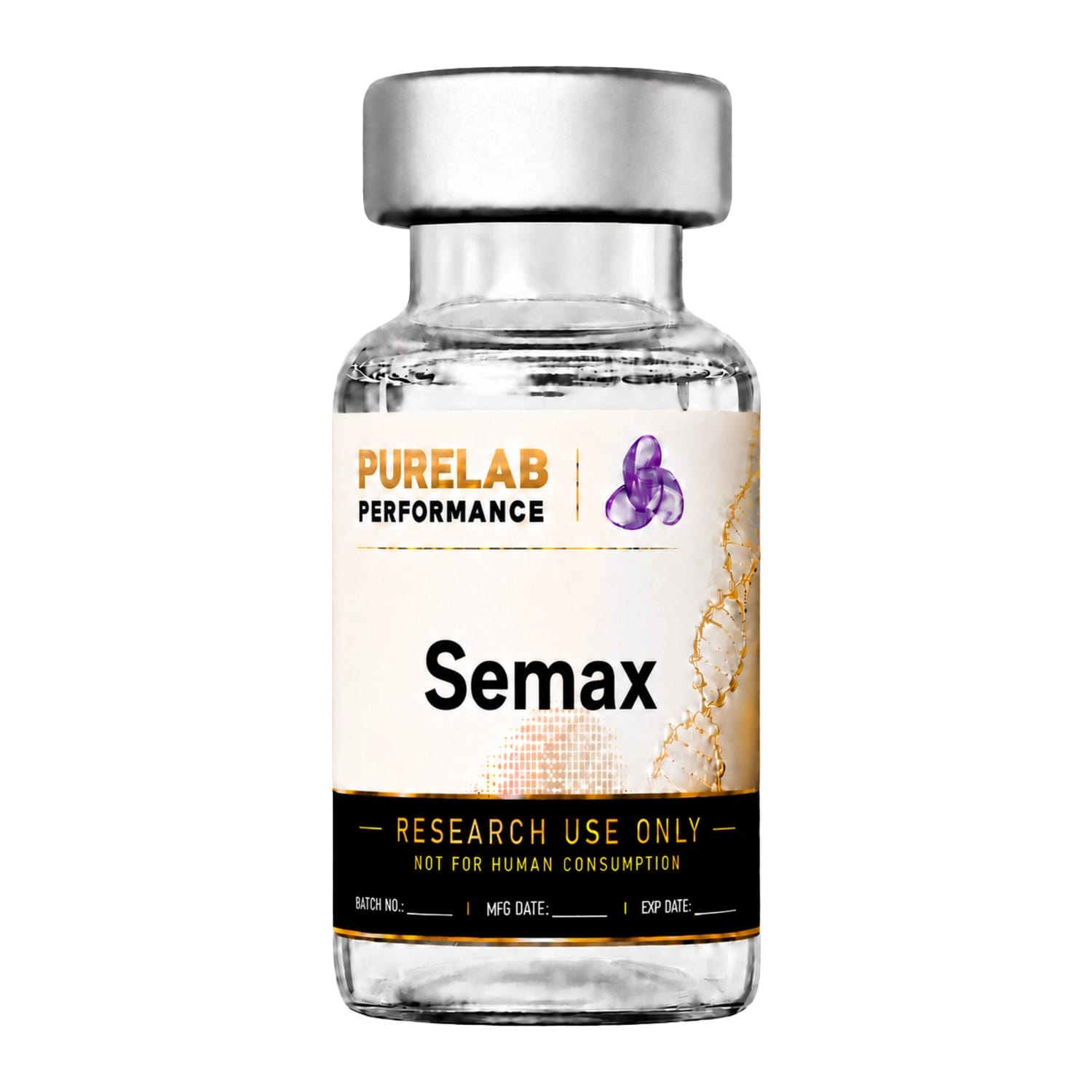
What Semax is
Semax is a synthetic heptapeptide consisting of the 4–7 fragment of adrenocorticotropic hormone (ACTH), extended with a C-terminal Pro-Gly-Pro tripeptide. It was developed at the Institute of Molecular Genetics of the Russian Academy of Sciences and is a registered medicine in Russia. It is not approved in the EU, the UK, or the United States.
The ACTH(4-7) core is a melanocortin fragment stripped of the sequence responsible for ACTH’s steroidogenic activity — the design intent being to retain putative central effects without triggering adrenal cortisol release. This page is organised around one question: what has actually been measured, and in what.
Structure and identity
Identity fields above are drawn from PubChem and are independently checkable at the link. Every batch we supply is assayed by an independent laboratory using HPLC-UV-MS against an authentic reference standard.
For the current lot, that certificate is pending. We will publish it in full when it is issued. Until then we print no purity number, because we do not have one we can stand behind.
Where the evidence stands
This is the section most vendors skip. It is the most important one on the page.
Neurotrophin and receptor gene transcription measured in rat cortex after arterial occlusionSome
Focal cerebral ischaemia models; almost entirely from the originating institutionsModerate
Russian-language reports; not indexed to Western trial-registry standardsLimited
No adequately powered trial outside the originating research networkNone
The application it is overwhelmingly sold forNone
The ACTH fragment design in vitro
Semax’s core is ACTH(4-7) — Met-Glu-His-Phe. The full ACTH molecule drives cortisol release from the adrenal cortex; this fragment does not carry the region responsible for that activity. The appended Pro-Gly-Pro is a stabilising extension that slows peptidase degradation, the same design trick used in Selank.
This is a coherent medicinal-chemistry rationale. It is a statement about what the molecule is not expected to do. It is not evidence of what it does.
Transcriptional effects in rat cortex rat
The most concrete mechanistic result comes from a 2010 study in Cellular and Molecular Neurobiology. Rats underwent permanent middle cerebral artery occlusion — an induced stroke — and cortical tissue was assayed for neurotrophin and neurotrophin-receptor mRNA at 3, 24 and 72 hours[1]. The measured findings:
- Semax increased transcription of Bdnf, TrkC and TrkA at 3 hours post-occlusion
- It increased Nt-3 and Ngf at 24 hours, and Ngf at 72 hours
- The authors report that Semax’s effect was selective to the ischaemic cortex — it did not produce the same profile in sham-operated or unoperated animals
Read what that says. These are mRNA transcription levels, in rat cortex, after an experimentally induced stroke. They are not behavioural outcomes, not functional recovery, and not human results. “Semax raises BDNF” — the claim you will see everywhere — is a compressed and misleading rendering of “Semax altered Bdnf transcript abundance in injured rat cortex at 3 hours.”
The PGP control problem
The same 2010 study ran a control that is almost never mentioned in marketing copy, and it is the most interesting thing in the paper.
The authors also tested PGP alone — the Pro-Gly-Pro tripeptide tail, without the ACTH fragment. PGP on its own also activated transcription of neurotrophins and their receptors, enhancing Bdnf and TrkC at 3 hours and Ngf, TrkB, TrkC and TrkA at 24 hours[1]. The transcriptional profiles of Semax and bare PGP partially overlapped.
In other words: a substantial part of the transcriptional signature attributed to “Semax” was reproduced by a three-amino-acid fragment that is not the active pharmacophore Semax is supposed to have. The authors’ distinction is that Semax’s effect was ischaemia-selective while PGP’s was “mainly unspecific” — a real difference, but a much narrower claim than the one the market makes.
Mechanism — unresolved preclinical
There is no agreed receptor for Semax. Proposals circulate; none is settled. A 2016 Russian review, for instance, works through the hypothesis that Semax’s described effects might be mediated indirectly via transthyretin, on the basis of overlapping transcriptional signatures in the ischaemic rat brain[2]. The paper is explicit that the mechanisms “are insufficiently understood”.
That candour is worth honouring. A compound sold for two decades whose developers describe its mechanism as insufficiently understood is a compound with a mechanism problem, not a mechanism.
The human data — all of it human
Semax is used clinically in Russia, principally in acute ischaemic stroke. The supporting human literature is in Russian, is generated within the originating research network, and has not been reproduced by any independent group under Western trial-registry and blinding standards. It is not indexed in a way that permits the kind of scrutiny a Western stroke trial would receive — and stroke is a field with a long, expensive history of neuroprotective agents that looked convincing in rodents and then failed in humans.
There is no trial of Semax in healthy human subjects for cognitive enhancement. None. That is the use for which it is almost exclusively sold outside Russia, and it has never been tested.
Limitations of the literature
The literature is captured. Effectively all positive evidence originates from the network that developed and commercialised the compound. No adversarial replication exists.
The control condition undercuts the headline. See §6. A large part of the transcriptional effect was reproduced by the peptide’s inert-by-design tail.
The model is a stroke, not a healthy brain. Every mechanistic result of note was measured in acutely injured tissue. Extrapolating from “altered neurotrophin transcription in infarcted rat cortex” to “improved cognition in an uninjured human” is not a small inferential step. It is an unbridged chasm, and no paper crosses it.
On “nootropic” claims
We are not going to make any. Not because we are being coy, but because the studies that would license such a claim have not been run — in humans, in healthy subjects, on any cognitive endpoint, by anyone. Vendors who describe Semax’s effects on focus, memory or mental clarity are describing something that exists in testimonials and does not exist in the literature.
Regulatory and anti-doping status
Semax is not listed by name on the WADA 2025 Prohibited List. Section S0 (Non-Approved Substances) prohibits at all times any pharmacological substance with no current approval by any governmental regulatory health authority for human therapeutic use. As with Selank, Semax’s S0 position is genuinely ambiguous because it holds Russian regulatory registration, and S0’s text turns on approval by “any governmental regulatory health authority”. We flag the ambiguity rather than resolve it.
Separately worth knowing: Semax is a fragment of a peptide hormone (ACTH), and corticotrophins are prohibited under S2.2. Semax is not ACTH and does not carry ACTH’s steroidogenic sequence, so S2.2 does not on its face apply — but an athlete relying on that reading is relying on their own chemistry, not on a ruling.
Anti-doping lists change annually and by governing body. If you compete under any tested organisation, the only reliable source is that organisation’s current prohibited list — not this page, and not any vendor’s.
Semax has not been approved by the FDA or by EU/UK regulators for any human therapeutic use.
What we don’t know
- Whether Semax has any measurable effect on cognition in a healthy human. Never tested.
- What its receptor is. There is no consensus target.
- How much of its activity is attributable to the ACTH(4-7) core rather than the PGP tail[1].
- Its human pharmacokinetics by the intranasal route in which it is most commonly used.
- Long-term human safety, at any dose.
We supply this compound for laboratory research. The rat ischaemia transcriptomics is real work. Nothing in it supports the product it has been turned into.
Semax supplied by PureLab Performance is furnished strictly for in-vitro laboratory research. It is not a medicine or a drug and has not been approved by the FDA to prevent, treat, or cure any medical condition, ailment, or disease. Bodily introduction of any kind into humans or animals is strictly forbidden by law. Per-kilogram dosing in animal models does not scale to humans. Purchasers must be 18 or older and qualified to handle research chemicals.
References
Retrieved from PubMed. DOIs link to the original publications. Chemical identity data retrieved from PubChem.
- Dmitrieva VG, Povarova OV, Skvortsova VI, Limborska SA, Myasoedov NF, Dergunova LV. “Semax and Pro-Gly-Pro activate the transcription of neurotrophins and their receptor genes after cerebral ischemia.” Cell Mol Neurobiol. 2010;30(1):71–9. DOI
- Vyunova TV, Medvedeva EV, Andreeva LA, Dergunova LV, Limborska SA, Myasoedov NF. “[Possible role of transthyretin in the biological mechanism of the regulatory peptide neuroprotection].” Mol Gen Mikrobiol Virusol. 2016;34(3):104–109. PubMed
- National Center for Biotechnology Information. “PubChem Compound Summary for CID 9811102, Semax.” PubChem
- World Anti-Doping Agency. “The 2025 Prohibited List — International Standard.” Sections S0 (Non-Approved Substances) and S2.2 (Peptide hormones and their releasing factors). WADA
Reviews
There are no reviews yet.