
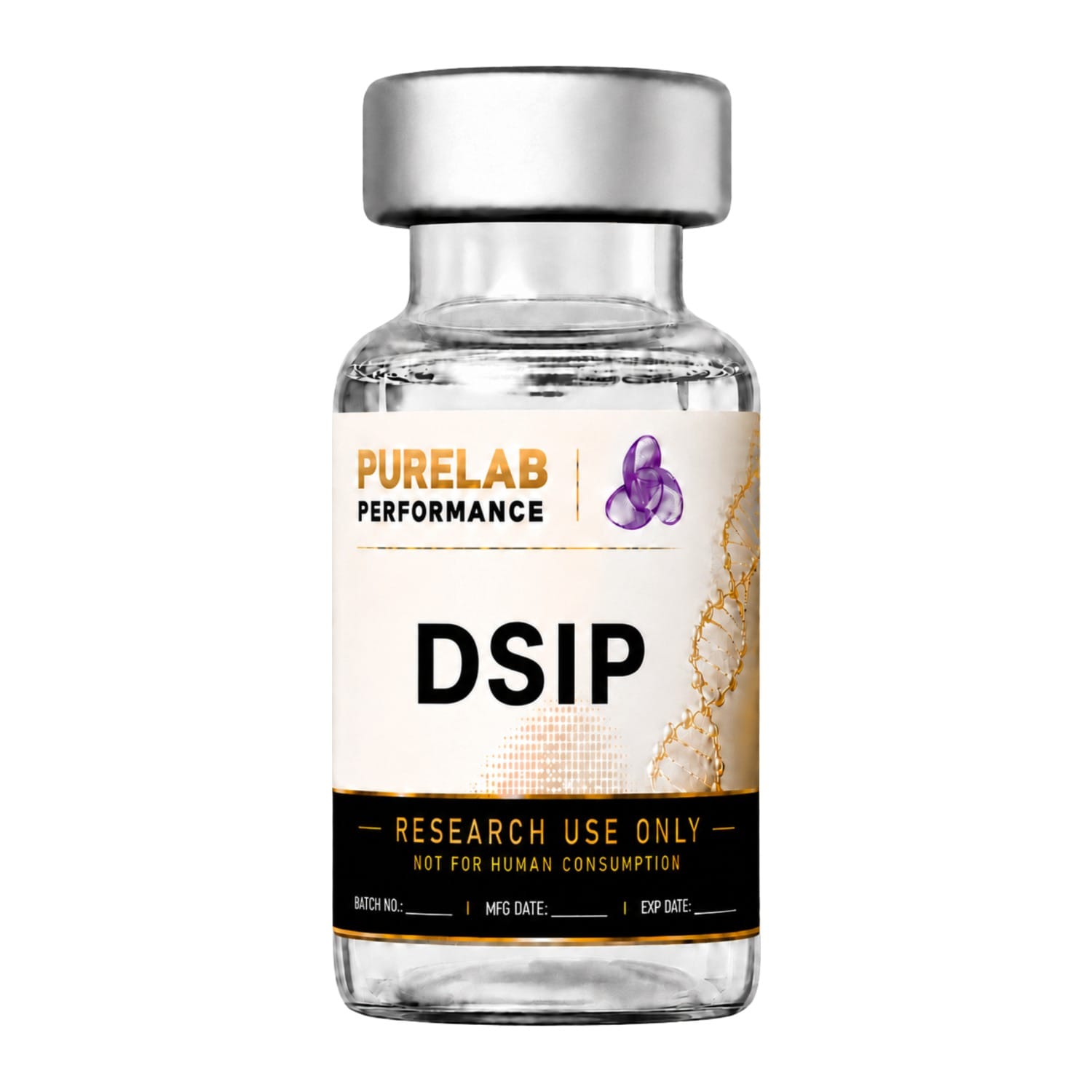
What DSIP is
DSIP is a synthetic nonapeptide — nine amino acids — first described in the late 1970s after being recovered from the cerebral venous blood of rabbits induced into a sleep-like state by electrical stimulation of the thalamus. It carries the International Nonproprietary Name emideltide.
The name is the marketing. “Delta sleep-inducing peptide” was a hypothesis given a name before it was a demonstrated effect, and the name has outlived the evidence by roughly four decades. This page is organised around one question: what has actually been measured, and in what.
Structure and identity
Identity fields above are drawn from PubChem and are independently checkable at the link. Every batch we supply is assayed by an independent laboratory using HPLC-UV-MS: the mass spectrum is compared against an authentic reference standard to confirm molecular identity, peak area is measured against the total chromatogram to establish chromatographic purity, and total peptide mass in the vial is measured against the stated label claim.
For the current lot, that certificate is pending. We will publish it in full when it is issued. Until then we print no purity number, because we do not have one we can stand behind.
Where the evidence stands
This is the section most vendors skip. It is the most important one on the page.
Blood–brain barrier passage characterised in rodent modelsSome
Rodent sleep architecture, seizure models, stress paradigms. Results inconsistent across groups.Moderate
A small number of open-label and small-sample reports, mostly 1980s, mostly not replicatedMinimal
Peak publication activity was the 1980s; the field has largely moved onDormant
The 1977 origin claim
DSIP entered the literature as an isolate from rabbit cerebral venous blood, with the claim that transferring it into recipient animals promoted delta-wave (slow-wave) sleep. The molecule was sequenced, synthesised, and named after the effect it was proposed to have.
That naming decision matters. A compound called “delta sleep-inducing peptide” carries an implied result in its own label, and a great deal of subsequent enthusiasm has rested on the name rather than on replication. The physiological role of endogenous DSIP — including whether the peptide functions as a genuine endogenous sleep factor at all — has never been established to the standard the name implies.
Sleep — the founding claim rodent
The rodent sleep literature on DSIP is genuinely mixed. Some groups reported increases in slow-wave sleep after administration; others reported no effect, effects only at particular circadian phases, or effects that did not survive controlled replication. There is no consensus dose, no consensus route, and no consensus mechanism.
A review of the sleep-peptide literature in the context of experimental epilepsy notes that DSIP and its analogues are discussed as candidate regulators sitting at the intersection of sleep–wake cycling and cortical excitability — which is to say, as a hypothesis, not a settled pharmacology[3].
A named effect is not a demonstrated effect. The sleep result that gave DSIP its name has never been established in a modern, adequately powered, randomised human trial, and the animal literature that followed it is inconsistent rather than convergent. Anyone selling DSIP on the strength of its name is selling you a 1977 hypothesis.
Blood–brain barrier transport preclinical
The most solid mechanistic work involving DSIP is not about sleep at all — it is about transport. DSIP was one of the peptides central to establishing that peptides can cross the blood–brain barrier, and that saturable transport systems exist at that barrier[1].
This is a real and durable contribution. It is also, precisely, a finding about transport kinetics in rodent models. It says that the molecule can get in. It says nothing about what it does once it is there.
Seizure models rodent
DSIP and its analogues have been examined in rodent models of chemically-induced convulsive activity, where they have been discussed as candidate endogenous stabilisers of brain excitability[2][3]. These are rodent electrophysiology and behavioural-seizure endpoints in acute models. They are not clinical findings, they are not efficacy findings, and they must not be read as either.
Stress and endocrine models rodent
DSIP appears in the Russian-language stress-physiology literature as one of a group of oligopeptides discussed as putative “anti-stress” factors modulating tolerance to emotional stress in animal paradigms[4]. That literature is largely theoretical, largely review-level, and has had very little independent Western replication. We list it because it exists, not because it is strong.
The human data — all of it
There is no modern randomised, placebo-controlled trial of DSIP in humans. The human record consists of a scatter of small, mostly open-label reports from the 1980s, in heterogeneous populations, with heterogeneous endpoints, and no successful replication programme. Publication activity in the field has been effectively dormant for decades.
We are not going to construct a table of human evidence out of that, because there is not enough of it to fill a table honestly.
“No modern human trials” is not the same as “safe” and it is not the same as “ineffective”. It means the question has not been asked properly. Long-term safety in humans is uncharacterised. There is no established human pharmacokinetic profile, no established dose, and no established route.
Limitations of the literature
The literature is old and it stopped. Most DSIP work clusters in the 1980s. When a field goes quiet, it is sometimes because the question was answered. Here it is more likely that the question stopped being interesting because the results would not replicate. Either way, an old literature that nobody continued is a weak literature, not a deep one.
The name is doing argumentative work the data cannot. “Delta sleep-inducing peptide” is a hypothesis-as-a-name. Treat every claim built on that name with the scepticism you would apply to any forty-year-old unreplicated result.
No agreed receptor or mechanism. Unlike compounds with a defined target, DSIP has no settled mechanistic account. Proposals exist. Consensus does not.
Regulatory and anti-doping status
DSIP is not listed by name on the WADA 2025 Prohibited List. That is not the end of the analysis. Section S0 (Non-Approved Substances) prohibits at all times any pharmacological substance not addressed by another section of the List and with no current approval by any governmental regulatory health authority for human therapeutic use. DSIP holds no such approval known to us, which on a plain reading places it within S0 — prohibited at all times, in and out of competition.
Anti-doping lists change annually and by governing body. If you compete under any tested organisation, the only reliable source is that organisation’s current prohibited list — not this page, and not any vendor’s.
DSIP has not been approved by the FDA or other major regulators for any human therapeutic use.
What we don’t know
- Whether DSIP has any reproducible effect on sleep architecture in humans. This has never been tested to a modern standard.
- What its receptor or molecular target is. There is no consensus.
- Its human pharmacokinetics, half-life, or bioavailability by any route.
- Long-term safety in humans — entirely uncharacterised.
- Whether the endogenous peptide has a physiological role at all.
We supply this compound for laboratory research. The transport biology is real and historically important. Almost everything else attached to the name is unfinished business.
DSIP supplied by PureLab Performance is furnished strictly for in-vitro laboratory research. It is not a medicine or a drug and has not been approved by the FDA to prevent, treat, or cure any medical condition, ailment, or disease. Bodily introduction of any kind into humans or animals is strictly forbidden by law. Per-kilogram dosing in animal models does not scale to humans. Purchasers must be 18 or older and qualified to handle research chemicals.
References
Retrieved from PubMed. DOIs link to the original publications. Chemical identity data retrieved from PubChem.
- Banks WA. “Peptides and the blood-brain barrier.” Peptides. 2015;72:16–9. DOI
- Stanojlović O, Hrnčić D, Radosavljević T. “[Endogenous anticonvulsants: neuropeptide Y and delta sleep inducing peptide].” Med Pregl. 2008;61(5-6):252–5. DOI
- Stanojlović O, Hrnčić D, Rašić-Marković A, Macut Dj, Djurić D, Šušić V. “[Sleep peptides in experimental models of epilepsy].” Glas Srp Akad Nauka Med. 2011;(51):141–9. PubMed
- Sudakov KV. “[Evolution of the stress concept].” Vestn Ross Akad Med Nauk. 2008;(11):59–66. PubMed
- National Center for Biotechnology Information. “PubChem Compound Summary for CID 68816, Emideltide (delta sleep-inducing peptide).” PubChem
- World Anti-Doping Agency. “The 2025 Prohibited List — International Standard.” Section S0, Non-Approved Substances. WADA
Reviews
There are no reviews yet.