
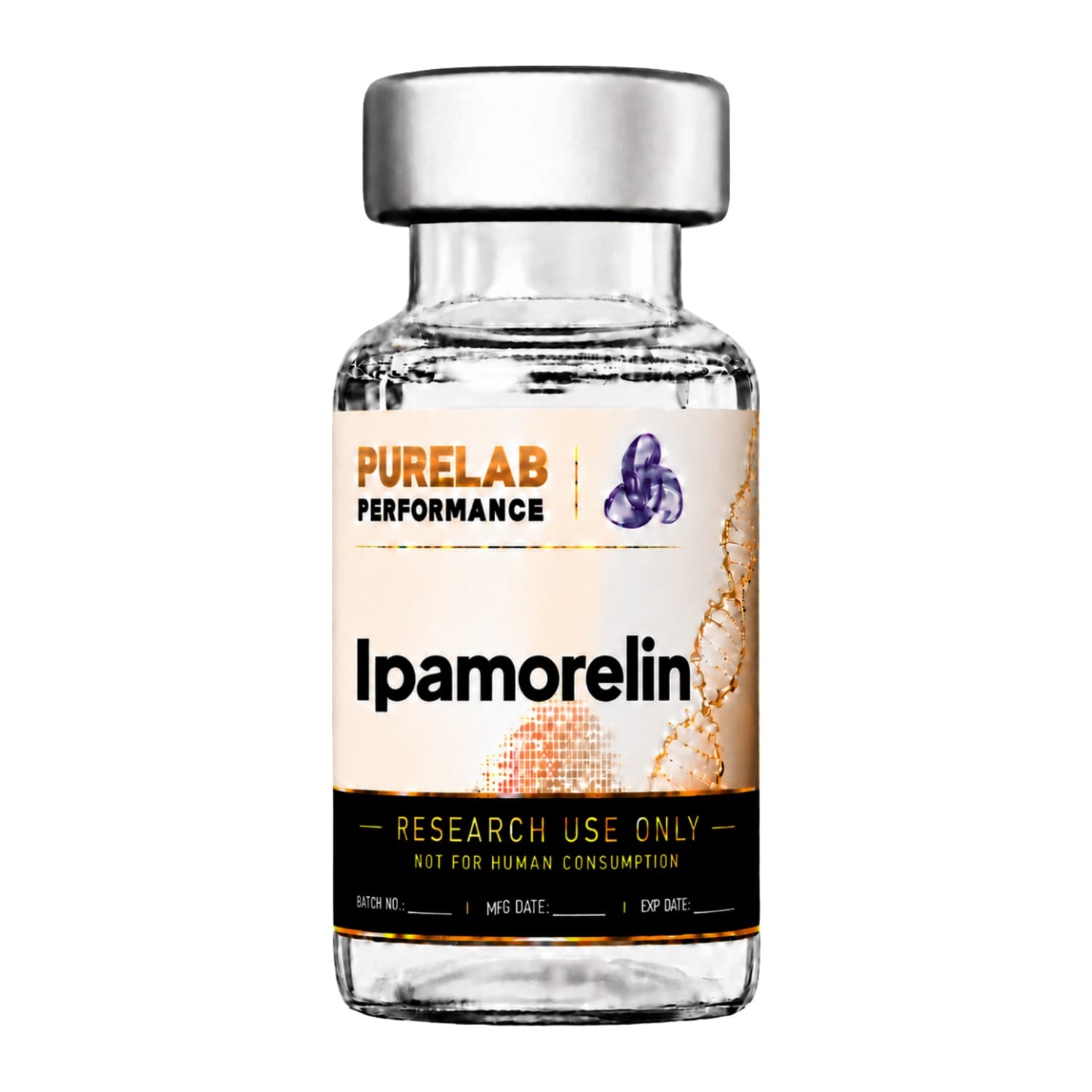
What ipamorelin is
Ipamorelin is a synthetic pentapeptide developed at Novo Nordisk in the 1990s under the code NNC 26-0161. It is an agonist at the growth hormone secretagogue receptor — the ghrelin receptor — and was derived from GHRP-1 by removing the central Ala-Trp dipeptide[1].
It has a genuine claim to being a scientifically interesting molecule, and a genuine clinical record of not working. Both of those are on this page.
Structure and identity
Five residues, two of them non-proteinogenic: alpha-aminoisobutyric acid at position 1 and 3-(2-naphthyl)-D-alanine at position 3. It is by some distance the smallest and best-characterised molecule in this section of the catalogue. Identity confirmation by mass spectrometry is straightforward at 711.9 g/mol.
Every batch we supply will be assayed by an independent laboratory using HPLC-UV-MS. The certificate for the current lot is pending.
Where the evidence stands
This is the section most vendors skip. It is the most important one on the page.
GH release from primary rat pituitary cells; receptor pharmacology with GHRP and GHRH antagonistsSolid
Rat, swine, ferret. GH release, bone formation under glucocorticoid, postoperative ileus, cisplatin weight lossExtensive
n=117 proof-of-concept. Primary endpoint not met (p=0.15)Negative
n=320, completed 2014. No results posted. No publication.Silent
The selectivity finding in vitro animal
The 1998 European Journal of Endocrinology paper that introduced ipamorelin is titled, without hedging, “Ipamorelin, the first selective growth hormone secretagogue”[1]. What was measured:
- In primary rat pituitary cells, ipamorelin released GH with potency and efficacy similar to GHRP-6 (EC50 1.3 ± 0.4 nmol/L; Emax 85 ± 5% of the GHRP-6 maximum).
- In anaesthetised rats, ED50 80 ± 42 nmol/kg.
- In conscious swine, ED50 2.3 ± 0.03 nmol/kg.
- Antagonist profiling confirmed it acts through a GHRP-like receptor, not the GHRH receptor.
- The selectivity result. In swine, GHRP-6 and GHRP-2 both raised plasma ACTH and cortisol. Ipamorelin did not — even at doses more than 200-fold above its ED50 for GH release. It also did not move FSH, LH, prolactin or TSH.
That is a real and reproducible pharmacological distinction, and it is the reason ipamorelin is still discussed thirty years later. It is a finding about hormone concentrations in pigs and rats. It is not a finding about anything in a person.
Animal models rodent
In 8-month-old female rats given methylprednisolone for three months, animals receiving ipamorelin alongside the glucocorticoid showed significantly greater maximum tetanic tension of the calf muscles and a four-fold higher periosteal bone formation rate than animals given the glucocorticoid alone[2]. In a rat model of postoperative ileus, repeated intravenous dosing increased cumulative faecal pellet output, food intake and body-weight gain relative to vehicle[3]. In ferrets, ipamorelin did not affect cisplatin-induced emesis but reduced associated weight loss by roughly 24% in the delayed phase[4].
These are rodent, porcine and ferret findings. The postoperative-ileus result in rats is specifically what motivated the human trials described below — which makes what happened next worth reading carefully.
The Phase 2 trial that missed human
Helsinn Therapeutics ran a multicentre, double-blind, placebo-controlled Phase 2 trial of intravenous ipamorelin (0.03 mg/kg twice daily, for up to seven days) in 117 adults undergoing open or laparoscopic small- or large-bowel resection. It is registered as NCT00672074 and was published in 2014 in the International Journal of Colorectal Disease[5].
The key efficacy endpoint was time from first dose to tolerance of a standardised solid meal.
Median time to first tolerated meal: 25.3 hours on ipamorelin, 32.6 hours on placebo — p = 0.15. Not statistically significant. The authors’ own conclusion, verbatim: “There were no significant differences between ipamorelin and placebo in the key and secondary efficacy analyses.”
Treatment-emergent adverse events occurred in 87.5% of the ipamorelin group and 94.8% of the placebo group. The drug was well tolerated. It simply did not beat placebo.
A seven-hour numerical difference that does not reach significance in 114 evaluable patients is exactly the kind of result that gets quoted as “ipamorelin accelerated recovery by 7 hours.” It did not. The trial was, in the authors’ framing, small and heterogeneous — but it was the trial that was run, and it did not show an effect.
Why it never went further
Helsinn ran a second, larger Phase 2: a 320-patient, double-blind, placebo-controlled dose-finding study of ipamorelin for recovery of gastrointestinal function after bowel resection, registered as NCT01280344, across 45 sites. It started in April 2011 and completed in May 2014[6].
No results have been posted to the registry. No publication of it appears in PubMed. There was no Phase 3. There has been no further clinical development of ipamorelin by anyone, anywhere, in the decade since.
We cannot tell you what that trial found, because nobody published it. We can tell you what a completed 320-patient Phase 2 followed by twelve years of silence conventionally indicates. That is the honest answer to “why did ipamorelin never advance past early clinical trials”: it was advanced, it was tested at scale, and the programme stopped.
Detection and doping controls
Ipamorelin is a routine target in sports drug testing. A direct-urine-injection LC–ion-mobility–TOF-MS assay covering ipamorelin and sixteen other prohibited peptides achieves limits of detection between 50 and 500 pg/mL, against a WADA minimum required performance level of 2 ng/mL[7]. A 2026 harmonised workflow extends coverage to 54 compounds in dried blood spots, serum and plasma[8].
Limitations of the literature
The preclinical work does not predict the clinical result. Ipamorelin is a clean demonstration of this. Rat and pig data were strong, consistent and mechanistically coherent. The human trial was negative. The number of positive animal papers was not the strength of the case.
The largest human dataset is unpublished. 320 patients were exposed to this drug in a completed trial whose results have never been made public. That is a hole in the safety and efficacy record that no vendor can fill.
What is known about human safety comes from a negative trial and from case reports. The 2014 trial found ipamorelin well tolerated at 0.03 mg/kg IV for up to seven days. A 2026 review of self-administration in this class catalogues prolactin and cortisol elevations, appetite change, dysglycaemia, fluid retention, myalgia and arthralgia, and injection-site reactions across GH secretagogues generally[9]. Neither is a long-term safety database.
Regulatory and anti-doping status
Ipamorelin is named explicitly on the WADA Prohibited List under S2.2.4, Growth Hormone Releasing Factors — “growth hormone secretagogues (GHS) and their mimetics [e.g. anamorelin, capromorelin, ibutamoren (MK-677), ipamorelin, lenomorelin (ghrelin), macimorelin and tabimorelin]”[10]. Section S2 substances are prohibited at all times, in and out of competition.
Ipamorelin has not been approved for any indication by the FDA or any other regulatory authority. Anti-doping lists change annually and by governing body. If you compete under any tested organisation, the only reliable source is that organisation’s current prohibited list — not this page, and not any vendor’s.
What we don’t know
- What the 320-patient Phase 2 found. Nobody published it.
- Whether the pig-derived selectivity result (no ACTH or cortisol rise) holds in humans. That comparison has not been made.
- What subcutaneous ipamorelin does over weeks or months in a person. The only human dosing on record is intravenous, in hospital, for up to seven days.
- Long-term safety in humans is uncharacterised. Per-kilogram dosing in rodents does not scale to humans, and nothing on this page should be read as implying that it does.
We supply this compound for laboratory research. The preclinical pharmacology is genuinely good work. The clinical file is a missed endpoint and an unpublished trial. We are not going to pretend it is more than it is.
Ipamorelin supplied by PureLab Performance is furnished strictly for in-vitro laboratory research. It is not a medicine or a drug and has not been approved by the FDA to prevent, treat, or cure any medical condition, ailment, or disease. Bodily introduction of any kind into humans or animals is strictly forbidden by law. Per-kilogram dosing in animal models does not scale to humans. Purchasers must be 18 or older and qualified to handle research chemicals.
References
Retrieved from PubMed, ClinicalTrials.gov, PubChem and the World Anti-Doping Agency. DOIs link to the original publications.
- Raun K, Hansen BS, Johansen NL, Thøgersen H, Madsen K, Ankersen M, Andersen PH. “Ipamorelin, the first selective growth hormone secretagogue.” Eur J Endocrinol. 1998;139(5):552–61. DOI
- Andersen NB, Malmlöf K, Johansen PB, Andreassen TT, Ørtoft G, Oxlund H. “The growth hormone secretagogue ipamorelin counteracts glucocorticoid-induced decrease in bone formation of adult rats.” Growth Horm IGF Res. 2001;11(5):266–72. DOI
- Venkova K, Mann W, Nelson R, Greenwood-Van Meerveld B. “Efficacy of ipamorelin, a novel ghrelin mimetic, in a rodent model of postoperative ileus.” J Pharmacol Exp Ther. 2009;329(3):1110–16. DOI
- Lu Z, Ngan MP, Liu JYH, et al. “The growth hormone secretagogue receptor 1a agonists, anamorelin and ipamorelin, inhibit cisplatin-induced weight loss in ferrets.” Physiol Behav. 2024;284:114644. DOI
- Beck DE, Sweeney WB, McCarter MD, et al. “Prospective, randomized, controlled, proof-of-concept study of the ghrelin mimetic ipamorelin for the management of postoperative ileus in bowel resection patients.” Int J Colorectal Dis. 2014;29(12):1527–34. DOI · ClinicalTrials.gov NCT00672074
- Helsinn Therapeutics (U.S.), Inc. “Phase II Double-Blind Placebo-Controlled Dose Finding Study to Evaluate Safety/Efficacy of Ipamorelin Compared to Placebo for Recovery of Gastrointestinal Function…” ClinicalTrials.gov identifier NCT01280344. Enrolment 320; completed May 2014; no results posted. Registry record
- Thomas A, Görgens C, Guddat S, Thieme D, Dellanna F, Schänzer W, Thevis M. “Simplifying and expanding the screening for peptides <2 kDa by direct urine injection, liquid chromatography, and ion mobility mass spectrometry.” J Sep Sci. 2016;39(2):333–41. DOI
- Mazzarino M, Colpaert T, Deventer K, Van Eenoo P. “Rapid and harmonized analytical workflow for the determination of peptidic and non-peptidic doping agents in dried and liquid blood matrices.” Analyst. 2026. DOI
- Dominikowski A, Rękoś Z, Olejarz M, Szczepanek-Parulska E, Domin R, Ruchała M. “The emerging landscape of performance-enhancing peptides modulating GH-IGF1 axis.” Front Endocrinol. 2026;17:1822475. DOI
- World Anti-Doping Agency. The Prohibited List, Section S2.2.4 — Growth Hormone Releasing Factors. wada-ama.org
- National Center for Biotechnology Information. PubChem Compound Summary for CID 9831659, Ipamorelin. PubChem
Reviews
There are no reviews yet.