
How to Read a GLP-1 Peptide Certificate of Analysis
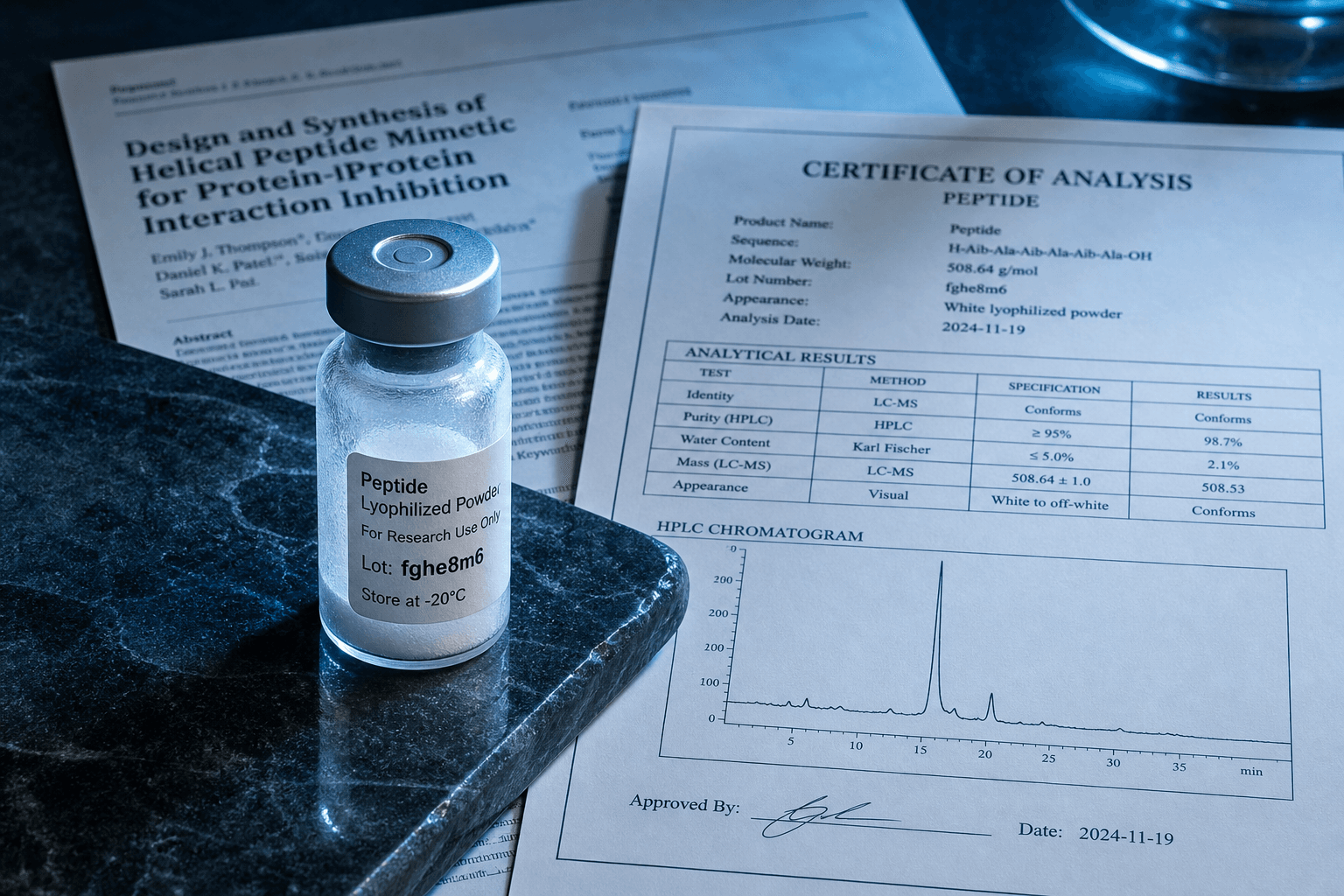
Illustration of lot-level documentation. Real figures for lot fghe8m6 are in the table below. Research use only.
A Certificate of Analysis is a lot-specific laboratory report. It is not a badge, not a brand promise, and not transferable from one vial to the next. If the lot on the PDF is not the lot printed on the vial, you do not have a certificate for the material in your hand. That is the first check, and it is the one most often skipped.
This is a reading guide for the GLP-1-class research peptides on the PureLab Performance hub — retatrutide and tirzepatide. Lot, chromatogram, identity, content, lab, date, verification. Not a dosing document. Not a reason to use a research reagent in a person. Research use only.
The worked example is real: retatrutide lot fghe8m6, assayed by Krause Analytical in Austin, Texas, report issued 5 August 2026. Chromatographic purity came back >99.9%. Content came back at 87.6% of the 30 mg label claim (26.3 mg of 30 mg stated). We publish both figures as returned. The second number is the unflattering one. It is also the one that tells you whether the COA is a document or a decoration.
1. Match the lot, or stop
Three strings have to be identical:
- the lot printed on the vial
- the lot printed on the COA
- the lot published on the product page
A certificate for the right peptide and the wrong lot is not evidence about the material in front of you. It is evidence about a different batch.
On the retatrutide product page the current lot is fghe8m6, reference PLP-RTT-010. Lot fghe8m6 was a 30 mg fill. Certificates for the 5 mg, 15 mg, and 20 mg vials are posted as those lots are released. A 5 mg vial and a 30 mg COA are not a match, even if the compound name is the same.
Tirzepatide currently reads LOT PENDING on the product page. There is no certificate to walk through until there is a lot. We do not invent one.
2. Name the laboratory, and make sure it exists
A serious COA names a laboratory that can be found without the vendor’s help: legal name, city, and a way to contact them that is not a Gmail address invented for the PDF.
Lot fghe8m6 was tested by Krause Analytical, Austin, Texas, by HPLC-UV-MS, against USP/NF 621. The lab is a real contract laboratory; peptide testing, including retatrutide and tirzepatide, is listed at krauselabs.com.
A logo in a header is not a laboratory. If the named lab cannot be found, or the same PDF appears under three lab names, treat it as marketing.
3. Read the date
The report for lot fghe8m6 was issued 5 August 2026. An undated COA is a brochure. A COA dated years before the lot on the vial is a different problem. Neither is a lot-specific result.
4. Chromatographic purity is a peak-area ratio, not a fill weight
This is the number vendors print largest, and the number people confuse with “how much peptide is in the vial.”
HPLC separates the sample; a UV detector records a chromatogram. Chromatographic purity is the main-peak area as a fraction of total integrated peak area. For lot fghe8m6: >99.9%.
That does not say the vial contains 30.0 mg. It does not say the main peak is the named peptide — co-eluting material can hide under one peak. Identity is mass spectrometry; purity is chromatography. They are related and they are not the same. See peptide purity and HPLC. If the COA quotes a percentage and offers no chromatogram, ask for the chromatogram.
5. Mass spectrometry answers a different question: is it the compound?
On lot fghe8m6, identity is confirmed — mass spectrometry versus an authentic standard. Method: HPLC-UV-MS. Chromatography separates and integrates; MS asks whether the main peak has the expected mass relative to a reference.
Confirmed identity plus high chromatographic purity is a strong pair. Confirmed identity of a light fill is still a light fill. That is the next line.
Retatrutide still has no PubChem compound record. CAS, formula, and molecular weight on the specification block are supplier-supplied, labelled that way. MS-versus-standard is the identity check we actually have. It is lot-level, not a public structure.
6. Content versus label claim is the number that makes people flinch
For lot fghe8m6:
| Result | Value |
|---|---|
| Chromatographic purity | >99.9% |
| Of stated label claim | **87.6% (26.3 mg of 30 mg stated)** |
| Identity | Confirmed — MS vs authentic standard |
| Method | HPLC-UV-MS |
| Standard | USP/NF 621 |
| Laboratory | Krause Analytical, Austin, TX |
| As, Cd, Pb, Hg | Not detected (USP 233) |
| Lot | fghe8m6 |
| Report issued | 5 August 2026 |
Purity asks: of the peptide-related peaks in this chromatogram, how much of the area is the main peak?
Content / label claim asks: of the mass this vial was supposed to contain, how much peptide is actually there?
Those can diverge. Salts, residual water, residual solvent, and fill variation sit in the gap. Lot fghe8m6: excellent chromatography, light of the 30 mg claim. We published 87.6% because that is what the lab returned.
For laboratory concentration math, the input mass is the assayed mass — 26.3 mg, not 30 mg, for this lot. That arithmetic is on GLP-1 peptide reconstitution and storage. Neither page is administration guidance.
7. Read what else was (and was not) tested
Lot fghe8m6 includes a heavy-metals panel: arsenic, cadmium, lead, and mercury, not detected, USP 233. That is not sterility, not endotoxin, not residual solvent. Krause lists those as add-ons. Absence of a line means it was not reported, not that it was zero.
8. Verify on the laboratory’s own channel if you can
A PDF on a vendor domain is a copy. The stronger control is a record at the laboratory.
Krause Analytical does not currently operate a public lot-lookup portal. No QR code resolves fghe8m6 on their site. Verification is a request: their contact form, or info@krauseanalytical.com, with lot code, compound, and report date.
That is weaker than a working public portal, and it belongs in the same paragraph as the purity number. We still name the lab, publish the lot, publish the PDF on the retatrutide product page, and publish the unflattering assay. A researcher who wants the lab’s confirmation has a named lab and a lot code. If a lab *does* run a portal, use it. Compare values, not logos.
What a COA is not
A COA is not FDA approval, and not a finding that the material is a drug, a supplement, or fit for human or veterinary use. Research Use Only is a use restriction, not a quality grade.
A COA is not a clinical result. Jastreboff et al., *N Engl J Med* 2023, is phase 2 investigational retatrutide under protocol. It is not a description of lot fghe8m6, and it is not a reason to introduce this reagent into a person. A purity percentage with no chromatogram, method, date, or lab is a claim, not an analysis.
Related reading
- Peptide purity and HPLC — why % area and MS identity are different questions
- What “Research Use Only” means
- GLP-1 peptide reconstitution and storage — laboratory concentration math, including assayed content
- Retatrutide product page — specification block for lot fghe8m6
- Tirzepatide product page — lot pending; we do not print numbers we do not have
- GLP-1 research peptides hub
Research Use Only (RUO). For laboratory research only. Not for human or veterinary use. Not a drug, not a supplement, not food. Not intended to diagnose, treat, cure, or prevent any disease. No statements on this page have been evaluated by the FDA. Retatrutide is investigational and not FDA-approved. Tirzepatide RUO material is not Mounjaro or Zepbound.