
Peptide Purity and HPLC
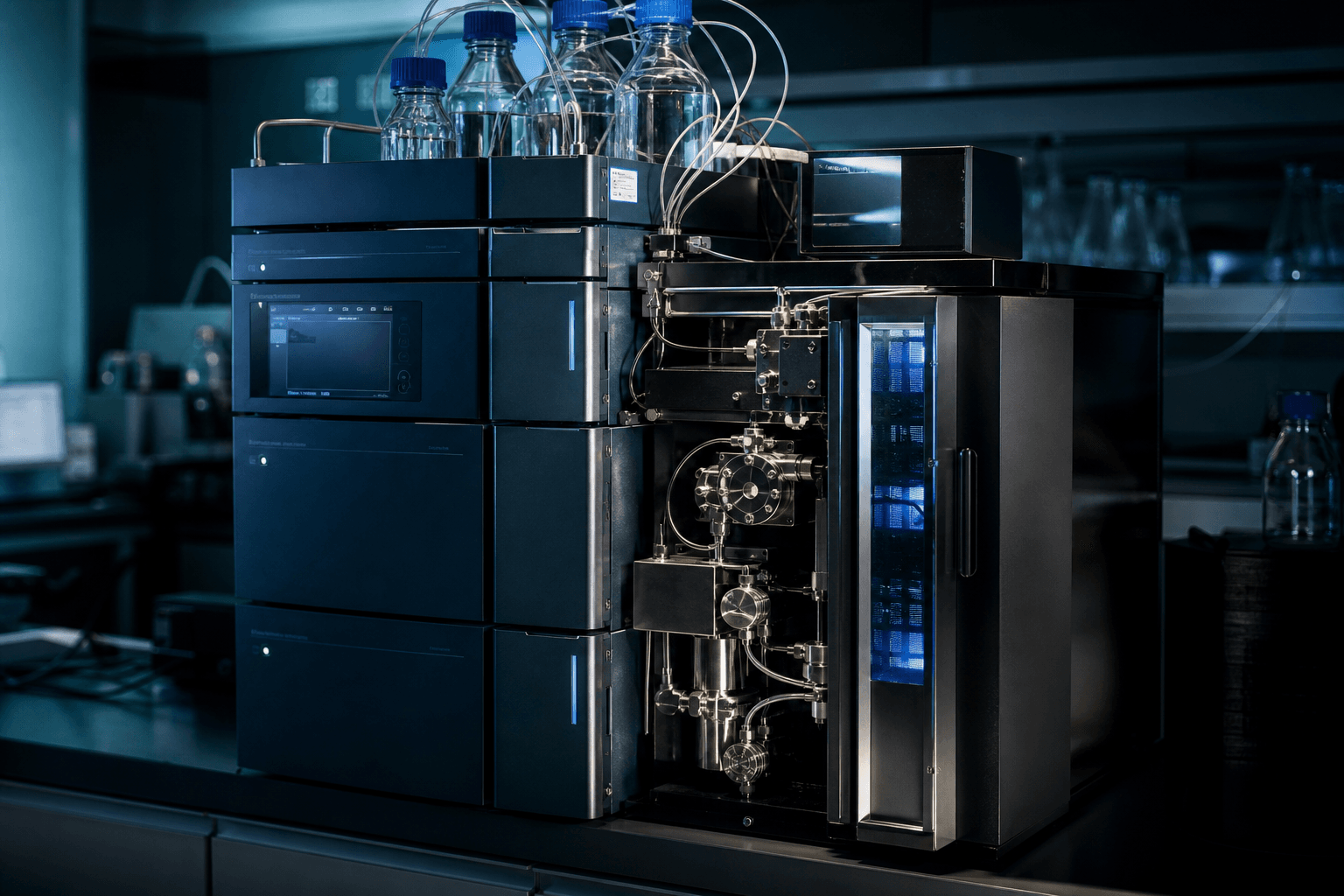
HPLC is how chromatographic purity is measured. Identity is a different test. Research use only.
“99% pure” is the most repeated phrase in research-peptide procurement, and it is doing three different jobs at once. Sometimes it means chromatographic peak-area. Sometimes it is being used as a stand-in for identity. Sometimes it is being used as a stand-in for how much peptide is in the vial. Those are not the same measurement, they are not interchangeable, and treating them as one number is how a laboratory ends up with a well-documented wrong answer.
This page is procurement literacy for GLP-1-class research peptides stocked by PureLab Performance — retatrutide and tirzepatide. It explains what HPLC % area actually is, why mass spectrometry is a different question, and why a high purity figure can sit next to a light assay. For how to read the rest of a certificate — lot match, named lab, date, verification — use How to read a GLP-1 peptide COA. Research use only. Not for human or veterinary use.
What HPLC is actually measuring
High-performance liquid chromatography pushes a dissolved sample through a column that retards different species to different degrees. A detector — for these lots, UV — records a chromatogram: signal versus time. Each peak is a detector response. Chromatographic purity is almost always reported as the area of the main peak divided by the total integrated peak area, expressed as a percentage.
That is a ratio of detector responses, under a stated method. For PureLab Performance GLP-1 lots the method is HPLC-UV-MS, referenced to USP/NF 621. UV tells you how the peak areas split. MS is there to ask a separate question about the main peak.
What % area is good at:
- Flagging related-substance peaks that actually resolve from the main peak
- Giving a repeatable, lot-level snapshot of the chromatogram you were shown
- Supporting a specification such as “chromatographic purity >99%” that can be compared across lots *if the method is the same*
What % area is not:
- Not identity. A single, clean peak of the wrong peptide is still a single, clean peak. Deletion peptides, truncated sequences, and some isomers can look ordinary on UV if they co-elute or nearly co-elute.
- Not content. % area does not know whether the vial was filled to 30 mg or 26.3 mg. Fill weight, water, counter-ions, and residual solvent live outside that ratio.
- Not weight percent of the solid. Different impurities have different UV response factors. A small, strongly absorbing impurity is over-counted; a UV-silent one is under-counted. % area is not a gravimetric assay.
- Not a chromatogram. A percentage without the trace is a rounded claim. Ask for the chromatogram.
If a vendor quotes “purity 99%” and cannot tell you whether that is HPLC % area, a weight-percent assay, or a number copied from a previous lot, you do not yet have a purity result. You have an adjective.
Identity is a mass-spectrometry question
Mass spectrometry asks whether the species in the main peak has the mass you expect, ideally against an authentic reference standard rather than against a spreadsheet.
On retatrutide lot fghe8m6, Krause Analytical reported identity as confirmed — mass spectrometry versus an authentic standard. That is the right form of words. “Looks like retatrutide on a UV trace” is not.
Two failure modes are worth keeping separate:
1. Right mass, dirty chromatogram. The compound is present; so is a lot of something else. Purity is the problem. 2. Clean chromatogram, wrong or unconfirmed mass. The vial is homogeneous and unidentified, or identified as a different sequence. Identity is the problem.
A laboratory that only runs HPLC-UV can speak to (1) in part and cannot speak to (2) at all. HPLC-UV-MS is the pairing that addresses both, which is why it is the method on the retatrutide specification block.
There is a further limit, and we already print it on the product page: retatrutide has no PubChem compound record. CAS, formula, and molecular weight remain supplier-supplied until a public record exists. MS-versus-standard is lot-level identity. It is not a substitute for a public structure database. Anyone printing a confident CAS number for retatrutide without saying where it came from is skipping that sentence.
Tirzepatide is the opposite case on the chemistry: PubChem CID 166567236, CAS 2023788-19-2, formula and mass retrieved from the public record. Identity is still a per-lot measurement. A public CID does not assay the vial. Tirzepatide’s certificate is currently pending; we do not print a purity or identity number we do not have.
The lot fghe8m6 lesson: both numbers can be true
Lot fghe8m6, 30 mg label claim, Krause Analytical, Austin, Texas, report issued 5 August 2026:
- Chromatographic purity: >99.9%
- Of stated label claim: 87.6% (26.3 mg of 30 mg stated)
- Identity: confirmed by MS versus authentic standard
The chromatography says the detected peptide-related material is overwhelmingly one peak. The assay says that peak’s mass in the vial is 26.3 mg, not 30 mg. Neither result is a rounding error in the other. Water, salts, residual solvent, and fill variation sit in that 12.4% gap. Publishing only >99.9% would have been the conventional move. Publishing 87.6% is the document.
If you are reconstituting this lot for laboratory work, the mass that belongs in the concentration equation is the assayed mass. That is GLP-1 peptide reconstitution and storage, and it is arithmetic, not administration.
Method, standard, and comparability
A purity number is only comparable to another purity number if the method is comparable. Column, gradient, wavelength, integration rules, and what gets counted as a peak all move the percentage. USP/NF 621 is the chromatography chapter referenced on these lots; it is a method framework, not a magic stamp that makes two labs’ % area values identical.
When you compare two vendors, compare:
- named laboratory
- method (HPLC-UV only versus HPLC-UV-MS)
- whether identity was run against a standard
- whether content / label claim was measured at all
- the chromatogram, not the headline
Two certificates that both say “99%” and disagree on the above are not two measurements of the same thing.
What HPLC will not save you from
Wrong lot. A beautiful chromatogram for lot A does not describe lot B. Lot match is still the first check on the COA guide.
Unnamed lab. A purity figure with no issuer is a caption.
Pending. Tirzepatide currently lists chromatographic purity, label claim, and identity as certificate pending, laboratory Krause Analytical. Pending is an honest state. A placeholder 99% would not be.
Use restriction. Analytical quality is not a change of intended use. Research Use Only still means not a drug, not a supplement, not for human or veterinary use, not FDA-approved as sold here. A chromatogram does not write a label.
Literature. Published trial papers — Jastreboff et al., *N Engl J Med* 2023 for retatrutide; the SURPASS and SURMOUNT programme for tirzepatide — describe drug products under protocol. They do not assay a research lot, and they are not a reason to use the research reagent in a person. Phase 2 is not approval. An approved branded product is not the RUO vial.
A short procurement checklist
1. Is purity stated as HPLC % area, with method and a chromatogram? 2. Was identity confirmed by MS, preferably versus an authentic standard? 3. Was content measured against the label claim, and was the unflattering number published? 4. Do lot, lab, and date match the vial and the product page? 5. If the lab runs a portal, did the record resolve there? (Krause, today, does not; verification is a request. That limit is documented in the COA guide.)
If the answer to (2) or (3) is “not reported,” you are missing a question, not a decimal place.
Related reading
- How to read a GLP-1 peptide COA — lot, lab, date, chromatogram, assay, verification
- What “Research Use Only” means
- GLP-1 peptide reconstitution and storage
- GLP-1 research peptides hub
- Retatrutide — research peptide
- Tirzepatide — research peptide
Research Use Only (RUO). For laboratory research only. Not for human or veterinary use. Not a drug, not a supplement, not food. Not intended to diagnose, treat, cure, or prevent any disease. No statements on this page have been evaluated by the FDA.