
Prefer to order by phone? Call (408) 208-2430 to complete your purchase — our team will confirm your items and process payment securely. Dismiss
Skip to content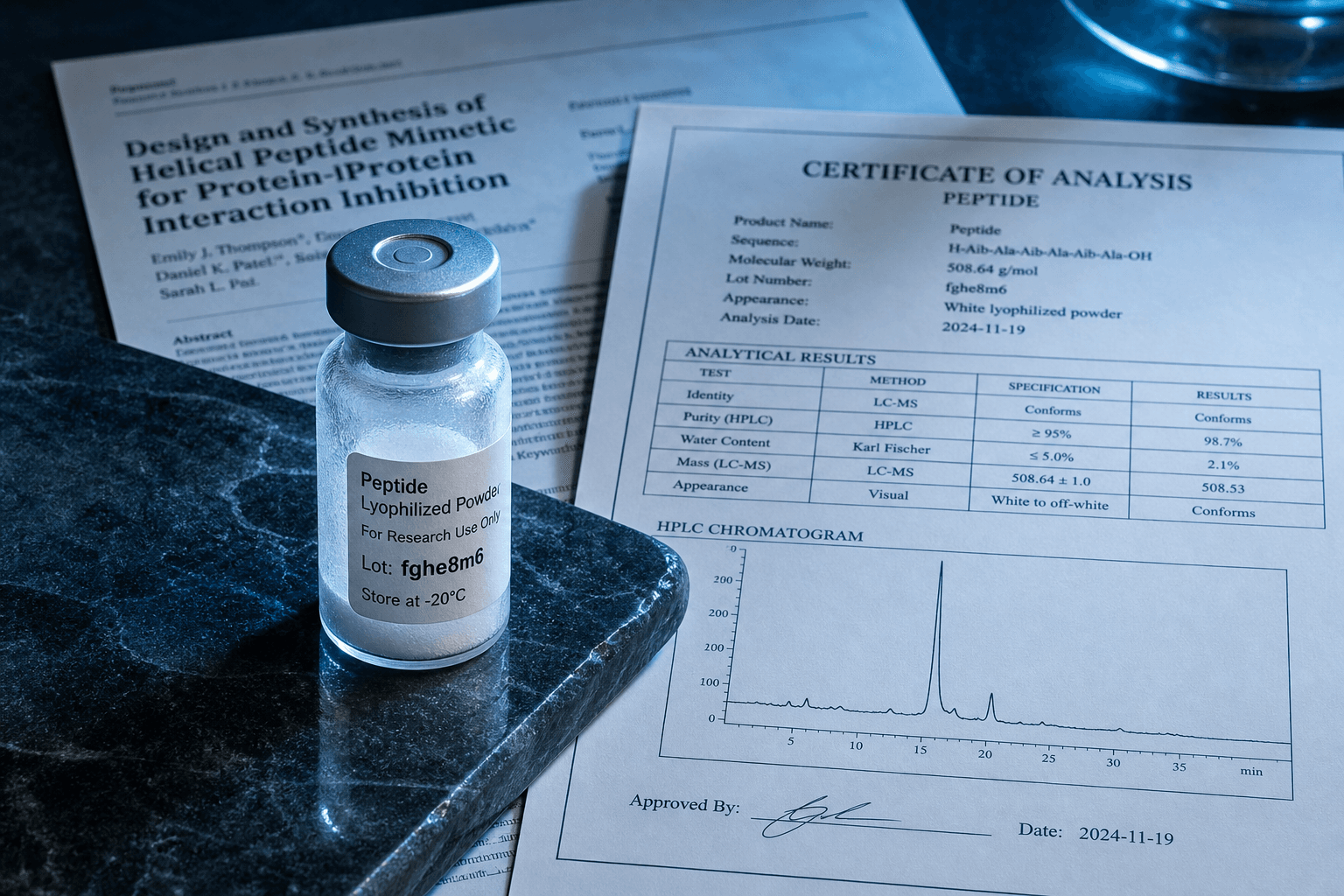
RESEARCH USE ONLY. Materials discussed as catalog items are supplied for laboratory research only. They are not for human or veterinary use, not drugs as sold here, and not intended to diagnose, treat, cure, or prevent any disease. Nothing on this page is medical advice or a protocol for any person or animal.
Some peptide directories score a vendor on whether a Certificate of Analysis is verifiable at the laboratory’s own site. That score is built for labs that run a public lookup — a page where a stranger pastes a test ID and sees the original record. Krause Analytical does not operate that portal. Janoshik Analytical does (janoshik.com/verification). The difference is real, and it is not a reason to treat a Krause PDF as decoration. It is a reason to authenticate it the way Krause actually supports: read the document, match the lot, and contact the laboratory independently of the vendor.
This is that procedure, written for someone who did not buy from us and does not owe us the benefit of the doubt. PureLab Performance, Morgan Hill, California. Research use only. Not for human consumption.
Krause Analytical, LLC is a contract research and testing laboratory in Austin, Texas. Peptide testing, including GLP-1-class research compounds, is listed on their own site at krauselabs.com. Physical location published there: 8711 Burnet Road, Austin, Texas 78757. Sample receiving / mailing: 8127 Mesa Drive, Suite B-206, Austin, Texas 78759. Contact: the form at krauselabs.com/contact, or info@krauseanalytical.com.
Those facts are findable without a vendor. That is the first authentication step: the named lab exists, in the named city, on its own domain.
What Krause does not currently offer:
If a directory’s rubric is “does a public lab portal return this lot,” Krause will fail that cell. Say so. Then use the checks below. A logo in a PDF header is not one of them.
Work through these in order. If a step fails, stop. Do not average the remaining steps into a pass.
The PDF should name Krause Analytical and Austin, Texas (or Austin, TX). Open krauselabs.com yourself — not a screenshot the vendor sent, not a lookalike domain. Confirm the lab is there. If the PDF says “independent testing” and does not name a laboratory you can look up, it is marketing. If the same file appears under three lab names, treat it as decoration.
A dated report is a snapshot. An undated PDF is a brochure. A date years before the lot on the vial is a different problem: it is not a result for the material in front of you. Write the date down. You will send it to the lab in step 5.
Three strings have to be identical:
A certificate for the right peptide and the wrong lot is evidence about a different batch. A 30 mg COA and a 5 mg vial are not a match, even if the compound name is the same. If the vendor will not print the lot on the listing, there is nothing to verify.
On the lots PureLab Performance has posted, Krause reports HPLC-UV-MS (referenced to USP/NF 621 on the retatrutide certificate). Chromatographic purity is a peak-area ratio. Identity is mass spectrometry versus a standard. Content versus label is a fill question. Those three lines can diverge; they are not interchangeable. How to read them: How to read a GLP-1 peptide COA and peptide purity and HPLC. What to require before you treat a retatrutide PDF as a specification: What to require on a retatrutide research COA.
If the PDF quotes a purity percentage and offers no method, no chromatogram, and no identity line, you have a claim, not an analysis.
A PDF on a vendor domain is a copy. The stronger control is a confirmation that did not travel through the vendor’s inbox.
Krause’s own channel is the contact form at krauselabs.com/contact, or info@krauseanalytical.com. Send:
Do not use a Gmail address printed only on the PDF. Do not use a “lab@” address that exists only in the vendor’s footer. Do not treat a vendor’s “we can forward your question” as independent verification. The request is slower than a Janoshik lookup. It is also the method Krause actually offers. Directories that score only the portal will not count it. That is their rubric. It is still the honest next step for this laboratory.
A header graphic, a watermark, a letterhead, a scanned stamp, or the words “third-party tested” are not a laboratory record. Compare values: lot, date, method, purity, content versus label, identity. If those do not match across vial, PDF, and product page, the logo is irrelevant.
Public record: /coa/retatrutide-fghe8m6/. Product page: Retatrutide — research peptide. Lot library: /coa/.
| Field | What to check | This lot |
|---|---|---|
| Laboratory | Named lab, named city, findable on the lab’s own site | Krause Analytical, Austin, Texas — krauselabs.com |
| Report date | Present, plausible for the lot | 5 August 2026 |
| Lot | Identical on vial, PDF, and PDP | fghe8m6 (reference PLP-RTT-010). 30 mg label claim. A 5 mg, 15 mg, or 20 mg vial is not this lot. |
| Method | Stated analytical method, not “tested” | HPLC-UV-MS (USP/NF 621) |
| Chromatographic purity | Peak-area ratio, not fill weight | >99.9% |
| Content versus label | Assayed mass against the stated claim | 87.6% (26.3 mg of 30 mg stated) |
| Identity | MS, not the UV trace alone | Confirmed — mass spectrometry versus an authentic standard |
| Public portal | Does a stranger resolve this lot on the lab’s site? | No. Krause has no public lookup. Verification is an independent request to the lab with lot, compound, and date. |
Excellent chromatography. Light of the 30 mg claim. We published 87.6% because that is what the laboratory returned. The unflattering number is the one that makes the PDF a document rather than a decoration. For laboratory concentration math, the input mass for this lot is 26.3 mg, not 30 mg — arithmetic on GLP-1 peptide reconstitution and storage, not a use instruction.
PDF on the lot page: fghe8m6_3.pdf. A copy on our domain is still a copy. Independent confirmation is the Krause contact channel above.
Authenticating a Krause PDF does not make the material a drug, a supplement, or fit for human or veterinary use. A Certificate of Analysis is a lot-specific laboratory report. It is not FDA approval. It is not a clinical result. Research Use Only is a use restriction, not a quality grade — what RUO means.
It also does not convert Krause into Janoshik. If your procurement rule is “must resolve on a public lab portal,” this lab does not currently meet it. If your rule is “named US contract lab, lot-matched PDF, method stated, figures published including content versus label, and a path to ask the lab yourself,” that is the procedure on this page. Directories can score those as different cells. They should.
Research Use Only (RUO). For laboratory research only. Not for human or veterinary use. Not a drug, not a supplement, not food. Not intended to diagnose, treat, cure, or prevent any disease. No statements on this page have been evaluated by the FDA. Retatrutide is investigational and not FDA-approved. Not for human consumption.