
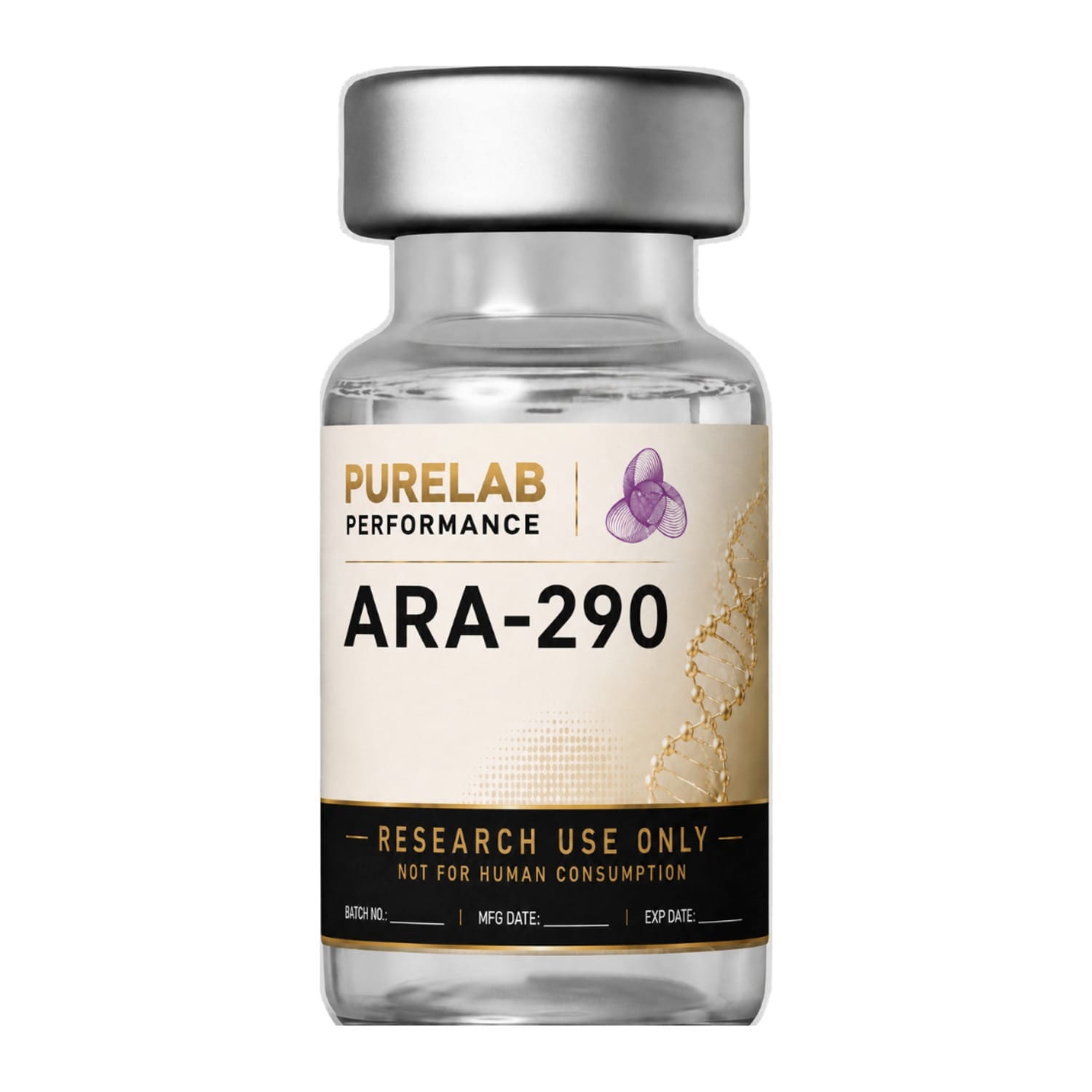
What ARA-290 is
ARA-290 — International Nonproprietary Name cibinetide — is an 11-amino-acid peptide derived from the helix-B domain of erythropoietin. It was engineered to retain EPO’s proposed tissue-protective signalling while carrying none of its haematopoietic activity: it does not raise red cell mass.
Unusually for this catalogue, ARA-290 has been through real, registered, randomised phase 2 clinical trials. That is a genuine distinction and we will say so. It is also, unfortunately, the reason we can be unusually specific about what it failed to do. This page is organised around one question: what has actually been measured, and in what.
Structure and identity
Identity fields above are drawn from PubChem and are independently checkable at the link; the CAS number is confirmed against ChemIDplus, DrugBank (DB13006), EPA DSSTox and the FDA Global Substance Registration System. This is one of the few compounds in this catalogue with a fully secured registry identity.
For the current lot, the certificate of analysis is pending. We will publish it in full when it is issued. Until then we print no purity number.
Where the evidence stands
This is the section most vendors skip. It is the most important one on the page.
Innate repair receptor signalling; also direct TRPV1 channel antagonism (§8)Some
Rodent nociception and tissue-injury modelsModerate
Genuinely conducted, registered, and published. Rare in this category.Yes
Pain endpoint not significant (P=0.157). A separate ophthalmic trial failed on every objective endpoint.Largely negative
Culver 2017 — read the endpoints human
The flagship human study is Culver et al., Investigative Ophthalmology & Visual Science, 2017: a phase 2b, 28-day, randomised trial in 64 subjects with sarcoidosis-associated small nerve fibre loss and neuropathic pain, comparing cibinetide at 1, 4 or 8 mg/day against placebo[1].
The pre-specified primary endpoint was change in corneal nerve fibre area (CNFA) — a corneal-imaging surrogate measured by confocal microscopy. It was not a symptom endpoint. That choice is itself informative, and we come back to it in §9.
The results, exactly as reported:
- CNFA (the imaging surrogate, primary endpoint): placebo-corrected mean change at day 28 was 109 (95% CI −429 to 647) at 1 mg — not significant; 697 (159 to 1236, P = 0.012) at 4 mg — significant; and 431 (−130 to 992) at 8 mg — not significant
- Intraepidermal GAP-43+ regenerating fibres: increased in the 4 mg group (P = 0.035)
- Pain: “Pain improved significantly in all groups” — including placebo. In the subgroup with moderate-to-severe pain, the placebo-corrected decrease in pain intensity in the 4 mg group carried P = 0.157
The paper describes the 4 mg pain change as “clinically meaningful”. Its associated P value is 0.157 — a value that does not reach statistical significance by any conventional threshold. Pain improved in every arm, placebo included, which is exactly the pattern you expect in an unblinded-to-hope pain trial where the drug is not separating from placebo.
ARA-290 is sold on the promise of relief from nerve pain. In the best trial it has, in the population it was designed for, the pain difference versus placebo did not reach significance. The positive finding was a corneal-imaging measurement.
The non-monotonic dose response
Look again at the CNFA numbers. The effect was significant at 4 mg and not significant at either 1 mg or 8 mg.
A dose response that appears in the middle of the range and vanishes at both ends is a warning sign, not a finding. Genuine pharmacological effects usually scale with exposure. A single significant result at one of three doses, with the higher dose reverting toward null, is the statistical shape most often produced by chance across multiple comparisons. It may be a real biphasic effect. It may be noise. The trial cannot distinguish these, and neither can we — and neither can anyone selling you this peptide.
Lois 2020 — the trial that failed human
Lois et al., Journal of Clinical Medicine, 2020, ran a phase 2 trial of cibinetide 4 mg/day (the dose that had worked in Culver) for 12 weeks in patients with diabetic macular oedema[2]. Nine were recruited; eight completed.
The result, in the authors’ own reporting: there was no improvement in the mean change from baseline to week 12 in
- best-corrected visual acuity (−2.9 ± 5.0)
- central retinal thickness (10 ± 94.6 microns)
- central retinal sensitivity (−0.53 ± 1.9 dB)
- tear production (−0.13 ± 7.7 mm)
Every objective endpoint was null. The only positive was a self-reported quality-of-life questionnaire score (NEI VFQ-25, 2.7 ± 3.1) — in an unblinded, single-arm, nine-patient study with no placebo control. A subjective improvement in an unblinded uncontrolled trial of nine people is not evidence. It is what an unblinded uncontrolled trial of nine people produces by default.
The authors’ stated conclusion is that “the cibinetide 12-week course was safe” and that improvements observed in some participants “warrant further investigation.” That is the language used when a trial has not shown efficacy. It is a safety statement plus an invitation to try again — not a result.
The terminated trial
A subsequent trial in diabetic macular oedema, registered as NCT06626971, was terminated. Trials are terminated for many reasons — recruitment, funding, futility — and a termination is not itself a scientific finding. But a development programme in which the flagship trial misses on pain, the ophthalmic trial fails on every objective endpoint, and the follow-up trial is terminated is a programme that has not been going well, and reading it any other way requires effort.
The mechanism may not be the marketed one in vitro
ARA-290 is sold on a specific story: it is an innate repair receptor (IRR) agonist, engaging a heteroreceptor complex of the EPO receptor and the β-common receptor to switch on tissue-protective signalling. That is the mechanism in the company literature and in essentially all vendor copy.
Zhang et al., Peptides, 2016, tested something else. Using calcium imaging, cell culture and behavioural assays, they found that ARA-290 specifically inhibits TRPV1 channel activity and relieves capsaicin-induced mechanical hypersensitivity in mice. Their conclusion is that ARA-290 “could potentially function as a novel antagonist for TRPV1 channel”[3].
TRPV1 antagonism is a direct action on a peripheral nociceptor ion channel. It is a completely different mechanism from immunomodulatory repair signalling through a cytokine receptor complex. It is not obviously compatible with the “tissue repair” framing that the compound is marketed under, and it suggests that whatever ARA-290 does may be simpler, more peripheral, and less regenerative than the story attached to it.
We are not claiming the IRR account is wrong. We are pointing out that a peer-reviewed paper offers a different one, and that vendors present a single settled mechanism where the literature contains at least two competing ones.
On surrogate endpoints
Culver 2017’s primary endpoint was corneal nerve fibre area. The paper is explicit that CNFA is being proposed as a surrogate — the authors’ framing is that their data “support its use as a surrogate endpoint to assess potential disease modifying therapies”[1].
Surrogate endpoints are legitimate scientific instruments and a necessary tool in early-phase work. They are also the standard mechanism by which drug programmes generate publishable positives while the outcomes patients care about stay flat. A trial whose imaging surrogate moves and whose pain score does not is a trial that has demonstrated an effect on a picture, and has not yet demonstrated an effect on a person.
Limitations of the literature
The trials are small. n = 64. n = 9. These are early-phase studies, and early-phase studies both over- and under-call effects.
The sponsor is in the author list. Araim Pharmaceuticals authors appear on both Culver 2017 and Lois 2020[1][2]. This is normal for company-sponsored trials, is properly disclosed, and is not misconduct. It is still a reason to read the framing of borderline results carefully — which is exactly what “clinically meaningful (P = 0.157)” requires you to do.
No trial has been run in healthy people. Every human study is in a patient population with a specific disease. Nothing in this literature speaks to what ARA-290 does in someone without that disease.
The mechanism is contested. §8.
Regulatory and anti-doping status
ARA-290 / cibinetide is prohibited by WADA under Section S2.1.5 — innate repair receptor (IRR) agonists, within the class of erythropoietins and agents affecting erythropoiesis. It is prohibited at all times, in and out of competition, and is a non-Specified substance.
This is worth stating precisely because ARA-290 is frequently promoted on the basis that it is “EPO without the erythropoiesis” — as though the absence of red-cell effects placed it outside the EPO section of the List. It does not. WADA lists IRR agonists explicitly, and cibinetide is the archetypal example of the class. An athlete relying on the “it doesn’t raise haematocrit” argument is relying on an argument WADA has already anticipated and closed.
Anti-doping lists change annually and by governing body. If you compete under any tested organisation, the only reliable source is that organisation’s current prohibited list — not this page, and not any vendor’s.
Cibinetide has not been approved by the FDA, the EMA, or any other regulator for any indication.
What we don’t know
- Whether ARA-290 has any effect on pain in humans. Its best trial did not show one (P = 0.157)[1].
- Whether the corneal-imaging result reflects anything a person would experience.
- Whether the 4 mg-only effect is a real biphasic dose response or a multiple-comparisons artefact.
- Which mechanism is operative — innate repair receptor agonism, TRPV1 antagonism, both, or neither[3].
- What it does in a person without an underlying disease. Never studied.
- Long-term human safety beyond the short trial exposures reported.
We supply this compound for laboratory research. It has a real registry identity, real trials, and a real regulatory history — and the honest summary of that history is that the trials did not work.
ARA-290 supplied by PureLab Performance is furnished strictly for in-vitro laboratory research. It is not a medicine or a drug and has not been approved by the FDA to prevent, treat, or cure any medical condition, ailment, or disease. Bodily introduction of any kind into humans or animals is strictly forbidden by law. Per-kilogram dosing in animal models does not scale to humans. Purchasers must be 18 or older and qualified to handle research chemicals.
References
Retrieved from PubMed. DOIs link to the original publications. Chemical identity data retrieved from PubChem.
- Culver DA, Dahan A, Bajorunas D, et al. “Cibinetide Improves Corneal Nerve Fiber Abundance in Patients With Sarcoidosis-Associated Small Nerve Fiber Loss and Neuropathic Pain.” Invest Ophthalmol Vis Sci. 2017;58(6):BIO52–BIO60. DOI
- Lois N, Gardner E, McFarland M, et al. “A Phase 2 Clinical Trial on the Use of Cibinetide for the Treatment of Diabetic Macular Edema.” J Clin Med. 2020;9(7):2225. DOI
- Zhang W, Yu G, Zhang M. “ARA 290 relieves pathophysiological pain by targeting TRPV1 channel: Integration between immune system and nociception.” Peptides. 2016;76:73–9. DOI
- ClinicalTrials.gov. Study NCT06626971 — diabetic macular oedema. Status: Terminated. ClinicalTrials.gov
- National Center for Biotechnology Information. “PubChem Compound Summary for CID 91810664, Cibinetide.” PubChem
- World Anti-Doping Agency. “The 2025 Prohibited List — International Standard.” Section S2.1.5, Innate repair receptor agonists. WADA
Reviews
There are no reviews yet.