
Prefer to order by phone? Call (408) 208-2430 to complete your purchase — our team will confirm your items and process payment securely. Dismiss
Skip to content
RESEARCH USE ONLY. This page contains unit-conversion arithmetic only. It is not a dosing guide, not a protocol, and not a preparation or administration instruction for any person or animal. Products discussed on this site are supplied strictly for laboratory and research purposes.
Tirzepatide is supplied in fourteen vial sizes, spanning a twenty-four-fold range of peptide mass. The tables below convert vial mass and solvent volume into concentration — nothing more. Choosing a volume is a measurement decision, not a protocol.
Sourced fact: Tirzepatide is an approved active ingredient. FDA’s Orange Book lists tirzepatide products under NDA 215866, applicant Eli Lilly and Co., first approved 13 May 2022, with additional strengths approved through January 2026. [2]
Sourced fact: FDA states it has “warned companies that have illegally sold unapproved drugs containing semaglutide, tirzepatide or retatrutide that are falsely labeled ‘for research purposes’ or ‘not for human consumption’” where those products “have been sold directly to consumers for human use with dosing instructions.” [3]
Inference: Those two facts sit together and both matter. An approved prescription product containing tirzepatide exists; research-grade material is not that product and is not an FDA-approved drug. This page contains no dosing instructions, no protocol, and no recommendation of any volume. It converts milligrams and millilitres into concentration, which is arithmetic that applies identically to any solute.
Read down to your vial mass, across to the volume of bacteriostatic water added. The cell is the resulting concentration.
| Vial | 1 mL | 2 mL | 3 mL | 5 mL |
|---|---|---|---|---|
| 5 mg | 5 mg/mL | 2.5 mg/mL | 1.67 mg/mL | 1 mg/mL |
| 10 mg | 10 mg/mL | 5 mg/mL | 3.33 mg/mL | 2 mg/mL |
| 15 mg | 15 mg/mL | 7.5 mg/mL | 5 mg/mL | 3 mg/mL |
| 20 mg | 20 mg/mL | 10 mg/mL | 6.67 mg/mL | 4 mg/mL |
| 30 mg | 30 mg/mL | 15 mg/mL | 10 mg/mL | 6 mg/mL |
| 40 mg | 40 mg/mL | 20 mg/mL | 13.3 mg/mL | 8 mg/mL |
| 50 mg | 50 mg/mL | 25 mg/mL | 16.7 mg/mL | 10 mg/mL |
| 60 mg | 60 mg/mL | 30 mg/mL | 20 mg/mL | 12 mg/mL |
| 70 mg | 70 mg/mL | 35 mg/mL | 23.3 mg/mL | 14 mg/mL |
| 80 mg | 80 mg/mL | 40 mg/mL | 26.7 mg/mL | 16 mg/mL |
| 90 mg | 90 mg/mL | 45 mg/mL | 30 mg/mL | 18 mg/mL |
| 100 mg | 100 mg/mL | 50 mg/mL | 33.3 mg/mL | 20 mg/mL |
| 110 mg | 110 mg/mL | 55 mg/mL | 36.7 mg/mL | 22 mg/mL |
| 120 mg | 120 mg/mL | 60 mg/mL | 40 mg/mL | 24 mg/mL |
Twenty units on an insulin syringe is 0.2 mL. The same grid, expressed as mass rather than concentration.
| Vial | 1 mL | 2 mL | 3 mL | 5 mL |
|---|---|---|---|---|
| 5 mg | 1 mg | 0.5 mg | 0.333 mg | 0.2 mg |
| 10 mg | 2 mg | 1 mg | 0.667 mg | 0.4 mg |
| 15 mg | 3 mg | 1.5 mg | 1 mg | 0.6 mg |
| 20 mg | 4 mg | 2 mg | 1.33 mg | 0.8 mg |
| 30 mg | 6 mg | 3 mg | 2 mg | 1.2 mg |
| 40 mg | 8 mg | 4 mg | 2.67 mg | 1.6 mg |
| 50 mg | 10 mg | 5 mg | 3.33 mg | 2 mg |
| 60 mg | 12 mg | 6 mg | 4 mg | 2.4 mg |
| 70 mg | 14 mg | 7 mg | 4.67 mg | 2.8 mg |
| 80 mg | 16 mg | 8 mg | 5.33 mg | 3.2 mg |
| 90 mg | 18 mg | 9 mg | 6 mg | 3.6 mg |
| 100 mg | 20 mg | 10 mg | 6.67 mg | 4 mg |
| 110 mg | 22 mg | 11 mg | 7.33 mg | 4.4 mg |
| 120 mg | 24 mg | 12 mg | 8 mg | 4.8 mg |
Worked example: a 30 mg vial reconstituted with 2 mL gives 15 mg/mL. Twenty units is 0.2 mL. 0.2 mL × 15 mg/mL = 3 mg.
An insulin syringe is graduated in units, which are a volume marking, not a mass. On both U-100 and U-50 insulin syringes, one unit corresponds to 0.01 mL. The difference is barrel capacity and gradation spacing — not the unit-to-volume relationship. A U-50 holds 0.5 mL across 50 units; a U-100 holds 1.0 mL across 100 units. Both are 100 units per millilitre.
The arithmetic is: mass = (peptide mg ÷ mL of solvent added) × (units × 0.01)
Our reconstitution calculator runs this across a 44-compound library if you would rather not do it by hand.
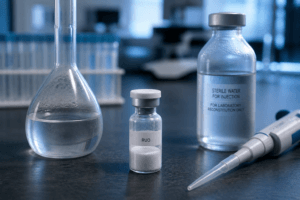
Sourced fact: The Bacteriostatic Water for Injection label directs: “Do not store reconstituted solutions of drugs for injection unless otherwise directed by the manufacturer of the solute.” The same label describes the product as supplied in “a multiple-dose container from which repeated withdrawals may be made to dilute or dissolve drugs for injection,” preserved with 0.9% or 1.1% benzyl alcohol. [1]
Inference: The widely-quoted 28-day figure describes the multiple-dose container of water, not what you dissolved in it. We traced that rule to its actual source — it is not printed on the FDA label at all — in where the 28-day rule actually comes from.
This is unit-conversion arithmetic for laboratory research planning. It is not medical or veterinary advice, not a protocol, not a recommendation of any volume, and not an instruction to administer anything to any person or animal. Research-grade tirzepatide is not an FDA-approved drug product and is not approved for human or veterinary use. Approved prescription products containing tirzepatide as an active ingredient exist under NDA 215866 and are a different thing entirely. [2]
Reconstitution arithmetic for every compound in the catalogue: BPC-157 · TB-500 · Wolverine Stack · GLOW · KLOW · CJC-1295 / Ipamorelin · Ipamorelin · CJC-1295 No DAC · GHK-Cu · Epitalon · MOTS-c · AOD-9604 · NAD+ · PT-141 · Tesamorelin · Retatrutide · Tirzepatide · SS-31 · Selank · Semax · KPV · DSIP · PEG-MGF · FOXO4-DRI · ARA-290 · 5-Amino-1MQ
Tirzepatide · Bacteriostatic Water, USP · Reconstitution calculator · Reconstitution handling guide · What is tirzepatide? · Tirzepatide vs semaglutide · Retatrutide vs tirzepatide
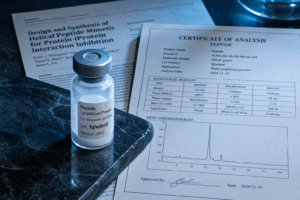
BPC-157 is currently the only compound in our catalogue with completed third-party COA figures published on its page — lot 3CDMQXU, chromatographic purity >99.95%, 99.2% of stated label claim, identity confirmed by HPLC-UV-MS, tested by Krause Analytical. Every other product page, including this one, states plainly that its certificate is pending.
RESEARCH USE ONLY — FULL DISCLAIMER. The products discussed on this page are supplied strictly for laboratory and scientific research purposes. They are not for human or veterinary use, and not for consumption. These statements have not been evaluated by the Food and Drug Administration. Nothing on this page is intended to diagnose, treat, cure, or prevent any disease in humans or animals. Nothing here constitutes medical or veterinary advice or a dosing, preparation, or administration recommendation for any person or animal.